Saturday, 18 March 2023

Bob Dylan - The Australian Connection - Part 2: Masterpieces


by Stuart Penney

1978 was an unusually busy year for Bob Dylan.  In January he re-signed a long-term contract with CBS and embarked on a 114-date world tour which ran (with breaks) from February through to December.  

Along with the albums Street Legal (June) and Bob Dylan at Budokan (August), we also got a trio of singles, two of which (“Is Your Love In Vain” and “Baby Stop Crying”) appeared on the new-fangled 12” format, a first for Bob.  

On the movie front the four-hour arse-numbing marathon that was Renaldo & Clara arrived in cinemas to mixed reviews in January, followed in April by his show-stealing appearance in The Band’s concert film The Last Waltz.  

And as if that weren’t enough Bob action, 1978 also saw the release of another significant Dylan record, one which many fans in Europe and America were blissfully unaware of at the time.


Continuing our trawl through Dylan’s Australian catalogue, we arrive at the triple compilation album Masterpieces (CBS S3BP 220502).  Released March 1978 exclusively in Australia, New Zealand and Japan, presumably to tie-in with the Oceania leg of his World Tour, it represents arguably the finest overview of his 60s and 70s work this side of Biograph.  Alongside the big hits and familiar classics, it also contained quite a few surprises, which we will examine below.  

I acquired my first vinyl copy of Masterpieces in the early 80s when a girlfriend brought one back from a visit to Australia.  It was an extremely desirable item in those pre-internet days with import record shops in London charging huge prices for it.  Although containing only one genuinely rare cut (“Mixed Up Confusion”) there are several other obscure and unusual tracks, plus singles and B-sides which were either difficult to find, or unavailable on album at the time, making it an important piece of the Dylan discography.  In Australia the triple vinyl set was immediately well received, selling well enough to reach #2 in the album chart and it was certified gold within four weeks of release, despite retailing at more than twice the price of a regular LP. 


With 39 selections spread over six sides and practically no sleeve information other than the track listing, buyers were left to figure out for themselves where the songs originated.  Most were obvious enough but tracks such as “Like A Rolling Stone” and “The Mighty Quinn,” for example, unexpectedly turned out to be the live Self Portrait versions from the 1969 Isle of Wight festival.  It wasn’t until we played the records that this, and a whole lot more, was revealed.  

The Cover:

Although not credited anywhere on the sleeve the front cover image is a tightly cropped head shot photo of Bob by Ken Regan (1939-2012) who was the official photographer on the Rolling Thunder Revue tour of 1975 / 76.  A wider shot is shown below.  Another photo from the same session later turned up in the booklet of the 2003 SACD release of Desire.


The hat Dylan is wearing shows up in countless photos from that period and is the same one seen throughout the movie Renaldo & Clara and on the sleeves of Desire and The Bootleg Series Vol.5 – Bob Dylan Live 1975 which were also photographed by Regan.


Ken Regan’s photos appeared on many Dylan albums, including Empire Burlesque, Biograph and several volumes of The Bootleg Series.  His work can also be seen on records by David Bowie, the Rolling Stones and countless others. 

Despite the paucity of liner notes, the tri-fold sleeve of Masterpieces was nonetheless impressive, featuring several full-page photos of Dylan from the Rolling Thunder Revue period.  Three showed him wearing the distinctive loose-fitting durag or middle eastern headgear adopted by virtually all band members onstage during the tour.  

In Sid Griffin’s book Shelter From The Storm: Bob Dylan's Rolling Thunder Years (2010), T.Bone Burnett insists the durag or bandana style head coverings were inspired by bricklayers who were building a wall at Dylan’s house around that time.  The workers wore rags around their heads “to stop them getting concrete and various bits of plaster or whatever in their hair.”  Dylan picked up on this look and, naturally, where Bob went so did those around him.


On the back cover, together with the track listing, we see a picture of Bob onstage at the Starlight Ballroom in the Belleview Biltmore Hotel, Clearwater, Florida.  The Rolling Thunder Revue played two shows there on April 22, 1976, both of which were filmed for a possible one-hour TV special.  The film was never broadcast but with a little judicious searching the footage can be found online.  

In the photo Dylan is wearing a durag with a distinctive Om (or Aum) Hindu symbol and playing a small body Martin 00-21 acoustic with slotted headstock.  This is the guitar he used throughout the 1974 Before the Flood tour with The Band, and it was later seen onstage in September 1975 at the Tribute to John Hammond show in Chicago.  Perhaps more importantly, we are assured this is the very same instrument Dylan used to record “Tangled Up in Blue” in late 1974.


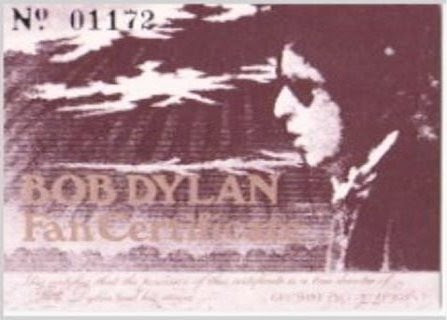
Although the Australian pressing was nicely presented in a triple fold-out sleeve, the Japanese, predictably, went one better with their deluxe version (CBS/Sony 57AP-875/6/7) which boasted all manner of extras including an impressive 40-page lyric/photo/discography book, an individually numbered "Fan Certificate" card, a poster and an obi (paper title strip), none of which were included with the Aussie or New Zealand versions.


Some of the eight Tokyo concerts from February and March were recorded and released in August 1978 as the double album Bob Dylan at Budokan (CBS/Sony 40AP 1100-1).  This was initially available only in Japan, until huge demand forced a worldwide release in April 1979.


Meanwhile, back in Australia there is a story that in 1978 a beer company ran a special promotion whereby purchasers of a 24-can carton of grog could get a free copy of Masterpieces!  The story may well be apocryphal, but I feel it really ought to be true.  It is Australia, after all. 

Dylan opened the 1978 world tour with 23 concerts in Japan (his first ever shows there), New Zealand and Australia.  These dates ran from late February, through March and into early April, making the March 1978 release of Masterpieces perfect timing, for Australian and New Zealand fans, at least. 


The Compact Discs:

The CD version of Masterpieces was released only in Australia, and it appeared in three distinctly different variations.  First in 1987 came a cruelly truncated two CD version with only 35 tracks (instead of 39 on the vinyl version).  The four missing tracks on this first CD pressing (CBS 462448 2) are “Idiot Wind,” “I Want You,” “Song To Woody” and “Love Minus Zero: No Limit”.  Meanwhile, “Rita May” and "George Jackson,” although included, suffered the indignity of early fade-outs. 

In 1991 Masterpieces was restored to its full 3 CD/39 track glory (Columbia 462448 9) and unbelievably, it appears just a single complaint to the record company brought about the change.


John Lattanzio, a Dylan fan based in Melbourne has claimed sole credit for the corporate U-turn.  He told me: “I wrote to Sony and complained about the fact that they'd edited songs by making them fade more quickly so they could fit on 2 CDs.  I said this was artistically reprehensible and it was like cutting pieces off the Mona Lisa to make it fit in the new frame.  I got a reply from someone who said they agreed with me, and they would immediately remaster it for a 3 CD set.  I was surprised!  I asked how many people complained and he said, ‘Only you, but we thought about it, and we agreed with you.’”

It seemed like a major win for the fans except, unfortunately, at this point Sony also changed the front cover to the rather unflattering close-up sepia photo of Dylan, taken from the inside centre panel of the LP gatefold sleeve.  Later CD pressings from 1992 mercifully reverted to Ken Regan’s original “blue sky” cover photo.

Masterpieces was also released as a double cassette in Australia with both CD cover variations.


The Track Listing:

Record 1, Side 1/CD 1: 

1: Knockin' On Heaven's Door (from Pat Garrett & Billy the Kid 1973)

2: Mr. Tambourine Man (from Bringing It All Back Home 1965)

3: Just Like A Woman (from Blonde on Blonde 1966)

4: I Shall Be Released (acoustic duet with Happy Traum from Greatest Hits Vol. II [aka More Bob Dylan Greatest Hits] 1971)

5: Tears Of Rage (from The Basement Tapes 1975)

6: All Along The Watchtower (from John Wesley Harding 1967) 

7: One More Cup Of Coffee (from Desire 1975)

Record 1, Side 2: 

8: Like A Rolling Stone (live 1969 Isle of Wight version from Self Portrait 1970)

9: The Mighty Quinn (Quinn the Eskimo) (live 1969 Isle of Wight version from Self Portrait 1970)

10: Tomorrow Is A Long Time (April 1963 live recording at Town Hall, New York City - from Greatest Hits Vol. II [aka More Bob Dylan Greatest Hits] 1971)

11: Lay, Lady Lay (live version from Hard Rain 1976)

12: Idiot Wind (live version from Hard Rain 1976)

Record 2, Side 1/CD 2: 

1: Mixed Up Confusion (mono alternate take of the 1962 single with later overdubs.  A stereo remix of this version was later included on the Biograph box set)

2: Positively 4th Street (single version 1965)

3: Can You Please Crawl Out Your Window? (fast version from the 1965 single)

4: Just Like Tom Thumb's Blues (recorded live in Liverpool, May 1966 and originally released as the B side of the June 1966 single “I Want You”)

5: Spanish Is the Loving Tongue (mono B side of the 1971 single “Watching the River Flow.”  A different version, recorded in 1969, appears on the Dylan album 1973)

6: George Jackson (Big Band Version) (B-side of the 1971 single)

7: Rita May (B-side of “Stuck Inside of Mobile with the Memphis Blues Again” live single.  From the Desire sessions 1975.  In some territories “Rita May” was the A-side) 

Record 2, Side 2

8: Blowin' In The Wind (from The Freewheelin’ Bob Dylan 1963)

9: Hard Rain's A-Gonna Fall (from The Freewheelin’ Bob Dylan 1963)

10: The Times They Are A Changin' (from The Times They Are A-Changin’ 1964)

11: Masters Of War (from The Freewheelin’ Bob Dylan 1963)

12: Hurricane (from Desire 1975)

Record 3, Side 1/CD 3: 

1: Maggie's Farm (live version from Hard Rain 1976)

2: Subterranean Homesick Blues (from Bringing It All Back Home 1965)

3: Ballad of A Thin Man (from Highway 61 Revisited 1965)

4: Mozambique (from Desire 1975)

5: This Wheel's On Fire (from The Basement Tapes 1975)

6: I Want You (from Blonde on Blonde 1966)

7: Rainy Day Women #12 & 35 (from Blonde on Blonde 1966)

Record 3, Side 2

8: Don't Think Twice, It's All Right (from The Freewheelin’ Bob Dylan 1963)

9: Song To Woody (from Bob Dylan 1962)

10: It Ain't Me Babe (from Another Side Of Bob Dylan 1964)

11: Love Minus Zero: No Limit (from Bringing It All Back Home 1965)

12: I'll Be Your Baby Tonight (from John Wesley Harding 1967)

13: If Not For You (from New Morning 1970)

14: If You See Her, Say Hello (from Blood On The Tracks 1975)

15: Sara (from Desire 1975)

1978 Australian Tour Dates:

March 9, 12, 13, 14, 15 - Brisbane Festival Hall

March 18 - Adelaide Westlake Stadium

March 20, 21, 22 - Melbourne Myer Music Bowl

March 25, 27, 28 - Perth Entertainment Centre

April 1 - Sydney Sportsground


CBS or Columbia?

As every Dylan fan knows, until 1991 Bob’s records appeared on the Columbia label in North America and on CBS in the UK and elsewhere.  Although the two labels were part of the same parent company it often seemed like they operated independently of each other.  But why was this?

The story of how the music world ended up with two very different and competing record labels named Columbia is a long and complex one involving endless mergers, takeovers and bankruptcies dating back more than a century.  Here’s a quick and (hopefully) relatively simple explanation:

It all started in 1889 in the District of Columbia (which is the “DC” in Washington DC) where the Columbia Phonograph Company had a monopoly on sales and service of phonograph players in DC and the surrounding states.  The company also manufactured commercial recordings of its own and by 1908 it had jettisoned the cylinder format in favour of the new flat disc records. 

In 1925 the Columbia Phonograph Company was bought out by its UK subsidiary the Columbia Graphophone Company (“Graphophone” was the name and trademark of an “improved” version of the phonograph).

In 1931 the UK Columbia Graphophone Company merged with the Gramophone Company, which sold records under the name His Master’s Voice (HMV), to form Electrical and Musical Industries (EMI).  

At this point EMI sold off the US arm of the Columbia Graphophone Company which was absorbed by Columbia Broadcasting System (CBS) in 1938.  From then on CBS/Columbia (US) and EMI/Columbia (UK) parted ways and operated as entirely separate companies.  The UK branch kept the Columbia “magic notes” logo which had originated with the US company in the early 1900s.  This logo continued to be used on British pressings until relatively recently.


The CBS label was launched in Europe in 1962 (until then their releases had appeared in the UK via the Philips group of labels).  Consequently, from 1962 to 1991 all US Columbia Records were released outside of North America on the CBS label to avoid conflict/confusion with EMI’s Columbia Gramophone Company.  

EMI guarded their own Columbia copyright fiercely and whenever the US-made records were exported into the UK/Europe any mention of “Columbia” had to be painstakingly blacked out (some might say "redacted") by hand on the labels and sleeves.  Anyone who frequented the London import record stores in the 70s will surely have noticed this puzzling phenomenon, sometimes known as the "doughnut labels" because of the black rings covering the Columbia name and details. Sometimes CBS stickers were added to these Columbia export copies but more often than not they were left with no label identity at all.

UK Columbia had once been arguably the most powerful and successful British label in the EMI group (certainly in the pre-Beatles era), but it was eventually overtaken by its erstwhile poor relation Parlophone.  During the late 70s it was gradually wound down, releasing its last single in 1989, after which the UK Columbia name and trademark were sold to the Japanese company Sony Music.  

Conveniently, Sony had already acquired Columbia Records in the US and Canada in 1988 and since it now owned the rights to both the US and UK labels, this left the door open for the American Columbia name to finally be used worldwide.  

The CBS label identity was then quickly phased out and since 1991 all Dylan’s releases have appeared on the Columbia label regardless of country (including the second CD version of Masterpieces).  Sometimes we saw a nod to the old EMI imprint, such as when Time Out Of Mind used the Columbia “magic notes” logo on the disc, presumably to add a retro feel.  

We live in an age where record labels have disappeared to the point where just two or three multi-national entertainment companies now own virtually everything there is to own in the music business.  So, it’s worth remembering that Columbia, the flagship label of Sony Music, remains as the oldest surviving brand name in recorded music. 


Just The Facts:

Of the 39 tracks on Masterpieces, 32 are drawn from 16 different Dylan albums.  The other seven tracks, all of them located on side two of record two (or at the start of disc two of the three CD set), are singles and B-sides, including the alternate take of “Mixed Up Confusion.”  

Every CBS/Columbia album released up to 1976 is represented, with the exception of Nashville Skyline and (perhaps unsurprisingly) Dylan.  Obviously, there is also nothing from the two 1974 breakaway albums Planet Waves and Before the Flood which were first released on Asylum (US) and Island (UK). 

Desire and Freewheelin’ fare best with four tracks each, followed by Hard Rain, Bringing It All Back Home and Blonde on Blonde with three apiece.  Greatest Hits Vol.II, The Basement Tapes, John Wesley Harding and Self Portrait get two tracks each, leaving seven albums represented by just a solitary track. 

With the benefit of hindsight, it was clearly a mistake to use live versions of “Like A Rolling Stone” and “Lay Lady Lay” in preference to the far superior and more popular studio recordings.  In 2023 the Spotify streaming figures tells us that the original versions of these songs are the second and ninth most popular Dylan tracks with 294 million and 82 million streams respectively.  On the other hand, side one, track one of Masterpieces leads off with “Knockin’ On Heaven’s Door” the most popular Dylan song of all with almost 300 million Spotify streams, so they got that one right. 

Masterpieces includes six of the top ten most popular Dylan songs on Spotify today, with a further two represented by live versions.  Not a bad strike rate for an album compiled 45 years ago.  It also helps that there is nothing more recent than “Hurricane” (1976) in the Spotify Dylan top ten, I suppose. 

Values:

At least seven different Australian vinyl pressings of Masterpieces have been identified dating from 1978 to the mid-80s.  All of them used the yellow/orange CBS label and the only differences appear to involve publishing credits, label typesetting, matrix number variations and the like.  Today, copies in top condition can be picked up for around AUD$50 - $70 (US$30 - $50 approx.) regardless of pressing.


The Japanese vinyl version, complete with all inserts, is much harder to find and prices exceeding AUD$300 (US$200 approx.) are not uncommon.  The CDs were only released in Australia, and all versions regularly turn up for around AUD$50 (US$30 approx.) or less. 


This is a heavily revised and expanded version of a feature which first appeared in “It - The Australian Record Collectors Magazine” issue #29, dated December 1998 – January 1999.  At that point Bob Dylan’s current album was
Time Out Of MindSince this article was first published, several of the obscure tracks on Masterpieces have been officially released as downloads or as physical records/CDs.  

Many thanks to John Lattanzio.


Thursday, 9 February 2023

The Thrill Is Gone: Why I No Longer Listen To Bob Dylan


by Stuart Penney

I probably won’t be buying the inelegantly named The Bootleg Series Vol. 17: Fragments - Time Out Of Mind Sessions (1996-1997), due for release this month.  I’m writing this in February 2023, and it seems my almost 60-year love affair with the music of Bob Dylan is drawing to an end.  Sorry, Bob, it’s not you, it’s me.  But with each passing year and every new album the relationship is getting harder to maintain.  Disclaimer: in reality the title of this piece should probably be something more mundane and less clickbait-y such as “Why I No Longer Enjoy Dylan’s Recent Music.”  But now that I've got your attention, gather ‘round folks while I tell you a story. 

I was just a lad going-on 14 years-old and still in high school when I first discovered Bob Dylan.  I’d read about him and seen photos in Record Mirror, then a classmate generously loaned me his copy of The Times They Are A-Changin’ LP and I was hooked right away.  The desperately cool image, the powerful songs, the acoustic guitar high in the mix and the voice like sand and glue – it couldn’t have been more perfect.  Around the same time Bob appeared on the early evening BBC TV current affairs show Tonight.  Introduced by the avuncular Cliff Michelmore he sang “With God On Our Side” and it was, as we would later learn to say, Game Over.

This was May 1964 and, barely a year after the Beatles had won our hearts and our fashion sense, along came Dylan to capture our minds.  Together they gave my generation a new way to look and a new way to live.  A new way to be, in fact.  Between them they became part of the fabric of our lives and took custody of our musical DNA.  

For reasons unknown, the very first UK Dylan single was “The Times They Are A-Changin’” b/w "Honey, Just Allow Me One More Chance" released in March 1965.  It was an odd choice as both songs came from albums which were, in those fast ‘n’ furious pop picking times, already considered “old” (Times They Are A-Changin’ and Freewheelin’, respectively).

But Dylan mania was sweeping Britain during 1964/65.  In the space of 18 months all six of his LPs released thus far entered the UK top 20, with five of them reaching the top 10 and two (Freewheelin’ and Bringing It All Back Home) peaking at #1.  That was Bob’s entire catalogue at that point.  In the top 20. 


His May 1965 tour of England was captured in the D.A. Pennebaker film Don’t Look Back (released in 1967) which is still regarded as one of the greatest rock documentaries of all time.  Oh yeah, and unlikely as it now seems, that “The Times They Are A-Changin’” single also made the UK top 10.  

The first Dylan record I bought with my own money (to use that limp cliché) was his fifth LP Bringing It All Back Home in mid-1965.  From there I gradually acquired the earlier releases (usually second-hand) while somehow scraping up the cash to buy each new record as it appeared.  

This trend continued unabated and uninterrupted for the next 50 years or so.  Believe me when I tell you that for five solid decades, I bought absolutely everything concerning Bob I could find: official LP releases (mono and stereo where applicable, naturally), bootlegs, CDs, singles, EPs and compilations (including every one of the cripplingly expensive The Bootleg Series box sets, of which more later), plus books, t-shirts, videos, DVDs and ephemera of all kinds. 

At a rough estimate I have well over a hundred Dylan LPs taking up several feet of shelf space on my record racks, plus an equal amount of CDs (following Oh Mercy in 1989 I switched from vinyl to CDs, by necessity, but we won’t go into that).  There are multiple copies of most of his 60s LPs, too (eg Highway 61 Revisited, Blonde on Blonde) because I simply can’t bear to leave them in the shops whenever I see original pressings for sale at an affordable price.  They must be originals, though.  I can’t be doing with the look, feel or (yes, really) the synthetic smell of today’s overpriced vinyl reissues.  

I’ve written reviews and articles about Bob for various record collecting magazines and until recently seldom missed an opportunity to see him in concert.  I’ll be the first to admit that I may have taken my Dylan obsession too far at times.  So, where did it all go wrong?

This may be controversial, but I’m of the opinion that his last great album of new (as opposed to archive) material was the Infidels LP in 1983.  It’s a fabulous rock record with top notch songs (“Jokerman,” “Man of Peace,” “License To Kill” etc), a fine band (Mick Taylor, Sly & Robbie, Mark Knopfler) and Bob’s voice is at its early 80s peak.  It’s an album where he sings with passion, as if his life depends on it.  He belts it out like he really cares.  Infidels still gets played regularly around here, although these days it tends to be via the magic of Spotify.  

As often happens with Dylan’s records, some great material was left off the released version, including “Blind Willie McTell” and “Foot Of Pride.”  Both of these tracks were later mopped up on the first volume of The Bootleg Series in 1991, but there are dozens of other outtakes which will make a great Infidels box set one day.


While on the subject of Infidels it’s worth noting that this perfectly formed album has, somewhat bizarrely, been the subject of controversy in recent years with the tracks “Neighborhood Bully” (pro-Israel), “Union Sundown” (anti-union) and “Sweetheart Like You” (misogyny) singled out for criticism in some quarters.  This is ironic considering Bob started his career as the darling of the left-wing protest movement.  Iconoclasm is rife today and few of our heroes are immune from its insidious reach.  But that’s probably a debate for another time and place. 

Infidels was followed by some comparatively low-key records.  I’m thinking of Empire Burlesque (1985), Knocked Out Loaded (1986) and Down In The Groove (1988) here.  All of them had high points, of course, (eg “Brownsville Girl” on Knocked Out Loaded) but none were what might be called enduring Dylan classics.  But the first album which made me question if my relationship with Bob had run its course was Time Out Of Mind in 1997.

Despite some good songs (“Not Dark Yet,” “Tryin’ To Get To Heaven” etc) Daniel Lanois’ swampy, mid-tempo production made many tracks sound alike and I simply couldn’t warm to it.  Yet Time Out Of Mind sold very well, won awards and was widely hailed as “a return to form” (another dreadful cliché) by the critics, so what do I know?  

The most melodic cut by far was “Make You Feel My Love.”  It became a surprise 21st Century classic which has, we are told, already been covered more than 450 times (citation definitely needed here. Ed.) by the likes of Adele, Neil Diamond, Boy George and Bryan Ferry.  It subsequently became a popular choice of contestants on those Pop Idol style talent shows where it is invariably performed - melismatic style - by warbling Gen Zers who have, in all probability, never heard of Bob Dylan.  And so it goes.  

Not everyone agrees with my assessment of this album, clearly.  Los Angeles Times music critic and author Robert Hilburn [@roberthilburn] recently said this on Twitter (not my caps): “If Bob Dylan had STARTED his career with Time Out Of Mind and that great string of albums, he STILL would be considered one of America's greatest songwriters.” 

By “that great string of albums” Hilburn was presumably referring to Love & Theft (2001), Modern Times (2006) and Together Through Life (2009).  The first of these includes “Mississippi,” a fabulous song (and a Time Out Of Mind leftover) which came in at #4 in the Rolling Stone list of “The 25 Best Bob Dylan Songs of the 21st Century.”  Number one on the list incidentally was “Things Have Changed” a non-album track which earned Bob an Oscar and a Golden Globe when it appeared in the film Wonder Boys.  It was a promising start to the new millennium for our man.  But then in 2009 came the ludicrous Christmas In The Heart album and things really did begin to change in the Dylan world.


Bob Dylan recording a Christmas record?  "WTAF?!?" as I believe the young people say.  But those familiar with Bob’s highly entertaining Theme Time Radio Hour* were happy to give him the benefit of the doubt and many assumed he was possibly having a joke with us.  Tracks such as “Here Comes Santa Claus” and “Must Be Santa” were, after all, fun and enjoyable in a kitsch, tongue in cheek kind of way.  Based on a German polka tune and structured as a boisterous call and response song, “Must Be Santa” was by far the highlight (it even came in at #24 on that Rolling Stone list but, then again, Christmas In The Heart had set a very low bar).  But the traditional songs and carols on the album such as “The First Noel” and “O Little Town Of Bethlehem” were much less enjoyable.  In fact, most were simply woeful.  It was a mighty long way indeed from “Visions Of Johanna.”


With a simple (yet quite delicious) twist of fate, “Must Be Santa” was first recorded in 1960 by the choral group Mitch Miller and the Gang (cover versions by Tommy Steele, Alma Cogan, Joan Regan and others soon followed in Britain).  Bandleader and record executive Miller released dozens of huge selling “sing along” choral albums in the 50s and 60s, becoming one of the most influential names in easy listening pop.  But in his day job as head of A&R at Columbia records it was Miller who objected most strongly when producer John Hammond brought Dylan to the label in 1961.  The painfully un-hip bandleader actively disliked Bob’s singing and he thought that “Hammond’s Folly” (as Dylan became known within the company) was simply not good enough to be given a record deal with Columbia.  Miller died in 2010, a year after Christmas In The Heart was released.  His views on Bob’s interpretation of “Must Be Santa” are not recorded.


 A Twitter pal recently tried to defend Christmas In The Heart by saying: “Well, if Tom Waits recorded a Christmas album, you’d probably love it.”  He was presumably trying to compare Bob and Tom’s vocal styles.  But it wasn’t quite the “gotcha” moment he was hoping for.  Aside from his largely ignored early albums, Waits has nearly always employed the heavily stylised vocal technique we hear from him today.  The same is not true of Dylan.  

*On episode #34 of Theme Time Radio Hour – Christmas & New Year’s (first aired December 2006), Dylan played a recording of “Must Be Santa” by Texas polka/rock outfit Brave Combo, from their 1991 album It’s Christmas Man! (Rounder CD 9033).  It was this arrangement Bob used on Christmas In The Heart.

Another hugely significant nail in the coffin was when Dylan gave up playing the guitar.  Extensive research (ie two minutes on Google) tells me the last time he played one onstage was 2012, in Chicago.  Seeing him perform without a guitar is like seeing Dolly Parton without her wig, Alice Cooper minus make-up or Angus Young devoid of his school uniform.  It looks all wrong.  Bob’s guitar playing, rudimentary as it may have been in later years, was an essential part of his stage presence and the instrument was inseparable from his image and his music.

It was the late, lamented Jeff Beck who said something like “Hang an electric guitar around the neck of any good-looking kid and he’s instantly a star.”  Beck was, in fact, comparing the briefly popular (but subsequently reviled) keyboard guitars, as favoured by jazz/rock fusion players such as Jan Hammer, to traditional electric instruments, but his point was well made.  Jeff could well have added: take that guitar away and suddenly the kid is Mel Tormé or Tony Bennett. Or Robbie Williams, if you prefer.


We’re told the reason Bob doesn’t play guitar anymore is due to tendinitis and/or arthritis in both arms making it difficult for him to strum.  That’s fair enough, he’s now well into his 80s, for heaven’s sake.  But he always has at least two other hotshot guitar slingers in the band taking care of business and his own instrument has been little more than an onstage prop for decades (just as it was with Elvis much of the time).  That said, I don’t want to see Bob behind a cheap keyboard on a chrome stand looking like a superannuated member of the Dave Clark Five any more than I want to see him wandering around the stage holding just a microphone, cabaret style. 

Following Tempest in 2012, things went from the sublime to the ridiculous with a trio of albums in which Bob groaned his way through five (count 'em) CDs-worth of Sinatra covers and American standards.  The first instalment Shadows In The Night (2015) sold well, reaching #1 in the UK and several other countries.  This was followed by Fallen Angels (2016) and Triplicate (2017).  They didn’t fare quite as well, but both made the charts.  And, yes, I foolishly bought them all, including the massively overpriced Triplicate, Bob’s only triple album to date (excluding compilations).  Old habits clearly die hard. 

He might have got away with releasing one such album, but five discs spread over three albums was stretching the friendship somewhat and hinted at a shortage of new original material.  The last time Dylan suffered from an extended bout of writer’s block he gave us the acoustic covers albums Good As I Been To You (1992) and World Gone Wrong (1993).  Although not earth-shattering, both were at least firmly on-brand and Good As I Been To You is worth owning if only for Bob’s gorgeous version of Lonnie Johnson’s “Tomorrow Night.”  Incidentally, and somewhat off topic, if you like this kind of thing, check out Bob’s achingly beautiful cover of the 1952 Jo Stafford hit “You Belong To Me” from the 1994 Natural Born Killers movie soundtrack. 

Several big-name rock artists have gone down the old standards path, of course, notably Rod Stewart, Paul McCartney and even Ringo.  Despite what they may try and tell us, this usually happens when the muse deserts them, and/or new material is proving hard to find.  It’s a quick and easy revenue source, after all.  

Rod in particular had some of the biggest sellers of his career with the multi volume The Great American Songbook.  But it’s a tricky thing to carry off successfully and in my view, only Harry Nilsson managed it with any degree of dignity on his excellent 1973 release A Little Touch Of Schmilsson In The Night.  But for me (and plenty of others I’ve spoken to) the stumbling block on all three of the Dylan albums was Bob’s voice. 

Ah, yes, let’s talk about Dylan’s voice.  It’s a dirty job but someone has to do it.  In the 60s our parents tried to tell us he couldn’t sing.  That was never true.  Not for a second.  He didn’t sing like anyone else, perhaps, but his unique vocal style was one of the main things we loved about him.  It was powerful, clear and always absolutely in the pocket (as musicians like to say).  And, as his voice changed over time we happily went along for the ride.  From the hillbilly twang of Freewheelin’, to the amphetamine fuelled nasal whine of Blonde on Blonde.  From the silky croon of Nashville Skyline, New Morning and Self Portrait, to the rebel yell of Hard Rain and Rolling Thunder, we lapped it up and came back for more.  For 40 years I flew the flag for Bob’s vocals and defended him against detractors every step of the way.  If ever there was a hill I was prepared to die on, it would have been this one. 

But nothing lasts forever and by the early 2000s Bob’s vocals were no longer the thing of beauty and wonder they had once been.  To put it bluntly, his voice seemed virtually ruined.  It happens to the best of them as old age creeps up.  To some degree or other it’s also happened to Robert Plant, Paul McCartney and Elton John, to name just three of Dylan’s contemporaries.  All have lost their range and none of them can project as powerfully as they once did, and we have no right to expect them to.  These are men who are a decade or more past pensionable age, after all.  But Bob’s voice has suffered more than most.  His present-day vocal sound has been called many things, most of them unflattering.  “A consumptive death rattle” being just one of the kinder descriptions.  His new way of singing alienated many older die-hard fans and, whether they admitted it or not, some young converts found it heavy going, too.  

The musical waters became further muddied in the early 2000s as fresh volumes of The Bootleg Series began to appear regularly alongside his new recordings, often causing Dylan overload.  The retrospective box sets were uniformly excellent, which often diverted attention from his sometimes-patchy new records.  But it was his concert performances which really divided opinion.  

Now, I can’t claim to be a regular attendee of The Never Ending Tour but I have seen Dylan play live a dozen or so times, starting with the life-changing 1966 UK tour.  I was also at the Isle of Wight in 1969 and the 1978 Earls Court comeback shows.  All of them were excellent and important concerts in their own way and I think I can say I’ve seen Bob perform at his peak. 


The last concert I attended was 2014 in Perth, Australia.  We had front row seats which always improves the concert-going experience, and it was a major thrill to be sitting just a few yards from the man in a smallish (2,500 seat) venue.  To paraphrase Bob himself, I was close enough to study the lines on his face, which was worth the price of admission alone.

But, as with all his concerts I’ve seen in the last 20-odd years, musically it was something of a challenge.  In fact, the last really great Dylan show for me was the True Confessions Australian tour of 1986 with Tom Petty and the Heartbreakers (released on video as Hard To Handle).  The band was cooking, Bob’s voice was in great shape, and he chatted freely to the audience, giving rambling introductions and cracking jokes between numbers.  Best of all, every song was perfectly recognisable.


Now, I know this is a touchy subject with some Dylan zealots, but it has to be said.  I’ve never enjoyed how Bob began mangling his songs around the turn of the millennium.  He started changing them almost to the point where (to borrow a line from Alan Partridge) they could be identified only by reference to their dental records or, at best, a few words picked up here and there.  I well remember concerts in the early 2000s where fans looked blankly across at each other as yet another unidentified song kicked off.  Then someone would recognise a line and hiss “It’s Positively 4th Street” (or whatever it was) along the row and we would all relax until the next number, when the spot the tune game would begin again.  Some of the lofty excuses offered were “They’re his songs, so he can sing them how he wants,” or “The songs are not set in stone, they’re organic.”  But I’ve never subscribed to that view.


In moderation this technique can sometimes prove interesting, admittedly.  The version of “Like A Rolling Stone” on the Bob Dylan At Budokan 1979 live album is a case in point.  The backing is stripped back and the chord sequence is markedly different to the original (some chords are missing, although perhaps only a musician would notice this), giving the song a more urgent feel, which works perfectly.  20 years later Bob would take these rearrangements to undreamed of (some might say ridiculous) extremes. 

Then there was the hit and miss nature of the performances themselves.  Whenever I expressed disappointment with a Dylan concert, I was often blithely told “Oh, you must have seen a bad show, but every now and then Bob will perform the best concert ever.  Three nights later in Dublin (or wherever) the show was especially good.  You just have to be lucky and catch him on a good night.”  Well, excuse me, but the thought of paying hundreds of dollars for tickets with the slim chance that I might “get lucky” and see him deliver a decent show no longer seems particularly appealing.  In fact, it turns the audience/performer dynamic on its head.


And yet, every time a new leg of The Never-Ending Tour kicks off, we see a tsunami of superlatives from fans on Twitter proclaiming they've witnessed the best concert in the history of the world, by anyone, ever.  Inevitably, a few devotees even claim to have invested their life savings flying from city to city to attend every show in North America and Europe (how’s your carbon footprint, guys?)  It’s almost as if they consider the Dylan tours to be like visiting a famous museum or art gallery which they can then tick off their bucket list.  Others appear to view their attendance as an act of ecumenical worship.  For some, Dylan’s concerts have now become analogous to religious gatherings it seems.

In the final analysis it’s all a matter of personal taste of course.  Bob Dylan is no longer the same performer whose music we thrilled to 40 or 50 years ago.  His most recent studio album Rough and Rowdy Ways arrived unannounced in 2020 preceded by the extraordinary 17 minute spoken poem “Murder Most Foul” (#5 in the Rolling Stone list).  Although I couldn’t decide if he was celebrating or mocking the Fab Four with the line “The Beatles are comin’, they’re gonna hold your hand,” it was nevertheless a thrill to hear him name-check them in a song.  It seemed we had gone full circle and arrived back to 1964.


Aside from a couple of generic blues numbers, invariably credited to Dylan but often indistinguishable from old songs (a recurring theme of his 21st Century albums - Bob cheekily even claimed authorship of “Rollin’ & Tumblin’” on Modern Times), the bulk of Rough and Rowdy Ways consisted of semi-spoken wordplay over an unremarkable instrumental bed.  The novelty soon wore off.  

But no matter how good, bad or downright bizarre the albums and the live performances, the weight of his legend and the importance of his massive back catalogue will always carry him through.  Such is Dylan’s cultural significance - his brand recognition if you like - he has become almost a mythical figure for many, especially among those who weren’t around to see him play live in the 60s (ie most people).  

As of 2023, Bob has been performing and making records for more than 60 years.  It’s been said he keeps touring because he doesn’t know how to stop.  But how much longer can he continue before he has to stop?  Another five years perhaps?  He’ll be 87 by then and we’ll be sailing deep into uncharted waters with a strong following wind.  Few, if any, artists in rock have ever maintained a career for that long.  

It goes without saying that I’ll always listen to Dylan’s early records.  At least, all those where his voice was still in good shape, plus the seemingly endless supply of The Bootleg Series retrospectives as well.  Yes, the first 27 years of his catalogue (up to and including 1989's Oh Mercy) will do me just fine, thanks.   

I like to think Bob’s music has always given more than it took from me, but the gap has narrowed considerably in recent years and I’m fast running out of stamina.  Thanks Bob, it’s been a long, strange trip.  And, like I said, it’s not you, it’s me.  Or, as an old girlfriend once quipped before flouncing out the door for the final time “I’m not incompatible, you are.”

Thanks to: Dylan writer and Twitter hound Roy Kelly for his encouragement and inspiration.  Find Roy on Twitter @stanyanfan49


Saturday, 21 January 2023

In Praise Of Strawberry Fields Forever

Nothing To Get Hung About - The Day My Beatles Single Almost Caused A Riot

"The Beatles are turning awfully 'funny', aren't they?" - HRH Queen Elizabeth II to EMI chairman Sir Joseph Lockwood, October 1967.

“Strawberry Fields Forever” will be 56 years old in February of 2023.  As we approach the Emerald (+ 1) anniversary of the Beatles’ landmark 14th UK single Stuart Penney remembers buying the record on the day of release and the unexpectedly hostile reception it received from some of his peers.


I heard “Strawberry Fields Forever” on the radio today.  It came up on one of those set-and-forget oldies stations and, as always, I stopped what I was doing and listened to all 4 minutes and 7 seconds of it from start to finish.  To encounter this most weirdly magnificent Beatles’ track in such a place came as something of a surprise, I don’t mind admitting.  It’s one of those songs I never grow tired of hearing, and yet it seemed somehow inappropriate to find it rubbing shoulders with prosaic “classic rock” staples by the likes of Billy Joel, Meat Loaf and Buckingham-Nicks era Fleetwood Mac.  


They often play Beatles’ records on the radio station in question, of course they do, but rarely does “Strawberry Fields” get an airing.  Even now, over half a century after it was released, it’s a record that demands the listener’s attention from the very first note.  56 years later it still sounds weird, otherworldly and unsettling, yet infuriatingly catchy at the same time.  It’s quite unlike anything else that made it to the top of the charts at that time.  And before you pedants jump in, I’m fully aware that “SFF” was cruelly kept off the UK number one spot by Engelbert Humperdinck’s sappy “Release Me,” thus interrupting the Fabs’ unparalleled run of 11 straight chart toppers.  But that little nugget of trivia only adds to the mystique.  It may make for a great pub quiz factoid, but after this slight blip the Beatles went on to effortlessly score six more UK number ones as if nothing had happened. 


But if “Strawberry Fields” with Paul’s wonky Mellotron intro (played on the “flute” setting, fact fans), John's heavily processed vocals and George Martin's dreamlike string and brass arrangement still seems eerie and captivating now, imagine what it sounded like in February 1967 when it first arrived.  We tend to think of the song as emblematic of the psychedelic era but together with its equally wonderful joint A-side “Penny Lane,” recording actually began in late 1966, making it one of the earliest records of its kind.  As with almost everything else they turned their hands to, the Beatles got there first.


As any fan worthy of the name will tell you, “Strawberry Fields” and “Penny Lane” were the first two songs recorded during the Sgt. Pepper's Lonely Hearts Club Band album sessions.  It had been six months since their last single "Yellow Submarine"/"Eleanor Rigby" and in an era when four singles and two LPs a year (plus maybe a couple of EPs as well) was the norm, the Fab Four were starting to look like slackers.  Also, it was the first time since 1963 they hadn’t had the number one Christmas single (Tom Jones claimed it in 1966 with “Green, Green Grass Of Home”).  So, because the album was taking longer than usual to complete, the two songs already in the can were rushed out as a single to keep the public happy.  

There’s something typically British about that.  Two of the finest pop songs of the sixties were hurriedly put out together on the same single, meaning that one of them was, in purely commercial terms at least, effectively wasted.  Until the Beatles came along to turn them into an art form, B-sides were not considered terribly important.  They were traditionally makeweight, disposable songs, often written by the artist (or someone close to them, such as their producer) in order to secure a share of the composer royalties via the back door (the writer of the B-side received the same royalty rate as the A-side composer).  


They could quite easily have made two singles out of “Strawberry Fields” and “Penny Lane” with a couple of existing LP tracks as B-sides and both would have been equally huge hits.  But the Beatles didn’t work like that.  They didn’t care to make people pay twice for the same songs so, in Britain at least, their singles generally comprised brand new songs and not recycled album tracks, as routinely happened in America.  This egalitarian approach meant that those two magnificent songs ended up together as possibly the greatest double-sided pop 45 of all time.  As the Ferrero Rocher advert once famously said “Ambassador, you are really spoiling us.” 


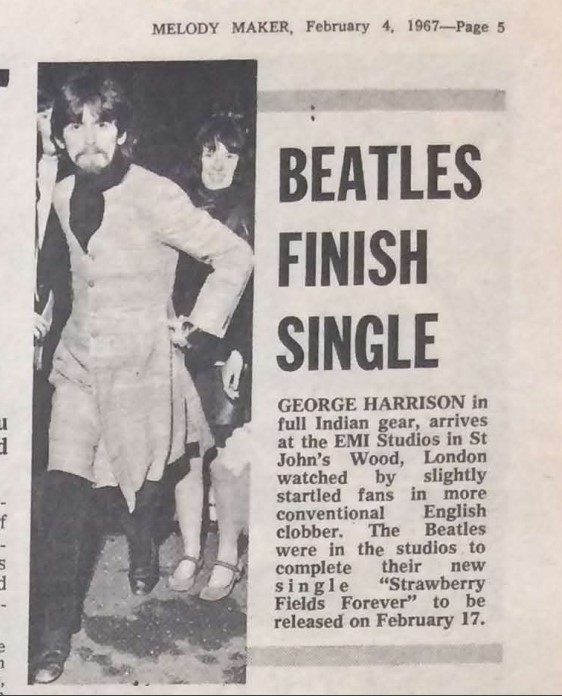
News of the single first appeared in Melody Maker on January 14, 1967, barely two weeks after recording was completed.  In a short news item on page one under the headline “Beatles Record” it read (using strangely mangled tense) The Beatles had recorded several tracks of their new LP at EMI’s Abbey Road Studios in London by the end of last week.  Brian Epstein told the MM: “Any track could be the next single, but it won’t necessarily come from the LP.  The third track would make a great single for anyone else, but the next Beatles single must be supreme.  The record might be released in February.  One rumoured title is “Strawberry Fields Forever.”  The story went on to cover news of a proposed Beatles TV spectacular and a one million dollar offer by American promoter Sid Bernstein for the group to play two shows at Shea Stadium. 


It’s not clear what song Epstein was referring to when he said “the third track” but, according to Mark Lewisohn’s book The Complete Beatles Recording Sessions (Hamlyn 1988), “When I’m Sixty-Four” was recorded concurrently with “Strawberry Fields” and “Penny Lane” during December 1966, so it could have been this. 

On January 28 the Melody Maker front page headline announced, in giant 54-point typeface, New Beatles Record – You Can Buy It On Feb. 17.  The story went on: The Beatles new single is “Strawberry Fields Forever” – as exclusively named in the MM two weeks ago.  The other side (there is no A or B side) is “Penny Lane.”  The Single will be released on February 17.  Both are Lennon-McCartney compositions.  

The first 250,000 copies of the single will be sold in a colour presentation sleeve specially prepared by EMI.  This is the first Beatles single since “Eleanor Rigby” and “Yellow Submarine” was released on August 5 last year. 

Just the first quarter million copies came in a picture sleeve, then?  In this age of downloads and streaming, 250,000 physical copies of any record is an undreamed-of amount, but such were the Beatles’ sales figures in 1967 when each new release filled warehouses across Britain.  And after the picture cover copies were sold out, the record probably went on to sell a similar amount in a generic Parlophone company sleeve.

With scant regard for factual accuracy, plus a certain amount of guesswork, the story continued “Strawberry Fields Forever” is about a Liverpool reform school for girls.  “Penny Lane” is the name of a road in the northern part of Liverpool – near the areas where John Lennon, Paul McCartney and George Harrison lived.  

“Strawberry Fields Forever” is very much a John Lennon composition.  It has none of the lyrical McCartneys [sic] qualities.  It’s a medium tempo number and doesn’t tell a connected story in the way that “Eleanor Rigby” does.  The words are rather bleak.

The group are continuing to work on their next LP and may do a TV spectacular based on the tracks on the album when it is released.  No release date has been set.


In reality Strawberry Field (there is no "s" at the end) was a Gothic Revival style mansion set in extensive grounds just a few hundred yards from John Lennon’s childhood home "Mendips" in Menlove Avenue, Woolton.  Built circa 1870 as a private residence, it was acquired in 1934 by the Salvation Army and converted to an orphanage (for both boys and girls).  The house itself was demolished in 1973, after which the children’s home continued until 2005 in new buildings constructed within the grounds.  The original wrought iron gates at the entrance were stolen in 2000 and sold to an antiques dealer who later returned them after he realised where they had come from. Strawberry Field was opened to the public in September 2019.

On his death in 1980 Lennon left a donation in his will to the children’s home and a few years later Yoko Ono gifted £50,000 towards the upkeep of the orphanage.  As for Penny Lane, the street lies well to the southeast of Liverpool city centre, not the north as the Melody Maker story reported.  

I was in my second year at college in Chesterfield when “Strawberry Fields” was released on Friday, February 17, 1967.  As with virtually every Beatles single since “She Loves You” four years earlier, I bought the record on the day of release.  Whether by accident or design (I never discovered which) for several years during the 60s British 7” singles sold for six shillings and eight pence each (that’s 33p in new money).  It sounds like an odd amount today, but thanks to the idiosyncrasies of the pre-decimal monetary system, it meant you could get three 45s for exactly one pound, something that has always struck me as a wonderfully neat and symmetrical thing.  But I digress.  

I handed over my 6s/8d at Hudsons record shop in the Chesterfield Market Hall during my lunch break and hurriedly took the single (Parlophone R5570) back to the college common room where we had a standard issue Dansette mono record player.  

As Melody Maker had predicted, the record came in an attractive picture sleeve, which was most unusual for UK singles at that time.  Countries in mainland Europe had been issuing their 45s in picture covers for years, but this didn’t become standard practice in post-austerity Britain until the late 60s/early 70s.  One side of the sleeve showed the Beatles in their new psychedelic garb set within an elegant picture frame, while the other featured childhood photos of the four.  We’ve seen those pictures reproduced many times since in books and the like, but in early 1967 they were a revelation, especially the modern photo showing their brand-new image. 

No longer the cuddly mop tops, all four now had moustaches and George was sporting a goatee beard.  John’s National Health wire spectacles were in evidence for the first time while George was wearing a long Nehru jacket of Indian design.  Paul and Ringo, meanwhile, simply looked cool in dark suits, double-breasted jackets and scarves or cravats. Spotlights were positioned alongside each band member and aimed directly at the camera.

The Dansette sat on the floor at the far end of the common room and a group of students gathered round in expectation as I placed the single on the turntable.  As “Strawberry Fields” began to play, we listened in silence, trying to make sense of this curious record.  Then, as it reached the end, we began to hear the first rumblings of dissent. 


Chesterfield College of Technology, as it was then called (it became simply Chesterfield College in 1984), housed a range of students.  Some, like me, were full-time scholars who fancied themselves as wannabe bohemian university types, but there was also an intake of part-time day-release students, many of whom came in from the nearby rural areas of Derbyshire a couple of days a week to study for apprenticeships in engineering, building work, animal husbandry and the like.  There was an uneasy dynamic between the two disparate groups and as Rudyard Kipling wrote in 1892, never the twain shall meet.  But on the rare occasions when they did cross paths, it sometimes ended badly.

It was one such red-faced farm boy who initially complained about the music.  Just as the strange backwards ending of “Strawberry Fields” began to drift back in, he came striding purposefully across the room and, elbowing his way through the gaggle of students around the Dansette he demanded, in his flat North Derbyshire vowels, “Turn that bloody rubbish off!”  Thus emboldened, some of his mates then joined in.  “I’ve never heard owt like it”, spluttered one, shaking his head.  Eventually one of the day-release boys reached down and unceremoniously ripped the tone arm from the record, causing a dreadful screeching sound as the stylus raked across the vinyl.  It’s the one sound every record buff has learned to fear above all others. 

From there the situation escalated into an unseemly slanging match with insults flying and both sides getting heated.  There was even some pushing and shoving amid the verbal abuse, but it thankfully never developed into real fisticuffs.  Just as well, really.  We were the ineffectual, long-haired students and they were, for the most part, brawny farm boys and factory workers.  Had violence eventuated, it would have been a one-sided contest, I fear.  We had by far the better vocabulary, though, and batted away their crude expletives with what we fondly imagined to be witty, Wildean rejoinders.

One of my college classmates at the time was none other than John Tams, soon to become properly famous in the world of folk music and acting.  He recorded with the Albion Band in the late 70s and appeared in the 90s TV series Sharpe where he played rifleman Daniel Hagman alongside Sean Bean as the eponymous star of the show.  It was Tams who introduced me to acoustic folk music and blues with records by Bert Jansch, John Renbourn, Tom Paxton, Lightnin' Hopkins, Sonny Terry & Brownie McGhee and others.  In May 1966, together with some other student friends, Tams and I went to see Bob Dylan at the Gaumont cinema in Sheffield.  I wrote about that momentous day here: LINK

Always the level-headed one, it was John Tams who eventually calmed things down that February lunchtime, and both sides drifted away amid muttered threats and insults.  But the fact that a humble pop record (albeit an extraordinarily good one) could provoke such intense feelings and conflicting emotions among what were, after all, a bunch of teenagers seems quite astonishing today.  It really was a textbook case of two very different worlds colliding.

Every new Beatles’ single was a huge deal, of course, but “Strawberry Fields” was a massive leap forward even for them.  They had been re-writing the pop music rule book with each new release since 1963 and this record took things to levels undreamed-of, setting the scene for the Sgt Pepper album which arrived a few months later in May 1967.  If they weren’t already unassailable, from this point on they had surely staked their claim for music immortality.

As for me, I was left feeling disgruntled with bruised pride and a nasty scratch across my brand-new copy of “Strawberry Fields.”  It was years before I managed to replace it with another and the clicks and pops on the original forever reminded me of that memorable ruckus in the student common room at Chesterfield College of Technology. 

Hudson's record store sadly closed its doors in 2012 after trading in Chesterfield for an incredible 105 years. I'm told it was the oldest family run record store in the world.


Seven Interesting Facts About Strawberry Fields Forever

  1. Recording began on November 24, 1966 and was completed on December 29.  The finished version stitched together two different recordings of the song (takes 7 and 26), one slowed down and the other speeded up, so they exactly matched each other in pitch and tempo.  Take a bow George Martin.  The edit comes at exactly 60 seconds into the released single after the line “Let me take you down ‘cause I’m going to…”  Spot it if you can. 

  2. In February 1967 “Strawberry Fields Forever”/ “Penny Lane” peaked at #2 in the UK singles chart but barely made the top ten in America.  It reached number one in Australia and several countries across Europe, however.

  3. Although “Strawberry Fields Forever” and “Penny Lane” weren’t heard in the Magical Mystery Tour film, their first appearance on album came when both were included on the US version of the MMT LP released at the end of November 1967.   

  4. On January 30 and 31, 1967 the Beatles shot a promo film clip for “Strawberry Fields Forever” at Knole Park in Sevenoaks, Kent.  A week later they filmed part of the promo for “Penny Lane” at the same location.  

  5. In March 1976 “Strawberry Fields Forever”/ “Penny Lane” re-entered the UK singles chart, reaching #32 as part of EMI’s Beatles reissue programme. Then, between 1982-1990 all 22 of the Beatles’ UK singles were reissued once again on the 20th anniversary of their original release.  “Strawberry Fields Forever”/ “Penny Lane” reached #65 in February 1987.  All their UK Parlophone and Apple singles were also made available as 7” picture discs during this time.  

  6. In the backwards coda section of the record, John is heard to say "cranberry sauce." In America this was misheard as "I buried Paul" providing an early so-called "clue" in the risible "Paul is dead" rumour of 1967.

  7. Many unreleased versions and remixes of “SFF”, from John’s home demo to the finished released version and all points in between, have appeared on the Beatles’ albums Anthology 2 (1996), Love (2007) and Sgt Pepper’s Lonely Hearts Club Band 50th Anniversary Box Set (2017).

    Hudsons record shop, Chesterfield, pictured circa 1969

A Murmuration of Tired Starlings: Cream – Wheels of Fire (Super Deluxe Edition)

by Stuart Penney I must declare a vested interest here. There was a period when  Wheels of Fire  was my all-time favourite album. From Marti...