Sunday, 16 July 2023

Paul McCartney Meets the Press Downunder


by Stuart Penney

30 years ago on March 4, 1993, I attended a Paul McCartney press conference in Perth, Western Australia.  It didn’t go entirely to plan.

There is, we are told, much to be said for being a big fish in a small pond.  Similarly, and stretching the metaphor to breaking point for the purposes of this story, even an ambitious minnow can sometimes get lucky in an isolated city such as Perth.  

Located way out on the west coast of Australia, Perth is said to be the most remote capital city on the planet.  It’s a spectacularly beautiful and relaxed place to live.  The skies are enormous, and the sun nearly always shines.  But it is also a mighty long way from anywhere else, something the locals can get a little touchy about if it’s mentioned too often.  

The facts are inescapable, however.  With a population of around two million, Perth sits a scarcely believable 2,693 km (1673 miles) from Adelaide, the closest city of comparable (or, indeed, of any) size.  To give some indication, that’s further than London to Moscow.  

There are pros and cons to this extreme isolation, naturally.  The tyranny of distance and the time difference between the east and west coasts mean that Perth had to create, by necessity, its own self-contained entertainment microcosm.  This was especially true before the internet brought instant communication and made the world a somewhat smaller place.  

At one time all the major record labels had offices in Perth and most of the national radio and TV stations still do.  Just about every international rock tour from Europe and the US invariably started or ended here.  It was (and still is) geographically expedient for them to do so.  The one notable exception being the Beatles, who skipped Perth completely during their sole Australian visit of 1964.

In the early 90s I freelanced for the street paper X-Press magazine.  Focussing on music, movies, the arts and entertainment, it was a kind of Perth “what’s on” freesheet - think of it as an inky version of London’s famous Time Out, if you will.  Given away at record stores, pubs, nightclubs, shopping malls and the like, its revenue came purely from advertising.  Every Australian state capital city had at least one such publication back then and the big population centres such as Sydney and Melbourne had two or three competing titles.

I was recruited as the X-Press heavy rock reviewer.  1991 was the year when grunge and thrash started to take off in a big way and the magazine urgently needed someone who could write about it.  This was not nearly as glamorous as it sounds.  I wasn’t exactly a heavy metal expert but since absolutely no one else at the mag wanted the job (in fact, most looked down their noses at the genre) I decided to give it a go.  How hard could it be, I reasoned.  

Before long I was interviewing big-name bands such as Metallica, Megadeth, Faith No More, Iron Maiden, Kiss and Def Leppard on a regular basis.  Along with the weekly album and live reviews I even had my own column titled, somewhat unimaginatively, “Full Metal Racket.”  There’s the Perth small pond syndrome at work in a nutshell.

The freelancers were paid a pittance, but by way of compensation we did get shedloads of free records and CDs plus tickets for almost every concert which came to town.  For a Perth music writer in the 90s life was good. 

Pre-release album previews and concert meet and greet events were also a big thing back then.  And just occasionally there were the press conferences.  So it was that in March 1993 I got a call from the local EMI office asking if I was interested in attending a Paul McCartney press conference scheduled to take place ahead of his first Australian tour in 18 years.  Was I interested?  I’d not enjoyed some of his recent albums around that time, it’s true (Press To Play and Off The Ground were particularly limp affairs) but this was Paul bloody McCartney, after all.  

After confirming that I was, indeed, interested I was instructed to report to a specific entrance at the concert venue, Subiaco Oval, an Australian Rules Football stadium the following afternoon.  

There I was ushered into a holding room along with a bunch of newspaper reporters, TV and radio presenters and a smattering of local media types.  I recognised a few of them from television, but we freelancers were a long way down the journalistic pecking order, so pleasantries were not exchanged.  

Since Perth was to be the first concert of the 10 date Australasian leg of McCartney’s 1993 The New World Tour, reporters from Sydney and Melbourne had also flown in to preview the show before it reached the all-important east coast cities.  These were Macca’s first Australian dates since the 1975 Wings Over the World Tour and media interest was running high. 

We were each handed a press pack consisting of a folder containing several 8 x 10 glossies of Paul, plus assorted biographical info and details about the tour itself. 

McCartney’s energetic publicist Geoff Baker then bounded into the room to deliver a pre-conference pep talk.  Fashionably unshaven with wire-rimmed glasses and wild hair, he resembled a hip geography teacher combined with perhaps a hint of Frank Zappa.  He was not at all what you might expect from the high-powered PR man of arguably the biggest rock star in the world.  

Baker briefed us on what was about to happen and exactly how the press conference would play out.  We were advised which topics to avoid during the Q&A section (these were mostly of the “will the surviving Beatles ever reform” type, although this directive was largely ignored by the mainstream newsmen) and told that Paul would sign autographs for us when it was all over.


Formerly the showbiz editor of the unashamedly downmarket UK red top tabloid Daily Star, Geoff Baker worked for McCartney for around 15 years, but it all ended badly in 2004 when he was sacked amid accusations that, in Paul’s words, “his work had failed to meet professional standards.”  

Baker had, in fact, previously been briefly dismissed and re-hired in 2003 after he tipped off journalists about Macca’s late-night visit to see illusionist David Blaine during his 44-day endurance stunt in a glass cage by the river Thames.  This resulted in an unseemly press scrum with some photographers claiming they were roughed-up by McCartney’s security team.  But it was when Paul’s second wife the abrasive Heather Mills entered the picture in 2002 that Baker’s position became untenable, and he was finally let go two years later.

After the briefing we trouped out to the football field where several rows of plastic chairs were arranged on the grass in front of a raised platform with a desk, upon which sat maybe 20 microphones.  This was to be an open-air press conference and there was a small PA system off to the side.  At this point Baker left us to wait under the unforgiving Western Australian sun for what seemed like an eternity.


Geoff Baker

Eventually, a top-of-the-line Ford LTD limousine (a stretched version of a Ford Falcon/Fairlane and probably the most prestigious Aussie-built car at that time) entered the field and parked on the grass a couple of hundred yards away from where we were sitting.  Paul and Linda got out and, shadowed by an enormous bodyguard built like a sumo wrestler, they walked to a roped-off area some distance from us where a gaggle of photographers was waiting. 

It was at this point I left my seat to take a closer look.  There was no way I was going to sit idly by while an actual Beatle was posing for photographs only yards away.  Significantly, I was the only one from the press enclosure to do so.  This would prove to be a miscalculation.

I made my way circuitously to the roped-off section and stood behind the photographers as they furiously snapped away.  It was bedlam with the newsmen jostling for position and calling out inanities like “This way Paul!” “One more!” and “Over here Linda!”  But the couple remained utterly unfazed throughout.  The thought occurred that McCartney had been living this fishbowl existence for 30 years, his entire adult life, in fact, so this was just another day at the office for him.  

Standing just a couple of feet away, I was struck by how tanned and attractive Linda looked in a blue floral dress and without a hint of make-up.  Her bare legs were heavily freckled, and she was the picture of health.  Sadly, within five years she would no longer be with us. 

The photo call completed, Paul’s entourage began to make its way to where the actual press conference was due to take place.  This was awkward.  I didn’t want to cut in front of them to re-take my seat, so I hung back, deciding to take the long way around and enter the area from the back.

At this point a heavily built man in a suit and carrying a walkie talkie who I assumed to be part of the stadium security stepped in front of me and stuck his arm out, blocking my path.  “Where do you think you’re going?” he barked aggressively.  “Er, back to my seat over there,” I said sheepishly, pointing in the general direction of the press conference area.  He became angry and not a little flustered at this, “You shouldn’t have been at the photo call in that case!” he spluttered.  

I don’t think he believed me at first, thinking I was just a chancer who had wandered in off the street.  Although that would have been extremely unlikely because as I noticed when arriving at the stadium earlier there was rigid security at every conceivable entrance.  I’d been asked to produce ID to gain access and my name was checked against a list. 

He was becoming more obnoxious by the second and at one point it seemed as if I was about to be ejected.  Eventually I produced my X-Press laminate and he finally seemed satisfied, albeit grudgingly, snapping “Hurry up and sit down, then, for God’s sake!”  I did as I was told and scrambled back to my seat just as Paul reached the platform and the press conference began.

I suppose it lasted around 30 minutes with questions ranging from the mundane (“What can fans expect from this tour?”) to the parochial (“How does it feel to be back in Australia?”) via the inevitable (“Do you have any plans to work with George and Ringo again?”).  

Serious questions were asked about drugs (Paul said while he was against the hard stuff, he was in favour of decriminalising marijuana); the hole in the ozone layer (a huge topic at the time) and animal rights, including laboratory experiments on monkeys.  The Royal Family and the Charles and Diana phone scandal were also discussed.  The so-called “Camillagate” and “Squidgygate” tapes had just been released by the media to huge public interest.  “Do you believe those tapes?” he said in bemused amazement. 

Paul was his usual upbeat, matey self throughout, offering friendly, non-controversial answers to even the most boring and unimaginative queries.  I was just happy to be there as an interested observer and didn’t raise my hand to pose a question.  If I had done so it probably would have been something painfully dull about guitars or similar. 


Finally, the press conference was over and Geoff Baker stepped up to announce that Paul would now sign autographs.  At this juncture all hell broke loose.  I was surprised to see hard-nosed TV newsmen and serious journalists in smart suits make a mad scramble towards the raised platform like crazed teenage Beatle fans.  They were literally elbowing each other out of the way and knocking over chairs in their haste to get a signature.  Items were roughly thrust at Paul from all directions, and he calmly and diligently began to sign them all.  He’d clearly experienced this a thousand times before. 

Not wishing to get caught up in the unseemly scrum, I decided to hang back and wait for the crush to thin out before offering up one of the 8 x 10 glossies to be signed (pictured here).  The signature was rushed (not surprising under the circumstances) and we didn’t make eye contact.  Polly, a friend and journalist colleague from X-Press had the foresight to take the colour photo insert of Paul from the Beatles’ “White Album” to get autographed and I cursed myself for not bringing something more imaginative.

After every last photo and scrap of paper had been signed, we were asked to wait in the enclosure while Paul and Linda, accompanied by the bodyguard, walked back to the limo and left the stadium.  And then it was all over.  

I should add at this point that I didn’t attend the McCartney concert on March 5.  It was one of those rare events where free tickets were in very short supply and X-Press was only allocated a couple which were immediately snapped up by others.  It seems crazy to say this now, but that run of poor McCartney albums from the late 80s/early 90s had dampened my enthusiasm somewhat.  I can offer no further excuses than that, m’lud.

Running for 78 shows in 19 countries and spanning five continents, The New World Tour kicked off in late February 1993 with concerts in Italy and Germany before ending in Chile, South America just before Christmas.  Along the way it took in Australasia, North America, Japan and most of Europe.  

The touring band consisted of Paul and Linda, Robbie McIntosh (guitar), Hamish Stuart (guitar, bass), Paul ‘Wix’ Wickens (keyboards) and Blair Cunningham (drums).  This was the line-up which had recently completed the album Off The Ground.  The tour was commemorated with the concert album Paul Is Live, released in November 1993.  Although mostly recorded in the US, it also featured three tracks from the March shows in Sydney. 

By coincidence, Bob Geldof was also in Perth in March 1993 doing a week-long stint as a DJ on the local radio station 96fm.  Geldof and McCartney had been mates since Live Aid in 1985 and Paul was invited on the show where they chatted on air between records.  

A journalist for the West Australian daily newspaper found himself in the centre of a media storm after filing a scathing review of the concert.  Veteran writer Ron Banks claimed the Perth show was a “limp squib” (perhaps he intended to write “damp squib”?) and that some fans had left the venue after an hour.  The review also got some of the song titles wrong.

It transpired that, to meet the deadline, Banks had dictated his copy mid-way through the concert using a primitive early mobile phone and, to add insult to injury, the sub-editors at his newspaper had mangled his words making the show seem even worse.  

Geoff Baker responded with a press release: “It is always the people, not the critics, who matter, and we were touched to hear of your concerns that we might be leaving Perth with a bad feeling (because of the blue meanie Ron Banks).

“Worry not - you have been nothing but kind to us since we arrived here, and we leave with your cheers in our hearts.”

The backlash from fans around the world proved so strong that Ron Banks was obliged to retract his original review and issue a clarification. 

Paul did not return to Perth until late 2017 with his One On One tour.  Subiaco Oval had closed since his last visit and this time he played the nib Stadium, a football (soccer) ground close to the city centre.  We live in the era of ground sponsorship and this stadium has had no few than six different names in recent years.  At the time of writing, it goes under the name HBF Park.

It wasn’t the end of McCartney’s link with the suburb of Subiaco, however.  On November 30, 2017, he performed an intimate rehearsal concert and Q&A session in front of 20 selected fans at the historic Regal Theatre.  Opened in 1938 the art deco venue has a seating capacity of just over 1,000.

Set List, Subiaco Oval, March 5, 1993

1. Drive My Car

2. Coming Up

3. Get Out Of My Way

4. Another Day

5. All My Loving

6. Let Me Roll It

7. Peace In The Neighbourhood

8. Off The Ground

9. I Wanna Be Your Man

10. Robbie's Bit

11. Good Rockin' Tonight

12. We Can Work It Out

13. And I Love Her

14. Every Night

15. Hope Of Deliverance

16. Michelle

17. Biker Like An Icon

18. Here, There And Everywhere

19. Yesterday

20. My Love

21. Lady Madonna

22. Live And Let Die

23. Let It Be

24. Magical Mystery Tour

25. The Long And Winding Road

26. C'Mon People

27. Paperback Writer

28. Fixing A Hole

29. Penny Lane

30. Sgt. Pepper's Lonely Hearts Club Band

Encore

31. Band On The Run

32. I Saw Her Standing There

33. O Sole Mio (snippet)

34. Hey Jude


Stop Press:
In August 2023 it was announced that McCartney's Got Back tour would play six dates in Australia during October/November.  Sadly, no Perth dates were scheduled this time.

Saturday, 20 May 2023

The Ones That Got Away: Near Misses With Rare Records - #2 Robert Plant


by Stuart Penney

Continuing our occasional series of tales of disappointment and squandered opportunity, here’s the story of the time I foolishly passed up the chance to buy both of Robert Plant’s impossibly rare (and now insanely valuable) pre-Led Zeppelin solo 7” singles for just a few pennies.  But first, a little background.  

Before joining Zeppelin, Plant had a brief and unsuccessful solo career, during which he recorded a pair of decidedly MOR singles for CBS:

Our Song / Laughin’, Cryin’, Laughin’ (CBS 202656) Released March 31, 1967

The CBS press release for “Our Song” reads: "A new solo singer from Birmingham, Robert Plant makes his debut on CBS with "Our Song.”  Robert used to sing with groups like The Listen and Black Snake Moan but recently decided that his soul-sound voice could be used to better effect as a solo artist." 


The A side is a cover of an Italian song, “La Musica è Finita.”  It first appeared at the alarmingly uncool Sanremo Song Festival in January 1967 where it was performed twice by two different singers - Ornella Vanoni and Mario Guarnera - and ended up in 4th place.  And, should anyone still care about this kind of thing, the winners of the festival were Iva Zanicchi and Claudio Villa with the song "Non pensare a me."

One of the co-writers of “La Musica è Finita” was Umberto Bindi who also penned "Il Mio Mondo."  An English language version of the song became a May 1964 UK chart topper for Cilla Black as “You're My World.”

The English lyrics for "Our Song" were written by Tony Clarke (1941 - 2010). Between 1967 - 1978 Clarke produced seven albums for the Moody Blues and oversaw the recording of the 1965 live debut LP by John Mayall & the Bluesbreakers.

Long Time Coming / I’ve Got A Secret (CBS 2858) Released July 14, 1967.

The heartfelt A-side ballad was first released (as “It Took A Long Time Coming”) in early 1967 by American singer Laura Lynn on the UK President label (PT 104).  

“I’ve Got A Secret” is a cover of a song by St. Louis soul outfit The Sharpees.  It originally appeared as the A-side of a 1966 single on the Chicago based label One-derful (4843). 

Predictably, since Plant was a total unknown at the time, both records flopped and sank without trace.  I can’t say how many copies were sold, but I’d guess there was a pressing run of around 500 copies each, most of which would have been returned to the record company unsold (or flogged off cheap, as we shall see).  As often happens with records which become hugely collectable years later, “A" label promotional copies (as shown here) are more plentiful than stock copies.  It’s likely a hundred or so promo pressings were sent out to UK radio stations and the music press for review, outstripping actual over-the-counter sales.


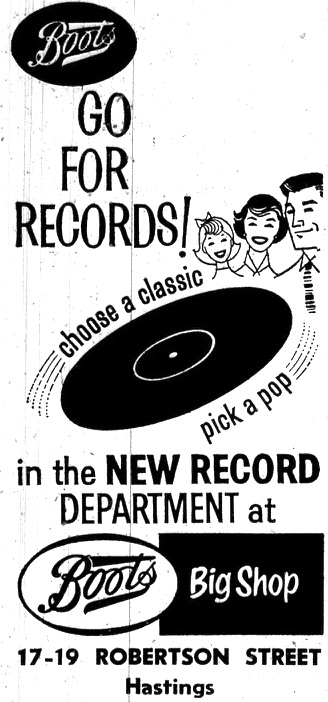
Fast forward to mid-1969 and the record department of Boots the Chemist in High Street, Sheffield.  That’s right, the record department.  In a chemist.  Alongside the beauty products and medical requisites Boots also sold records back in the 60s and 70s.  But just like Woolworths before them, they had scant knowledge and very little interest in the music they stocked.  As often happened, the girl who might serve you at the record counter in Boots (or Woolworths) was, in all probability, selling cosmetics the week before.  So, any questions regarding the new releases by Dr. Strangely Strange, Third Ear Band, Principal Edwards Magic Theatre or Captain Beefheart would inevitably be met with the blankest of blank stares.

Boots the Chemist in High Street, Sheffield as it looked in the 60s

But despite that, Boots record department was always worth a visit for a couple of reasons.  Their chart singles were usually a little cheaper than the dedicated record stores and they also tended to heavily discount slow selling titles, so there were often bargains to be had.  It seems the record company reps could talk the buyers at Boots head office into ordering anything, no matter how obscure, with the assurance it would be a big seller.  Naturally, other than the big-name artists, this was seldom true, and the stores ended up with a lot of dead stock which was invariably knocked out cheap (seemingly below cost price) just to get it out the door.


And so it was that one day in mid-1969 while browsing the discount bins I found new old stock copies of not one but both of the aforementioned Robert Plant solo singles in Boots’ Sheffield store marked down to 1s/6d each (that’s 7½p in new money). A full-price single was 6s/8d (33p) at that time.

I pulled the records from the box, still in their correct orange CBS die-cut sleeves, and carefully turned them over to read the B-sides. After noting the 1967 release dates, I silently mused “Robert Plant.  Hmmm.  That name looks familiar.  I wonder if this could be the singer with Led Zeppelin.  I didn’t know he’d made records before joining the band.”  At this point I should have quietly handed over my three shillings (15p) for both records like any sane person would have done and walked away merrily whistling “Communication Breakdown.”  

But I didn’t do that.  Oh no.  Instead, I inexplicitly put the records back in the discount box and kept on browsing.  Finding nothing else of interest, I left the store without a second thought. 


From the book A-Z Record Shop Bags by Jonny Trunk


Today those Robert Plant singles can sell for up to £1,000 each in mint condition and their value will surely increase in the years ahead.

Caveat emptor: in recent years we've seen unofficial (ie counterfeit) copies of "Long Time Comin'" in orange vinyl and "Our Song" in white vinyl for sale. Even these can sell for £40 or more.

For the sake of completion, I should also mention that Plant had previously appeared on a 1966 single by Midlands band Listen. The A-side "You'd Better Run" is a cover of a song by the Young Rascals while the B-side "Everybody's Gonna Say" is a Listen original. During the recording the band was replaced by session musicians leaving Plant as the only Listen member to appear on the record.


You'd Better Run / Everybody's Gonna Say (CBS 202456) Released November 26, 1966.

Footnote: Boots the Chemist was established 1849 in Beeston, a suburb of Nottingham by John Boot.  It was built into a household name by his son Jesse with stores all over Europe and the Far East.  As of August 2019, Boots had 3,063 branches across six countries.  In 2007 Boots the Chemist Limited was re-branded Boots UK Limited.


The first chemist branch outside Nottingham opened in 1884 in Sheffield.  The branch at 4-6 High Street, Sheffield was opened in May 1898 and is still there today in the same location.  Needless to say, it’s been a long time since they sold recorded music.


More Record Trivia:

Robert Plant wasn’t the only hopeful with a record in the shops on Friday March 31, 1967.  The very same day “Our Song” was issued, the UK CBS release sheet listed the following singles:

CBS 202610 - Paul Revere and the Raiders - Ups and Downs / Leslie

CBS 202642 - Guy Darrell - Crystal Ball / Didn't I

CBS 202645 - Romeo Z - Come Back Baby Come Back / Since My Baby Said Goodbye

CBS 202652 - The Executives - Sensations/Smokey Atmosphere 

CBS 202653 - The Harry Roche Constellation - Casino Royale (Have No Fear, Bond Is Here)/In the Pad of the Mountain King

CBS 202654 - Roger Bloom’s Hammer - Out of the Blue / Life's A Gamble

CBS 202655 - Gene Latter – Always / A Woman Called Sorrow

CBS 202656 - Robert Plant – Our Song / Laughin’, Cryin’, Laughin’

CBS 202657 - Joan Regan – No One Beside Me / A Love So Fine 

CBS 202658 - Dr. West's Medicine Show And Junk Band - Gondoliers, Shakespeares, Overseers, Playboys And Bums / Daddy I Know

CBS 2668 - Stan Butcher His Birds And Brass - Somethin' Stupid / Janie

Of those, only Paul Revere & the Raiders had a realistic chance of becoming a hit.  But despite making the lower reaches of the US charts “Ups & Downs” failed to sell in Britain.  Joan Regan was a big name in 50s UK pop but her time had passed by 1967 and “No One Beside Me” was roundly ignored.   

More interesting was Dr. West's Medicine Show & Junk Band’s “Gondoliers Shakespeares, Overseers, Playboys And Bums.”  They scored a minor US hit with their follow-up “The Eggplant That Ate Chicago” and while both singles failed to sell in the UK, band member Norman Greenbaum went on to score a worldwide #1 in 1969 with “Spirit In the Sky.”

A few months later the UK CBS release sheet for July 14, 1967 looked like this:

CBS 2843 - Gene Latter - A Little Piece Of Leather / Funny Face Girl

CBS 2846 - The Statler Brothers - Ruthless / Do You Love Me Tonight

CBS 2847 - Lynne Randell - Ciao Baby / Stranger In My Arms

CBS 2858 - Robert Plant - Long Time Coming / I’ve Got A Secret 

CBS 2859 - The Buckinghams – Mercy, Mercy, Mercy / You Are Gone

UK born Lynne Randell emigrated to Australia as a child where she became a successful pop star, touring America on the same bill as the Monkees and Jimi Hendrix.  “Ciao Baby” was her biggest hit, reaching #8 in Australia and becoming a hugely sought-after Northern Soul classic.

“Mercy, Mercy, Mercy” started life as a jazz instrumental by Cannonball Adderley.  Among several vocal covers was this one by “Kind Of A Drag” hitmakers The Buckinghams which flopped in Britain but reached #5 in the US.  


Record Mirror September 1967


Melody Maker 1972

Thursday, 4 May 2023

Led Zeppelin - The Greengrocer Strikes Back

         Record Shopping In Berwick Street, 60s Style

by Stuart Penney

What springs to mind when we think of Berwick Street? For Oasis fans it's probably the band's second album (What's The Story) Morning Glory? Love it or loathe it, this 1995 release is one of the biggest selling UK albums of all time and its clearly identifiable cover photo put Berwick Street firmly on the London pop locations map.

For others it could be the record stores.  In recent decades this humble Soho thoroughfare has become world famous for its profusion of CD and vinyl shops.  Every year on Record Store Day men of a certain age (and it is nearly always men, let’s be honest) can be seen queueing outside Sister Ray or other participating shops in all weathers well before daybreak.  

They do this in order to be first in line to secure that limited edition Morrissey 12” single in blue vinyl, or whatever other coveted RSD release has taken their fancy.  That same 12” single will, in all probability, be up for sale on eBay before the day is out, but that’s another story (morning glory).


Record Store Day was inaugurated in 2007, and Sister Ray were one of the first UK participants.  But record shops had been thriving in Berwick Street for years – Reckless Records moved there in 1984, followed by Sister Ray in 1989 and others soon followed.  More recently the advent of streaming, plus the COVID lockdown, saw a sharp reduction in the number of music outlets in the area, but several have survived. 


Before any of this, however, there was Musicland.  Operating from 1967 to 1975 at the junction of Berwick and Noel Street, this legendary record store was a mecca for imported US vinyl.  Back then many albums were released in America weeks or even months before we saw them in Britain and, together with One Stop Records in nearby Dean Street, Musicland always had the latest and best selection of imports in Soho.  All this was pre-megastore, of course.  Virgin opened their first shop in 1971, but at that point they were a small concern operating above an Oxford Street shoe store.


My trusty record buyer’s diary from the period (in reality, just a dog-eared school exercise book) tells me I scored John & Yoko’s Plastic Ono Band - Live Peace in Toronto (shrink-wrapped with calendar) from Musicland just before Christmas 1969.  Other significant purchases around that time included the first T. Rex single “Ride A White Swan” (October 1970), a trio of US-only Donovan albums Hurdy Gurdy Man, Barabajagal and Mellow Yellow (various dates during 1968-69) plus Frank Zappa’s Hot Rats (February 1970).  

Literally on the doorstep of Musicland was the famous Berwick Street market.  First officially recognised in 1892, but established more than a century earlier, it’s one of the oldest street markets in London with a long and chequered history.  For the purposes of this story, however, all we need to know is that in the late 1960s the market had a rather excellent record stall.


In time honoured tradition, record company sales reps and music journalists alike would supplement their income by offloading unwanted samples and review copies at the Berwick Street market record stall, turning it into a goldmine for obscure new releases and promo records of every description.  I picked up countless rare gems there, some of which I still have and many others I regret parting with.  One memorable visit yielded a dozen or so Blue Horizon “A” label promo singles, including items by Fleetwood Mac, Otis Rush and Chicken Shack


Then, one day toward the end of October 1969 I was at the stall checking out the new arrivals, as I did most lunchtimes, when “Whole Lotta Love,” the opening track from the recently released Led Zeppelin II album came bursting from the speakers.  This was a big deal.  Zeppelin were poised to become the world’s biggest band and there was a huge media buzz around their eagerly awaited second album.  I decided to hang around the stall as long as possible to hear more.  

Now, immediately alongside the record seller was a fruit and vegetable stall, one of several in Berwick Street.  With his textbook cockney accent, fingerless gloves and toothpick thin roll-up permanently clamped to his bottom lip, the fruit and veg seller could have come straight out of Eastenders central casting, had the venerable TV soap existed at the time.  His well-honed cheery patter could often be heard above the music as he served the customers, forever charming the ladies with a cheeky “Mind how you go, darlin’.”  

It goes without saying that he also had the full complement of greengrocer's apostrophes on his signs - apple's, orange's, banana's etc.  Of course he did. But that’s probably a gripe for another day. 


The fruit and veg man didn’t seem too thrilled with the music emanating from the record stall, however, and judging from the disapproving glances he kept firing in our direction I could tell he wasn’t much of a heavy rock fan.

By this point “Whole Lotta Love” was nearing the end.  We’d negotiated the strange orgasmic middle section where the swirling sound effects move disconcertingly back and forth across the stereo spectrum, and now Jimmy Page was peeling off those life affirming staccato guitar phrases which lead back into the song.  

There we were, serious record browsers all, heads bowed over the LP crates, nodding along with the music as Robert Plant launched into the coda around a minute from the end.  "I'm gonna give ya every inch of my love" he threatened ominously, before bellowing “Shake for me girl, I wanna be your back door man" in an overtly suggestive manner. This was followed by a series of wordless grunts and moans, each one more exaggerated than the last.  Then at exactly the 4:58 mark Plant let out an extended groan which seemed louder, longer and noticeably more strained than anything which had gone before.  

It was at that point the fruit and veg man finally spoke up.  With perfect timing he raised his voice above the general hubbub and with a look of undiluted disdain called out: “Farkin’ hell!  What’s wrong with ‘im?  He sounds like he's bleedin' constipated!”  Everyone, including the record seller, roared with laughter.  How could we not? 


It was a priceless moment and one which has stayed with me to this day.  Even now, more than half a century later, I can never hear the final minute of “Whole Lotta Love” without thinking of the fruit and veg man and his perfectly executed interlocution.  It was the kind of witty put down our dads might well have said at the time, had they thought of it.  But it also comprehensively pricked the pomposity of Plant’s performance (if you’ll excuse the accidental alliteration) without taking anything away from the timeless recording itself.  

I’ve dined out on this story endlessly over the years and even passed it onto my son who now quotes the line freely whenever he hears the song.  Probably to the bafflement of his peers I shouldn’t wonder.


Record Mirror May 1967

A Murmuration of Tired Starlings: Cream – Wheels of Fire (Super Deluxe Edition)

by Stuart Penney I must declare a vested interest here. There was a period when  Wheels of Fire  was my all-time favourite album. From Marti...