Saturday, 21 January 2023

In Praise Of Strawberry Fields Forever

Nothing To Get Hung About - The Day My Beatles Single Almost Caused A Riot

"The Beatles are turning awfully 'funny', aren't they?" - HRH Queen Elizabeth II to EMI chairman Sir Joseph Lockwood, October 1967.

“Strawberry Fields Forever” will be 56 years old in February of 2023.  As we approach the Emerald (+ 1) anniversary of the Beatles’ landmark 14th UK single Stuart Penney remembers buying the record on the day of release and the unexpectedly hostile reception it received from some of his peers.

I heard “Strawberry Fields Forever” on the radio today.  It came up on one of those set-and-forget oldies stations and, as always, I stopped what I was doing and listened to all 4 minutes and 7 seconds of it from start to finish.  To encounter this most weirdly magnificent Beatles’ track in such a place came as something of a surprise, I don’t mind admitting.  It’s one of those songs I never grow tired of hearing, and yet it seemed somehow inappropriate to find it rubbing shoulders with prosaic “classic rock” staples by the likes of Billy Joel, Meat Loaf and Buckingham-Nicks era Fleetwood Mac.  


They often play Beatles’ records on the radio station in question, of course they do, but rarely does “Strawberry Fields” get an airing.  Even now, over half a century after it was released, it’s a record that demands the listener’s attention from the very first note.  56 years later it still sounds weird, otherworldly and unsettling, yet infuriatingly catchy at the same time.  It’s quite unlike anything else that made it to the top of the charts at that time.  And before you pedants jump in, I’m fully aware that “SFF” was cruelly kept off the UK number one spot by Engelbert Humperdinck’s sappy “Release Me,” thus interrupting the Fabs’ unparalleled run of 11 straight chart toppers.  But that little nugget of trivia only adds to the mystique.  It may make for a great pub quiz factoid, but after this slight blip the Beatles went on to effortlessly score six more UK number ones as if nothing had happened. 


But if “Strawberry Fields” with Paul’s wonky Mellotron intro (played on the “flute” setting, fact fans), John's heavily processed vocals and George Martin's dreamlike string and brass arrangement still seems eerie and captivating now, imagine what it sounded like in February 1967 when it first arrived.  We tend to think of the song as emblematic of the psychedelic era but together with its equally wonderful joint A-side “Penny Lane,” recording actually began in late 1966, making it one of the earliest records of its kind.  As with almost everything else they turned their hands to, the Beatles got there first.


As any fan worthy of the name will tell you, “Strawberry Fields” and “Penny Lane” were the first two songs recorded during the Sgt. Pepper's Lonely Hearts Club Band album sessions.  It had been six months since their last single "Yellow Submarine"/"Eleanor Rigby" and in an era when four singles and two LPs a year (plus maybe a couple of EPs as well) was the norm, the Fab Four were starting to look like slackers.  Also, it was the first time since 1963 they hadn’t had the number one Christmas single (Tom Jones claimed it in 1966 with “Green, Green Grass Of Home”).  So, because the album was taking longer than usual to complete, the two songs already in the can were rushed out as a single to keep the public happy.  

There’s something typically British about that.  Two of the finest pop songs of the sixties were hurriedly put out together on the same single, meaning that one of them was, in purely commercial terms at least, effectively wasted.  Until the Beatles came along to turn them into an art form, B-sides were not considered terribly important.  They were traditionally makeweight, disposable songs, often written by the artist (or someone close to them, such as their producer) in order to secure a share of the composer royalties via the back door (the writer of the B-side received the same royalty rate as the A-side composer).  


They could quite easily have made two singles out of “Strawberry Fields” and “Penny Lane” with a couple of existing LP tracks as B-sides and both would have been equally huge hits.  But the Beatles didn’t work like that.  They didn’t care to make people pay twice for the same songs so, in Britain at least, their singles generally comprised brand new songs and not recycled album tracks, as routinely happened in America.  This egalitarian approach meant that those two magnificent songs ended up together as possibly the greatest double-sided pop 45 of all time.  As the Ferrero Rocher advert once famously said “Ambassador, you are really spoiling us.” 


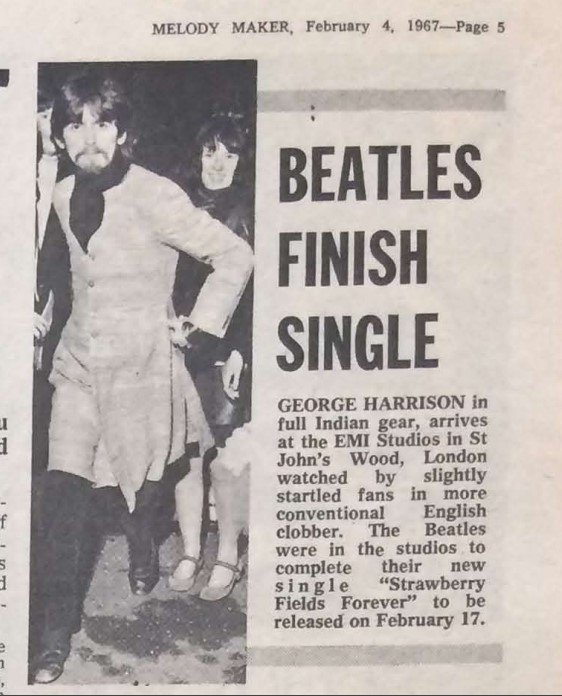
News of the single first appeared in Melody Maker on January 14, 1967, barely two weeks after recording was completed.  In a short news item on page one under the headline “Beatles Record” it read (using strangely mangled tense) The Beatles had recorded several tracks of their new LP at EMI’s Abbey Road Studios in London by the end of last week.  Brian Epstein told the MM: “Any track could be the next single, but it won’t necessarily come from the LP.  The third track would make a great single for anyone else, but the next Beatles single must be supreme.  The record might be released in February.  One rumoured title is “Strawberry Fields Forever.”  The story went on to cover news of a proposed Beatles TV spectacular and a one million dollar offer by American promoter Sid Bernstein for the group to play two shows at Shea Stadium. 


It’s not clear what song Epstein was referring to when he said “the third track” but, according to Mark Lewisohn’s book The Complete Beatles Recording Sessions (Hamlyn 1988), “When I’m Sixty-Four” was recorded concurrently with “Strawberry Fields” and “Penny Lane” during December 1966, so it could have been this. 

On January 28 the Melody Maker front page headline announced, in giant 54-point typeface, New Beatles Record – You Can Buy It On Feb. 17.  The story went on: The Beatles new single is “Strawberry Fields Forever” – as exclusively named in the MM two weeks ago.  The other side (there is no A or B side) is “Penny Lane.”  The Single will be released on February 17.  Both are Lennon-McCartney compositions.  

The first 250,000 copies of the single will be sold in a colour presentation sleeve specially prepared by EMI.  This is the first Beatles single since “Eleanor Rigby” and “Yellow Submarine” was released on August 5 last year. 

Just the first quarter million copies came in a picture sleeve, then?  In this age of downloads and streaming, 250,000 physical copies of any record is an undreamed-of amount, but such were the Beatles’ sales figures in 1967 when each new release filled warehouses across Britain.  And after the picture cover copies were sold out, the record probably went on to sell a similar amount in a generic Parlophone company sleeve.

With scant regard for factual accuracy, plus a certain amount of guesswork, the story continued “Strawberry Fields Forever” is about a Liverpool reform school for girls.  “Penny Lane” is the name of a road in the northern part of Liverpool – near the areas where John Lennon, Paul McCartney and George Harrison lived.  

“Strawberry Fields Forever” is very much a John Lennon composition.  It has none of the lyrical McCartneys [sic] qualities.  It’s a medium tempo number and doesn’t tell a connected story in the way that “Eleanor Rigby” does.  The words are rather bleak.

The group are continuing to work on their next LP and may do a TV spectacular based on the tracks on the album when it is released.  No release date has been set.


In reality Strawberry Field (there is no "s" at the end) was a Gothic Revival style mansion set in extensive grounds just a few hundred yards from John Lennon’s childhood home "Mendips" in Menlove Avenue, Woolton.  Built circa 1870 as a private residence, it was acquired in 1934 by the Salvation Army and converted to an orphanage (for both boys and girls).  The house itself was demolished in 1973, after which the children’s home continued until 2005 in new buildings constructed within the grounds.  The original wrought iron gates at the entrance were stolen in 2000 and sold to an antiques dealer who later returned them after he realised where they had come from. Strawberry Field was opened to the public in September 2019.

On his death in 1980 Lennon left a donation in his will to the children’s home and a few years later Yoko Ono gifted £50,000 towards the upkeep of the orphanage.  As for Penny Lane, the street lies well to the southeast of Liverpool city centre, not the north as the Melody Maker story reported.  

I was in my second year at college in Chesterfield when “Strawberry Fields” was released on Friday, February 17, 1967.  As with virtually every Beatles single since “She Loves You” four years earlier, I bought the record on the day of release.  Whether by accident or design (I never discovered which) for several years during the 60s British 7” singles sold for six shillings and eight pence each (that’s 33p in new money).  It sounds like an odd amount today, but thanks to the idiosyncrasies of the pre-decimal monetary system, it meant you could get three 45s for exactly one pound, something that has always struck me as a wonderfully neat and symmetrical thing.  But I digress.  

I handed over my 6s/8d at Hudsons record shop in the Chesterfield Market Hall during my lunch break and hurriedly took the single (Parlophone R5570) back to the college common room where we had a standard issue Dansette mono record player.  

As Melody Maker had predicted, the record came in an attractive picture sleeve, which was most unusual for UK singles at that time.  Countries in mainland Europe had been issuing their 45s in picture covers for years, but this didn’t become standard practice in post-austerity Britain until the late 60s/early 70s.  One side of the sleeve showed the Beatles in their new psychedelic garb set within an elegant picture frame, while the other featured childhood photos of the four.  We’ve seen those pictures reproduced many times since in books and the like, but in early 1967 they were a revelation, especially the modern photo showing their brand-new image. 

No longer the cuddly mop tops, all four now had moustaches and George was sporting a goatee beard.  John’s National Health wire spectacles were in evidence for the first time while George was wearing a long Nehru jacket of Indian design.  Paul and Ringo, meanwhile, simply looked cool in dark suits, double-breasted jackets and scarves or cravats. Spotlights were positioned alongside each band member and aimed directly at the camera.

The Dansette sat on the floor at the far end of the common room and a group of students gathered round in expectation as I placed the single on the turntable.  As “Strawberry Fields” began to play, we listened in silence, trying to make sense of this curious record.  Then, as it reached the end, we began to hear the first rumblings of dissent. 


Chesterfield College of Technology, as it was then called (it became simply Chesterfield College in 1984), housed a range of students.  Some, like me, were full-time scholars who fancied themselves as wannabe bohemian university types, but there was also an intake of part-time day-release students, many of whom came in from the nearby rural areas of Derbyshire a couple of days a week to study for apprenticeships in engineering, building work, animal husbandry and the like.  There was an uneasy dynamic between the two disparate groups and as Rudyard Kipling wrote in 1892, never the twain shall meet.  But on the rare occasions when they did cross paths, it sometimes ended badly.

It was one such red-faced farm boy who initially complained about the music.  Just as the strange backwards ending of “Strawberry Fields” began to drift back in, he came striding purposefully across the room and, elbowing his way through the gaggle of students around the Dansette he demanded, in his flat North Derbyshire vowels, “Turn that bloody rubbish off!”  Thus emboldened, some of his mates then joined in.  “I’ve never heard owt like it”, spluttered one, shaking his head.  Eventually one of the day-release boys reached down and unceremoniously ripped the tone arm from the record, causing a dreadful screeching sound as the stylus raked across the vinyl.  It’s the one sound every record buff has learned to fear above all others. 

From there the situation escalated into an unseemly slanging match with insults flying and both sides getting heated.  There was even some pushing and shoving amid the verbal abuse, but it thankfully never developed into real fisticuffs.  Just as well, really.  We were the ineffectual, long-haired students and they were, for the most part, brawny farm boys and factory workers.  Had violence eventuated, it would have been a one-sided contest, I fear.  We had by far the better vocabulary, though, and batted away their crude expletives with what we fondly imagined to be witty, Wildean rejoinders.

One of my college classmates at the time was none other than John Tams, soon to become properly famous in the world of folk music and acting.  He recorded with the Albion Band in the late 70s and appeared in the 90s TV series Sharpe where he played rifleman Daniel Hagman alongside Sean Bean as the eponymous star of the show.  It was Tams who introduced me to acoustic folk music and blues with records by Bert Jansch, John Renbourn, Tom Paxton, Lightnin' Hopkins, Sonny Terry & Brownie McGhee and others.  In May 1966, together with some other student friends, Tams and I went to see Bob Dylan at the Gaumont cinema in Sheffield.  I wrote about that momentous day here: LINK

Always the level-headed one, it was John Tams who eventually calmed things down that February lunchtime, and both sides drifted away amid muttered threats and insults.  But the fact that a humble pop record (albeit an extraordinarily good one) could provoke such intense feelings and conflicting emotions among what were, after all, a bunch of teenagers seems quite astonishing today.  It really was a textbook case of two very different worlds colliding.

Every new Beatles’ single was a huge deal, of course, but “Strawberry Fields” was a massive leap forward even for them.  They had been re-writing the pop music rule book with each new release since 1963 and this record took things to levels undreamed-of, setting the scene for the Sgt Pepper album which arrived a few months later in May 1967.  If they weren’t already unassailable, from this point on they had surely staked their claim for music immortality.

As for me, I was left feeling disgruntled with bruised pride and a nasty scratch across my brand-new copy of “Strawberry Fields.”  It was years before I managed to replace it with another and the clicks and pops on the original forever reminded me of that memorable ruckus in the student common room at Chesterfield College of Technology. 

Hudson's record store sadly closed its doors in 2012 after trading in Chesterfield for an incredible 105 years. I'm told it was the oldest family run record store in the world.


Seven Interesting Facts About Strawberry Fields Forever

  1. Recording began on November 24, 1966 and was completed on December 29.  The finished version stitched together two different recordings of the song (takes 7 and 26), one slowed down and the other speeded up, so they exactly matched each other in pitch and tempo.  Take a bow George Martin.  The edit comes at exactly 60 seconds into the released single after the line “Let me take you down ‘cause I’m going to…”  Spot it if you can. 

  2. In February 1967 “Strawberry Fields Forever”/ “Penny Lane” peaked at #2 in the UK singles chart but barely made the top ten in America.  It reached number one in Australia and several countries across Europe, however.

  3. Although “Strawberry Fields Forever” and “Penny Lane” weren’t heard in the Magical Mystery Tour film, their first appearance on album came when both were included on the US version of the MMT LP released at the end of November 1967.   

  4. On January 30 and 31, 1967 the Beatles shot a promo film clip for “Strawberry Fields Forever” at Knole Park in Sevenoaks, Kent.  A week later they filmed part of the promo for “Penny Lane” at the same location.  

  5. In March 1976 “Strawberry Fields Forever”/ “Penny Lane” re-entered the UK singles chart, reaching #32 as part of EMI’s Beatles reissue programme. Then, between 1982-1990 all 22 of the Beatles’ UK singles were reissued once again on the 20th anniversary of their original release.  “Strawberry Fields Forever”/ “Penny Lane” reached #65 in February 1987.  All their UK Parlophone and Apple singles were also made available as 7” picture discs during this time.  

  6. In the backwards coda section of the record, John is heard to say "cranberry sauce." In America this was misheard as "I buried Paul" providing an early so-called "clue" in the risible "Paul is dead" rumour of 1967.

  7. Many unreleased versions and remixes of “SFF”, from John’s home demo to the finished released version and all points in between, have appeared on the Beatles’ albums Anthology 2 (1996), Love (2007) and Sgt Pepper’s Lonely Hearts Club Band 50th Anniversary Box Set (2017).

    Hudsons record shop, Chesterfield, pictured circa 1969

Saturday, 10 December 2022

Strange Tales From the Rock & Roll Coalface


by Stuart Penney

Sometime during 1971 I answered an advertisement in the London Evening Standard for a casual job as a house and flat cleaner. It certainly wasn’t the kind of employment I would normally undertake but I was, how shall I put it, “resting” at the time. That is to say, I was signing on at the Labour Exchange and sponging off my girlfriend while simultaneously pursuing an increasingly unpromising career as a musician. With the UK unemployment figures sitting at a low 2.5% and jobs plentiful, the DHSS (Department of Health and Social Security, as it was then) took an understandably dim view of long-term benefit claimants, so urgent measures were called for before the dole cheques dried up.

The advert made the job sound almost attractive. It promised flexible hours, implying you could choose to work only when it suited, thus avoiding those tiresome early morning starts, which I thought seemed perfect. How wrong I was. For a start, the pay was beyond pitiful, even for the time.  The workers received a paltry £1.50 per cleaning job, out of which we gave 50p commission to the agency.  And you really couldn’t do more than two jobs a day, even if you had the inclination, or the stamina, since you had to find your own way to each location by bus or tube and pay all travel expenses yourself. Plus, the bookings were often in far flung suburbs of London, involving huge travel time and plenty of walking. 

The cleaning agency’s HQ was a seedy office above a Carnaby Street boutique and there always seemed to be a number of oddball characters coming and going, lending the place an air of danger. On my second visit there I encountered infamous black power activist Michael X (1933-1975) furiously berating another man on the stairs over an apparent late delivery (of what I never discovered) and I began to suspect the agency might possibly be a front for something other than house cleaning.


I never quite figured out the extent of his connection with the company, but Michael X (real name Michael de Freitas, aka Abdul Malik) was often seen hanging around the office, acting like he owned the place and silently glowering at anyone who dared pass the time of day with him. Why the self-styled "most powerful black man in Europe" was involved with a down-at-heel cleaning agency was unclear. He certainly wasn’t cleaning houses, that’s for sure. Despite a somewhat murky past, which included working as an enforcer for notorious slum landlord Peter Rachman and serving jail time for stirring up racial hatred, he had, paradoxically, become the darling of London’s left-wing counterculture and stories of his exploits regularly appeared in the underground press, including International Times and Oz magazine.


In 1967 he hooked up with Swinging London scene maker and UFO club co-founder John “Hoppy” Hopkins (1937-2015) and was instrumental in organising the first outdoor Notting Hill Carnival. He eventually entered John & Yoko’s orbit and after the couple famously shaved off their flowing locks for charity in early 1970, they donated a bag of their hair to be auctioned in aid of one of Michael’s revolutionary causes. The Lennons were going through their pro-active political phase at that time and so were ripe candidates for the kind of radical sloganeering Michael X and his unsavoury acolytes were espousing. John & Yoko's largesse even extended to paying Michael's bail when, along with four others, he was arrested for extortion in 1971. A month later he skipped the country with unseemly haste.


The man who ran the agency, a smooth-talking Arthur Daley type, told me he had been the manager of Liverpool band the Koobas and while his claim seemed a little random, as I believe the younger generation say, I had no reason to doubt that he was telling the truth (although, to be fair, he looked nothing like Tony Stratton Smith or Brian Epstein, both of whom also claimed to manage them). The group never made the big time, and few would have heard of them - then or now - so why bother to invent such a tale? To add to his claim, a copy of the Koobas’ LP sat permanently propped up on a bookcase behind his desk and he always seemed keen to talk about the band who had supported the Beatles in 1965 and Jimi Hendrix in 1967 but had broken up before their sole album was released. Now unfeasibly rare, original pressings of that self-titled Koobas record regularly sell online for more than £1,000 today, despite being reissued several times along with their entire recorded output on retrospective labels such as The Beat Goes On.


The cleaning jobs were often in respectable middle class London suburbs such as Mill Hill, Hendon and Golders Green out on the far reaches of the Northern Line, and involved plenty of tedious silver polishing, dusting and vacuuming for bored Jewish housewives (not a euphemism) who were endlessly fussy and seldom happy with my standard of work. During that period, I must have taken the Brasso (or was it Dura-glit?) to dozens of menorahs (that's seven-branched Hebrew candelabrum to you) the sacred religious symbol found in so many homes in that part of North West London. I was new to all this, and it was a window into a strange and unfamiliar world.

But now and then something more interesting would crop up. One day I was sent to an upmarket penthouse on the top floor of a tall apartment block near Victoria Station. It transpired that the beautifully furnished luxury flat belonged to the American record producer and songwriter Kenny Young (1941-2020). He’d co-composed several famous songs including “Under the Boardwalk” a huge 1964 hit for the Drifters (also recorded the same year by the Rolling Stones on their second LP).


Young's song "Gentleman Joe's Sidewalk Cafe" was covered in 1968 by Status Quo on the B-side of their first hit "Pictures Of Matchstick Men." Born Shalom Giskam in Jerusalem, he moved to New York as a child and, after changing his name to Kenny Young, took a job as a songwriter at the famous Brill Building in 1963. Although not successful in the US, a recording of his 1968 song "Captain of Your Ship" by Reparata & the Delrons became a UK hit so Young came to Britain with the band to appear on Top of the Pops. In 1969 he took up residency in London and began working with Irish singer Clodagh Rodgers for whom he wrote, arranged, and produced a string of UK pop hits, including "Come Back and Shake Me" probably her biggest seller, reaching #3 in the singles chart.

Although not conventionally handsome pop star material himself - he was a tall, ungainly man with oversized, owlish glasses - Young released a couple of early 70s solo albums on Warner Brothers: Clever Dogs Chase the Sun (1971) and Last Stage for Silver World (1973) before forming the band Fox with Australian singer Noosha Fox in 1974. They scored a trio of mid-70s hit singles including "S-S-S-Single Bed" which reached #4 in the UK and topped the Australian charts.

Kenny was not at home when I arrived, but a stunningly attractive lady who I presumed was his wife buzzed me in via the intercom. She was laid up in bed with a box of tissues and a streaming cold but directed me to the kitchen where, to my surprise, I found a large and quite magnificent Afghan Hound named Pasha. You rarely see them today, but during the 60s and 70s Afghans were the default fashion accessory dog of choice for rock stars, media celebrities and King's Road poseurs alike.

The scene which greeted me in the kitchen was a sight to behold. It seemed Pasha had been confined to the apartment for some considerable time because the dog had relieved itself on almost every square inch of the kitchen floor and the smell was overpowering. I was told where the disinfectant, sponges, mops and buckets were kept and instructed to clean up after the animal, a task which seemed, at the time, no less unpleasant and insurmountable than the fifth labour of Hercules (those lacking a classical education may care to look this up). Next, I was expected to wash what appeared to be a week's worth of dirty pans and dishes. All of this was done without the aid of a single pair of Marigolds, I should add. 

When I'd completed these soul-destroying tasks, Kenny’s wife asked if I wouldn't mind feeding the Afghan (fresh meat only, of course, not tinned) before taking him down to street level and walking him around the block for a while, in the hope of forestalling a repeat performance of the kitchen soiling incident. Luckily, I love dogs, so it was a welcome break from the tedium of cleaning and, after the gag-inducing smell in the kitchen, I really needed a breath of fresh air at that point. 

But Victoria is a very busy place at the best of times, and this was rush hour. The huge dog, though docile with a lovely temperament, was highly strung and nervous in traffic. He proved a real handful, straining on the leash every time the whoosh of air brakes from a passing bus or truck was heard, and I was worried he might dash into the road, possibly taking me with him. So I made absolutely sure to keep a tight hold of the valuable animal.  

After Pasha had done the business on a quiet side street, we took the lift back to the penthouse to find that Kenny had arrived home in the meantime. He was shocked and embarrassed to find I’d had to clean up after his dog and couldn't apologise enough. Kenny even slipped me an extra ten-pound note as I left. That was more than I’d earned for the entire week.  What a gentleman! 


I later discovered that Kenny Young had written and produced a rare (and now hugely valuable) 1969 single for a group called Pasha who were named after his Afghan Hound. "Somebody Shot the Lollypop Man"/"Pussy Willow Dragon" (Liberty LBF 15199). It transpired that Pasha was none other than Merseybeat legends the Searchers recording under another name.

I didn’t last much longer at the cleaning agency after that. It was menial and unrewarding work and, as a guitarist, I had to take care of my hands, after all. But to this day, whenever one of those poptastic hits by Clodagh Rodgers or Fox comes on the radio, I still associate it with Kenny Young, a certain skittish Afghan Hound and, with due acknowledgment to Derek and Clive, the absolute worst job I ever had.  

As for Michael X, in the mid-70s he went on trial for a double murder in his native Trinidad. Yet again the Lennons stepped up and paid for his defence lawyer, the controversial civil rights activist William Kunstler. But it was to no avail. Michael was found guilty and hanged in Port of Spain jail on May 16, 1975, aged 41.  Not for the first time had John & Yoko’s patronage proved somewhat ill-advised.


Trivia Footnote: As mentioned above, during several brief periods of unemployment I had to report to the Labour Exchange, as they were then called (they were renamed Job Centres in 1973) once a week to confirm I had been actively looking for work. Like most things I believe it's all done online today, but back then "signing on" as it was known, involved a face-to-face grilling from a soulless civil servant in an equally grim and soulless government building.


It wasn't always a bad experience, though. At my local dole office in North West London I sometimes found myself queuing behind the actor Frank Richards (1931-2022) who played effete vicar the Reverend Timothy Farthing in the much-loved BBC TV series Dad's Army. This was always a minor thrill which cheered up an otherwise depressing experience no end. Like myself, Frank was presumably also "resting" between engagements in 1971.


Sunday, 6 November 2022

Bob Dylan – The Australian Connection - Part 1: The EPs


Dylan Down Under - Part 1 - The EPs


by Stuart Penney

This is a heavily revised and expanded version of a feature which first appeared in “It - The Australian Record Collectors Magazine” issue #28, dated October 1998.  At that point Bob Dylan’s current album was Time Out Of Mind.


Due to its geographical isolation Australia was for the second half of the last century a law unto itself regarding matters of a cultural nature.  This was especially true in the world of popular music where thanks to the tyranny of distance combined with a healthy dose of cultural cringe record releases were routinely delayed, sometimes edited (ie censored), and generally chopped and changed about to suit the mores of the local market.  

That’s not the case so much today, of course.  The advent of the internet has made the world a much smaller place, enabling instant communication between individuals and companies at opposite ends of the planet.  But, back in the 50s, 60s and 70s when it regularly took days or weeks for a directive to arrive from head office in London or New York, the record company outposts in far-flung Sydney, Melbourne and Wellington pretty much had free rein over the product they issued.  This independence produced some truly weird and wonderful releases, many of which are unique to Australia and New Zealand. 


CBS Australia’s Dylan catalogue got off to a shaky start.  Following a lengthy delay, the first four or five albums were eventually released during 1964/65, apparently in random order.  If the catalogue numbers are any guide, the first Aussie LP to appear was Bob’s third LP The Times They Are A-Changin’, closely followed by Freewheelin’.  His self-titled debut LP seems to have been slotted in between Bringing It All Back Home and Highway 61 Revisited.  Meanwhile, the early singles were seemingly overlooked altogether, and “Subterranean Homesick Blues” became the debut 7” down under.  The situation improved greatly in 1966 as the catalogue finally began to match the US and UK releases.


Since the early 1970s Dylan’s Australian records have, for the most part, mirrored their US counterparts, with the odd European or British-sourced release thrown in to keep things interesting.  The 1978 triple LP set Masterpieces (arguably the world's finest Dylan compilation album, released only in Australasia and Japan) and a string of nine unique and highly desirable 7" EPs more than made up for the early chaos and confusion.

Picture sleeve singles, while somewhat thin on the ground, have also appeared from time to time, with local pressings of “Hurricane,” “Heart Of Mine” and the Australian-only 1986 tour release “Emotionally Yours” attracting interest from collectors around the world.  Mono copies of the LPs from 1966-68 are now highly prized and 70s / 80s promo items are fast becoming hard to find.  But we begin by looking at those legendary EPs.  These are the jewels in Dylan’s Aussie discography and represent some of the rarest and most desirable Australian releases of all - by any artist.


ALL-STAR HOOTENANNY (CBS BG 225035) 1965

Where Have All The Flowers Gone (Pete Seeger) / This Land Is Your Land (The New Christy Minstrels / Blowin' In The Wind (Bob Dylan) / This Train (The Brothers Four)

With only one Dylan track, this is not especially sought-after compared to the other nine EPs, but this release is significant in that it marked Bob's first appearance on a 7" record in Australia.  Released in 1965, it features four tracks from the CBS LP of the same name. 


US Columbia issued several of these Hootenanny compilation albums during the mid-60s (Hootenanny '64, Folk Jamboree etc) each containing a solitary Dylan track.  All-Star Hootenanny, however, appears to be the only one to gain an Australian release.

On the full 1964 All-Star Hootenanny LP, as released in Australia, UK and the US, Dylan also appears on the Carolyn Hester track “Swing and Turn Jubilee” where he plays harmonica.


THE TIMES THEY ARE A-CHANGIN' (CBS BG 225062) 1965

The Times They Are A-Changin' / When the Ship Comes In / Only A Pawn In Their Game / One Too Many Mornings 

Released in early 1965, this EP began a run of nine unique Australia / New Zealand releases, all with attractive picture covers and each featuring one or more tracks seldom seen on a 7" release (in this case “When The Ship Comes In” and “Only A Pawn In Their Game”).


The sleeve essay, with its cliche-ridden references to Charlie Chaplin, Woody Guthrie, beatniks and hobos, is lifted directly from Robert Shelton's (writing as Stacey Williams) liner notes for the 1962 Bob Dylan album.

This was also issued in New Zealand (CBS BG 465005) with a subtly different cover design (ie all of Dylan's left ear is visible on the Kiwi sleeve!)


THE FREEWHEELIN' BOB DYLAN (CBS BG 225068) 1965

Blowin' In The Wind / Don't Think Twice, It's Alright / Corrina, Corrina / Down The Highway 

Two years after the release of the (US) Freewheelin' LP, came this attractively packaged EP.  Bob and his then girlfriend Suze Rotolo are seen walking arm-in-arm, as per the album sleeve, except the snowy New York street scene and parked cars have now vanished, leaving the pair looking curiously detached.


  Rear sleeve notes continue the "Chaplinesque" theme and directly quote Dylan confidante and biographer Robert Shelton.  “Down The Highway” is the unusual track here.


BOB DYLAN (CBS BG 225083) 1965

Pretty Peggy-O / Song To Woody / Freight Train Blues / Talkin' New York 

All of Dylan's Australian albums up to Highway 61 Revisited were released either out of order or delayed, so by the time his self-titled debut album appeared down under in mid-1965 (compared to March 1962 in the US and June 1962 UK), Bob's music had changed out of all recognition.  

In the face of his new, electric direction, the acoustic blues and hillbilly music on his first LP (from where the tracks on this EP are taken) seemed primitive and outdated.  As a result, both sold poorly, but while the album was, by necessity, kept on catalogue, the EP was quickly deleted.


Long rumoured not to exist by Dylan historians and discographers alike this is, without doubt, one of the rarest and most desirable Australian EPs of all - by any artist.  A clean copy is now next to impossible to find.  Along with the identical - and possibly even scarcer - New Zealand version released in 1966 (CBS BG 465017) this is thought to be the only EP in the world to feature “Pretty Peggy-O.”

Featuring a cropped version of the 1962 LP cover photo, it appears as if Bob is holding a guitar strung for a left-handed player.  In fact, the original LP sleeve designer had simply flipped the image in the interests of symmetry and to align the track titles to the right.  Sleeve notes are, once again, lifted from the debut Bob Dylan album.


BOB DYLAN’S MR. TAMBOURINE MAN (CBS BG 225099) 1966

Mr. Tambourine Man / Subterranean Homesick Blues / On The Road Again

Titled Bob Dylan’s Mr Tambourine Man (presumably to make clear who wrote the Byrds’ hit single) and utilising a trimmed, black and white adaptation of the Bringing It All Back Home album sleeve photo, this EP looks almost as good as it sounds.  In an ornate drawing room, we see the affluent-looking Dylan sitting on a couch beside an elegant woman (played by Sally Grossman, wife of Bob's then-manager Albert).  The the pair are surrounded by an array of books, records and magazines which, we assume, were meant to reflect Bob's influences and reading / listening habits in 1965.  As well as a copy of Dylan's own Another Side LP, records by Lord Buckley, the Impressions, Lotte Lenya, Robert Johnson, Ravi Shankar and Eric Von Schmidt are also clearly visible (on the LP sleeve, if not the EP).


The liner notes (borrowed from the Bob Dylan LP, yet again) incorrectly speak of "the four tracks from this EP", but with the length title track occupying the whole of side one, there is definitely only room for three.  “On The Road Again” is the surprise track here.  Also issued in New Zealand (CBS BG 465021).

Variations of this EP exist with at least three different spellings of “Subterannean” on the labels.

Six LPs seen on the Bringing It All Back Home sleeve


LIKE A ROLLING STONE (CBS BG 225111) 1966

Like A Rolling Stone / Highway 61 Revisited / From A Buick 6

The scholarly sleeve notes quote from Robert Shelton's 1962 New York Times Dylan live review.  They recall the sessions for Bob's debut album and yet again name-drop Blind Lemon Jefferson and Woody Guthrie.  All well and good, but in all probability none of this meant very much to the average 60s teenage record buyer picking up this EP simply to hear the big hit single “Like A Rolling Stone.”

Lest we forget, by 1965 Dylan was no longer the rustic folkie described in the liner notes.  He had reinvented himself as a bona fide rock star and “Like A Rolling Stone” was already a massive hit single all around the world (reaching top 5 in Australia, US and UK).


Once again, the marathon title track occupies all of side one, with “From A Buick 6” and “Highway 61 Revisited” (coincidentally, the b-sides of the next two Dylan singles) completing the hard-rocking trio.  The front cover, showing a black and white photo of Dylan in satin shirt and Triumph motorbike t-shirt against a yellow background, was lifted from the sleeve of Bob's then-current Highway 61 Revisited LP.  Also issued in New Zealand (CBS BG 465023).


JOHN WESLEY HARDING (CBS BG 225193) 1968

John Wesley Harding / The Wicked Messenger / I'll Be Your Baby Tonight / All Along the Watchtower 

Helped no doubt by the inclusion of “All Along the Watchtower,” Bob's first EP for over two years appears to have sold in respectable numbers and while not exactly common these days, it turns up more often than might be expected.  The front cover is a faithful reproduction of the LP sleeve (albeit with added lettering) and, for the first time on an Australian Dylan EP, the musicians, producer and engineer were credited on the cover.  

The inevitable size reduction of the front cover photo makes it impossible to spot the Beatles' faces allegedly hidden upside down in the tree trunk - although given the poor-quality reproduction of Australian JWH LP sleeves, that was never an easy task even with the larger album artwork.  An original US or UK pressing of the LP is required in order to see the Fab Four clearly (if, indeed, they really are there).


Photographer John Berg who took the Polaroid photo used on the cover of JWH said during an interview with John Baudie for the Dylan fanzine The Telegraph: "I got a call from Rolling Stone magazine in San Francisco.  Someone had discovered little pictures of The Beatles and the hand of Jesus in the tree trunk.  Well, I had a proof of the cover on my wall, so I went and turned it upside down and sure enough.  Ha ha ha!  I mean, if you wanted to see it, you could see it.  I was as amazed as anybody."

Spot them if you can. Accidental Beatles’ heads appeared on the John Wesley Harding LP sleeve

When Berg was asked if he still had the original Polaroid used for the cover photo, he replied "No. I used to have it in a frame, but I sold it at a benefit for NARAS (National Academy of Recording Arts and Sciences).  It was auctioned off.  It made about 50 bucks.  I should never have done it."

Under the curious heading “Hear more of the Bob Dylan greatness on these CBS albums” Blonde On Blonde, Greatest Hits Vol.1 and John Wesley Harding itself are advertised (in mono and stereo) on the back cover.


NASHVILLE SKYLINE (CBS SBG 225223) 1969

Lay Lady Lay / I Threw It All Away / Nashville Skyline Rag / Country Pie

Signalling yet another major change in musical direction, Nashville Skyline legitimised country music at a stroke for an entire generation of rock musicians who had, for the most part, previously ignored - or even reviled - it – and it probably opened the door to the country rock craze of the 70s.  Such was the Dylan's influence at that time.  

Set within a vivid blue border, the front sleeve features a black and white adaptation of the album cover photo showing a broadly smiling Dylan holding his Gibson J200 guitar (a gift from George Harrison) and genially doffing his hat at the camera.


While it was obviously the big hit “Lay Lady Lay” which attracted buyers to Bob's first stereo Aussie EP, the inclusion of his debut instrumental “Nashville Skyline Rag” must have surprised more than a few of his casual followers.  The musicians were credited on the back cover once more, while the Blonde On Blonde, Greatest Hits Vol.1 and John Wesley Harding LPs are again advertised on the reverse, although significantly they were now offered only in stereo.


NEW MORNING (CBS SBG 225243) 1971

New Morning / Three Angels / The Man In Me / Wigwam 

Although it didn't come within a sniff of the charts in the US or Britain, “Wigwam” was a surprise top ten Australian single for Dylan.  So, no matter that this curious instrumental originated not from the New Morning album, but the earlier Self Portrait double set, it was tacked on here as a matter of expediency.


Despite the presence of “Wigwam” though, New Morning appears to have found few takers and is now one of the hardest Dylan Aussie EPs to find.  With its sepia photo and cream border, the wordless front cover is an almost exact reproduction the LP sleeve.  Nashville Skyline and Greatest Hits Vol.1 are pictured on the reverse.


A HARD RAIN'S A-GONNA FALL (CBS SBG 225258) 1972

A Hard Rain's A-Gonna Fall / If Not For You / The Mighty Quinn (Quinn, The Eskimo) / Watching The River Flow

With the exception of Bob Dylan, this is the rarest Australian Dylan EP by a country mile.  Issued in late 1972 at a time when most other countries had well and truly pensioned off the 7” EP format, this ill-matched assortment of songs was drawn from the double LP Greatest Hits Vol. 2 (or More Bob Dylan's Greatest Hits as it was titled in the UK).


All three sleeve photos used on the double LP hits compilation were taken by Barry Feinstein during Bob's appearance at the Concert for Bangla Desh in August 1971.  The monochrome EP sleeve, however, uses yet a different Feinstein picture from the same concert.  The original can be seen in full colour on page 44 of the booklet which accompanies the Concert For Bangla Desh triple LP box set.


While “A Hard Rain's A-Gonna Fall” and “If Not For You” are the well-known album versions (lifted from Freewheelin' and New Morning, respectively), “Watching The River Flow” was, prior to its appearance on Greatest Hits Vol.2, only available as a 1971 single.  “The Mighty Quinn (Quinn, The Eskimo)” is the seldom heard 1969 live at the Isle Of Wight version from Self Portrait.

Thanks to Robert Penney at penneydesign.com for his photo editing skills

Weird Scenes Inside The Gold Mine - Record Store Tales

Anyone who has worked in a record shop for any length of time will have stories to tell about the customers they encountered. All human life...