Showing posts with label Bert Jansch. Show all posts

Thursday, 2 January 2025

Davy Graham – He Moved Through The Fair: The Complete 1960s Recordings


Davy Graham – He Moved Through The Fair:

The Complete 1960s Recordings

(Cherry Tree CRTREE8BX28)

CD review by Stuart Penney

Even if Davy Graham had only ever written and recorded one piece of music, his immortality would be assured, thanks to “Angi.”  This timeless guitar instrumental is as ubiquitous in folk music as “Smoke on the Water” and “Stairway to Heaven” are in the world of rock: endlessly copied, but rarely equalled.  I was almost tempted to say “This simple guitar instrumental” but that would be unfair.  Even though every budding folk guitarist must learn to play at least a basic version of “Angi” almost as a rite of passage, to perform it with the flair and dexterity Davy brought to the piece is another matter entirely. 

There are at least three different spellings of the title.  Bert Jansch recorded it as “Angie” on his 1965 self-titled debut LP and his version is arguably even more well-known and influential than Davy’s original.  Bert cleverly added a verse of Nat Adderley’s “Work Song” to his arrangement, a tune Davy had been performing onstage since his earliest days.  A previously unreleased 1961 version of “Work Song” recorded live in Edinburgh can be found here on Disc One (see also Disc Eight). 

Following the year he spent kicking around the London folk clubs, Paul Simon cemented the tune’s worldwide fame when he recorded it as “Anji” on the 1966 Simon & Garfunkel album Sounds of Silence.  Back home, Stan Webb’s blues boomers Chicken Shack also called it “Anji” for their perfunctory electric version on the 1969 LP 100 Ton Chicken.

Starting life on the 1963 Topic EP 3/4 AD shared with Alexis Korner, “Angi” fittingly, leads off this magnificent and lovingly compiled box set.  Comprising eight CDs, it claims to feature Davy’s complete 60s recordings.  That adds up to an impressive 162 tracks in all, a healthy number of which are rare and / or previously unreleased. 

Another shared EP From A London Hootenanny gave us “She Moved Through The Fair” and “Mustapha.”  Recorded live in 1963, these eastern flavoured pieces introduced Davy’s famous DADGAD guitar tuning to the folk world and are just as important as “Angi” in the Graham repertoire.  It wasn’t too long before the rock guys began to take notice.  Jimmy Page took “She Moved Through The Fair,” retitled it “White Summer” and made it his solo showcase, first with the Yardbirds and later with Led Zeppelin where it became part of a live DADGAD medley with Bert Jansch’s “Blackwaterside” (retitled “Black Mountain Side.”)  Naturally, neither Davy nor Bert received credit for Page’s appropriation (these were arrangements of traditional pieces after all) but those who knew the truth have been shouting it from the rooftops ever since.

Following five obscure demo tracks funded by comedian Bob Monkhouse (yes, really), Disc One continues with Davy’s first full album, The Guitar Player.  Released in 1963 on Pye records’ budget imprint Golden Guinea, this instrumental collection features a sometimes-uneasy mix of folk, blues, jazz and easy listening pop.  The Latin-tinged “Don’t Stop the Carnival” originated on the 1962 Sonny Rollins LP What’s New (four years before Alan Price made the song a pop hit) while classics “Take Five,” “Cry Me A River” and “Yellow Bird” are also treated to Graham’s fretboard wizardry.  

But it’s on tracks such as “How Long, How Long Blues,” “The Ruby and The Pearl,” “Buffalo” and “Blues For Betty” where things start to get really interesting.  Here we find Davy virtually inventing a style of acoustic guitar which, two or three years hence, would become the gold standard among British folk blues luminaries such as John Renbourn, Wizz Jones, Bert Jansch and others.   


Disc Two contains Davy’s debut Decca solo album and his most acclaimed work Folk, Blues & Beyond.  Released in January 1965, it established him as a major force in the folk blues guitar world.  While the playing here is truly groundbreaking, Davy’s vocals, average at best, are an acquired taste.  This was a common theme throughout his career and probably prevented him becoming a bigger star outside the folk circuit.

Nevertheless, the guitar work is astonishing, especially for 1965.  “Leavin’ Blues,” “Rock Me Baby” and “Ain’t Nobody’s Business If I Do,” while rooted in the pentatonic scale, veer off into dazzling jazz improvisation using complex augmented, diminished, 9th, 11th and 13th chords and God knows what else.  Nobody in the folk world was playing with such confidence and outrageous technique at the time. 


Recorded in 1964 with Shirley Collins, Folk Roots, New Routes forms Disc Three. Clean living Shirley admits to being somewhat intimidated by Davy, who would disappear at regular intervals during recording only to reappear reinvigorated and with a spring in his step.  Before long Davy would deliberately choose to become a junkie, just as his jazz heroes had done before him. 

The drug scene really wasn’t Shirley's world, yet the unlikely collaboration was a triumph: her pure traditional folk voice meshing perfectly with Davy’s virtuosic folk blues guitar, the like of which had never been heard before.  In fact, it was the first time many of these traditional English folk songs had been recorded with a guitar backing.  It’s all tremendous stuff, but “Nottamum Town,” “Hares on the Mountain” and “Love Is Pleasing” are the stand outs, along with two dazzling solo instrumentals from Davy, “Rif Mountain” and “Blue Monk.”


Disc Four sees Davy drawing material from many styles for Midnight Man, his 1966 fourth LP.  Here we find songs by the Beatles (“I’m Looking Thru You”), Herbie Hancock (“Watermelon Man”), Elvis (“Money Honey”) and Rufus Thomas (“Walkin’ The Dog”) along with the usual helping of blues standards (“Stormy Monday,” “Fire In My Soul” etc).  Only the aforementioned underwhelming vocals prevented this from being a major work at the time, but as always Davy’s guitar playing saved the day. 


Disc Four ends with 10 tracks from the CD Live at St. Andrews Folk Club, 8th May 1966.  This set remained unreleased until 2007 and unlike some other live material which has been unearthed in recent years, it’s top-quality stuff.  Both the audio quality and Davy’s performances are excellent.  The remaining 10 tracks from the St. Andrews CD are spread over Discs Six and Seven.

On Disc Five we find After Hours At Hull University 4th February 1967 a 14-track collection, recorded on a Philips domestic tape recorder by Davy’s lifelong friend John Pilgrim in his quarters at Hull University.  Pilgrim (1933-2020) achieved fame, if not fortune, as the washboard player with 50s skiffle band The Vipers, before becoming a journalist, bookseller, jazz and blues expert and many other things besides.

Given the circumstances the audio quality is pretty good, and this recording finds Davy at his most relaxed, chatting between songs and delivering material such as “She Moved Through The Fair” (here titled “She Moved Through The Bizarre,”) “Cocaine,” “Jubilation” and “How Long Blues.”  His playing is superb throughout and the party atmosphere only adds to the enjoyment.  It sounds like only a handful of people were present, so this is what it must have sounded like having Davy play in your front room.

These recordings remained unreleased until 1997 when they appeared on Rollercoaster Records.  I initially thought we’d gained a bonus track here, until I noticed the original 1997 Rollercoaster CD has a typo on the sleeve, listing track 13 twice.

1968’s Large As Life And Twice As Natural arrives on Disc Six.  Featuring the stellar line-up of Danny Thompson (upright bass), Jon Hiseman (drums), Dick Heckstall-Smith (sax) and Harold McNair (flute) this was the first (and probably only) one of Davy’s major label LPs to be released on both sides of the Atlantic, hinting that some kind of US commercial success might be in the wind.  It was not to be, however, although a raga-jazz interpretation of Joni Mitchell’s then-current “Both Sides Now” (released as a single in October 1968) was a bold attempt. 

Elsewhere it was business as usual with material by Lead Belly (“Good Morning Blues,”) Fred McDowell (“Freight Train Blues”) and Sonny Terry and Brownie McGhee (“Beautiful City”) sitting comfortably alongside traditional songs “Bruton Town” and “Babe, It Ain’t No Lie.”  Davy also contributed some of his finest original material to date including the instrumentals “Blue Raga” and “Tristano” (this was also released as the B-side of the "Both Sides Now" single).  Overall, this was regarded as his best album since Folk Blues & Beyond. 


The remainder of Disc Six comprises eight more tracks from Live at St. Andrews Folk Club, continued from Disc Four.

The ever-reliable Danny Thompson returns on Disc Seven for the 1969 LP Hat.  This features a strange mix of contemporary pop material.  After a somewhat odd interpretation of the Sgt Pepper track “Getting Better,” we get a brace of Paul Simon songs “Homeward Bound” and “I Am A Rock” plus Dylan’s “Down Along The Cove.”  All are enjoyable enough, but once again, Davy’s vocals are found wanting.


Much better is the blues material, especially a pair of Willie Dixon numbers made famous by Muddy Waters: "Hoochie Coochie Man” and “I’m Ready.”  The final two tracks from Live at St. Andrews Folk Club are tacked on at the end of this disc.

And so to Disc Eight and Davy’s final major label albums The Holly Kaleidoscope and Godington Boundary, both from 1970.  Recorded with Holly Gwinn (his wife at the time) on vocals, The Holly Kaleidoscope was his sixth and last album for Decca.  It has the usual high points - “Blues At Gino’s,” “Sonnymoon For Two,” “Fingerbuster,” “Ramblin’ Sailor” and “Charlie” are all excellent - but two covers apiece by Paul Simon (“Bridge Over Troubled Water” and “Flowers Never Bend with the Rainfall”) and Paul McCartney (“Blackbird” and “Here, There & Everywhere”) are less successful.  Holly appears on just a few tracks, but her crystalline vocals (sounding not unlike Joan Baez) make all the difference. 


Godington Boundary originally appeared on the President label, a London-based independent notable for hits by the Equals and Eddy Grant.  This is not one of Davy’s best albums but, as always, the playing is worth the price of admission alone.  He even used an electric guitar here and there on this record. Holly provides vocals on five tracks, including a decent cover of the Incredible String Band’s “Everything’s Fine Right Now.”

Yet again the stand-out tracks are the instrumentals, especially “Forty Ton Parachute,” “Round Midnight” and “Work Song.”  This last was written by Nat Adderley but the sleeve notes mistakenly credit it to his older brother Cannonball Adderley.  These were the last records Davy would make before a growing heroin dependency curtailed his career for a number of years. When he returned to low key recording and performing in the mid-70s he had changed his name to Davey Graham and the glory years were well and truly over. 


Original vinyl copies of Davy's 60s albums now change hands for huge money and although all have previously been available on CD, most are now out of print (and not all are on Spotify), so it’s good to see them all together in one place at last and with a handful of unreleased bonus tracks too.  Cherry Red have done their usual excellent packaging and design job with a 28-page booklet and attractive card sleeves in a chunky CD-sized box. The in-depth and informative sleeve notes are by David Suff. 


Track Listing

DISC ONE

The First Recordings and THE GUITAR PLAYER

1. Angi

2. Davy’s Train Blues

3. ¾ AD

4. Worksong +*

5. Saturday Night Shuffle +*

6. Angi +*

7. God Loves His Children, Brother +*

8. Hey Bud Blues +*

9. She Moved Through The Fair

10. Mustapha

11. Careless Love

12. Hallelujah, I Love Her So

13. Sunset Eyes

14. Southbound Train

15. Take Five

16. Don’t Stop The Carnival

17. Sermonette

18. Take Five

19. How Long, How Long Blues

20. Sunset Eyes

21. Cry Me A River

22. The Ruby & The Pearl

23. Buffalo

24. Exodus

25. Yellow Bird

26. Blues For Betty

27. Hallelujah, I Love Her So

DISC TWO

FOLK, BLUES & BEYOND

1. Leavin’ Blues

2. Cocaine

3. Sally Free And Easy

4. Black Is The Colour Of My True Love’s Hair

5. Rock Me Baby

6. Seven Gypsies

7. Ballad Of The Sad Young Men

8. Moanin’

9. Skillet

10. Ain’t Nobody’s Business What I Do

11. Maajun (A Taste of Tangier)

12. I Can’t Keep From Cryin’ Sometimes

13. Don’t Think Twice, It’s Alright

14. My Babe

15. Goin’ Down Slow

16. Better Git It In Your Soul

DISC THREE

FOLK ROOTS, NEW ROUTES

1. Nottamun Town

2. Proud Maisrie

3. The Cherry Tree Carol

4. Blue Monk

5. Hares On The Mountain

6. Reynardine

7. Pretty Saro

8. Rif Mountain

9. Jane, Jane

10. Love Is Pleasin’

11. Boll Weevil, Holler

12. Hori Horo

13. Bad Girl

14. Lord Gregory

15. Grooveyard

16. Dearest Dear

DISC FOUR

MIDNIGHT MAN plus 

1. No Preacher Blues

2. The Fakir

3. I’m Looking Thru’ You

4. Hummingbird

5. Watermelon Man

6. Stormy Monday

7. Money Honey

8. Walkin’ The Dog

9. Fire In My Soul

10. Lost Lover Blues

11. Neighbour, Neighbour

12. Jubilation

13. Rags And Old Iron

14. Jelly Roll Baker

15. Jubilation *

16. Travelling Man *

17. Sally Free & Easy *

18. I’m Ready *

19. Work Song *

20. Rock Me *

21. No Preacher Blues *

22. The Preacher *

23. Sweet Home Chicago *

24. The Cat Came Back *

DISC FIVE

AFTER HOURS, Live at Hull University, 4th February 1967 

1. Work Song*

2. Cocaine*

3. Buhaina Chant*

4. Grooveyard*

5. Bourée In E Minor*

6. Gavotte or Bourée from the D Minor Suite*

7. How Long Blues*

8. She Moved Thru’ The Bizarre / Blue Raga*

9. Miserlou*

10. Hey Bud Blues*

11. Buffalo*

12. Jubilation*

13. Louisiana Blues

14. Afro-Blue

DISC SIX

LARGE AS LIFE & TWICE AS NATURAL plus

1. Both Sides Now

2. Bad Boy Blues

3. Tristano

4. Babe, It Ain’t No Lie

5. Bruton Town

6. Sunshine Raga

7. Freight Train Blues

8. Jenra

9. Electric Chair

10. Good Morning Blues

11. Beautiful City

12. Blue Raga

13. Better Git It In Your Soul*

14. Neighbour, Neighbour*

15. Panic Room Blues*

16. Skillet Good & Greasy*

17. Buhaina Chant*

18. Money, Honey*

19. Maajun*

20. Miserlou*

DISC SEVEN

HAT plus

1. Getting Better

2. Lotus Blossom

3. I’m Ready

4. Buhaina Chant

5. Homeward Bound

6. Love Is Pleasing

7. Hornpipe for Harpsichord Played Upon Guitar

8. Down Along The Cove

9. Hoochie Coochie Man

10. Stan’s Guitar

11. Pretty Polly

12. Bulgarian Dance

13. I Am A Rock

14. Oliver

15. She Moved Through The Fair*

16. Bulgarian Dance*

DISC EIGHT

THE HOLLY KALEIDOSCOPE and GODINGTON BOUNDARY

1. Flowers Never Bend with the Rainfall

2. Wilt Thou Unkind

3. Blackbird

4. Blues At Gino’s

5. Since I Fell For You

6. Sunny Moon For Two

7. Fingerbuster

8. Here, There And Everywhere

9. Ramblin’ Sailor

10. Mary, Open The Door

11. I Know My Love

12. Charlie

13. Bridge Over Troubled Water

14. Little Man You’ve Had A Busy Day

15. I’m A Freeborn Man (Of The Travelling People)

16. The Preacher

17. All Of Me

18. Afta

19. On Green Dolphin Street

20. Dallas Rag

21. ‘Round Midnight

22. Work Song

23. Joe Joe, The Cannibal Kid

24. Everything’s Fine Right Now

25. A Mighty Fortress Is Our God

26. Mother Nature’s Son

27. Grooveyard

28. Forty Ton Parachute

29. Nadu Silma

* live recording

+* previously unreleased recording


Thursday, 9 April 2020

Donovan - His 50 Greatest Songs – Ranked


by Stuart Penney
We’re living in extraordinary and uncertain times.  2020 will probably be the most momentous year any of us will experience in our lifetimes.  So, whether you’re in voluntary self-isolation or total lockdown, what better way to occupy that enforced leisure time than to explore some of the most captivating and original pop music from the second half of the 1960s.  Here for your delectation is a roundup of what I consider to be the top 50 Donovan songs (plus half a dozen extras I simply couldn’t leave out) in order of importance, not to say greatness. It’s a dirty job, but someone had to do it.  Please feel free to disagree.
Bubbling Under:
56: Lord of the Dance (1971)
Written in 1967 by poet Sydney Carter and set to the tune of Joseph Brackett’s 1848 American Shaker song “Simple Gifts”, “Lord of the Dance” is a singalong highlight on HMS Donovan
55: The Fat Angel (1966)
Conceived at Shawn Phillips’ Marble Arch flat and written for Mama Cass Elliot, the lyrics reference a certain recently formed San Francisco group, with the line “Fly Jefferson Airplane”.  Two years later Grace Slick’s band recorded their own version of “The Fat Angel” on the 1968 live album Bless Its Pointed Little Head.  Body shaming was an alien concept in the 60s and, however well-meaning, I suspect “The Fat Angel” might have a different title if it were written today. Find it on the US version of Sunshine Superman.
54: Please Don’t Bend (1996)
The 1996 Rick Rubin-produced Sutras was Donovan’s first album of new material in over a decade.  It was released on Rubin’s own American Recordings label with the idea of introducing Don to a new generation of fans. Sutras failed to sell, but tracks such as “Please Don’t Bend” (on which Donovan was re-united with Danny Thompson) were well received and helped re-establish him as a current artist releasing new material.


53: The Heights of Alma (1980)
Donovan plays a cittern / octave mandolin on this rousing Crimean War song from the Neutronica album.  Following a run of slow sellers in the late 70s Don’s stocks were low and the LP was initially released only in Germany, France, Italy and Australia.
52: Voyage into the Golden Screen (1967)
A deceptively simple song from For Little Ones, which is the acoustic half of A Gift To A Flower To A Garden box set (the two AGFAFTAG albums were also released separately in the US and other territories).  Double tracked Jansch-style acoustic guitar and some of Donovan’s most florid lyrics make this track irresistible.  
51: Breezes of Patchulie (1966)
Perhaps because of its resemblance to “Celeste” this charming outtake from 1966 remained unreleased until the Troubadour box set in 1992.  It was later added to the Sunshine Superman CD as a bonus track.  In 2014 the song gave its name to the four CD set Breezes of Patchouli – His Studio Recordings 1966–1969.  A very early prototype version titled “Darkness of My Mind” appeared on the album Sixty-Four, released in 2004.  The spelling presumably should be Patchouli rather than Patchulie, but both variations have been seen on CD booklets over the years.


The Top 50:
50: Song Of The Wandering Aengus (1971)
With words by W.B. Yeats (1865-1939) from his 1899 poetry collection Wind Among The Reeds this piece is especially remembered for its evocative final two lines: "The silver apples of the moon / The golden apples of the sun" which have been used many times elsewhere.  Donovan wrote the tune and delivers a captivating solo acoustic performance on the HMS Donovan album. 
49: Summer Day Reflection Song (1965)
The style was still acoustic folk, but the lyrics were veering toward Ginsberg-style beat poetry: “Marionette dangles death / Insensitivity is fed / By the TV wizard's wand / Whilst in the spell you're conned”.  Don plays some adept finger picking while Shawn Phillips adds 12-string guitar fills to this Fairytale track.  In 2000 the 36-track double CD Summer Day Reflection Songs collected every track Donovan recorded for the Pye label during 1965.


48: I Like You (1973)
This highly personal Cosmic Wheels track was the last Donovan single to trouble the charts anywhere in the world, creeping into the top 60 in the US and Australia.  It’s a fine song though, featuring Cozy Powell (drums), Clive Chaman (bass) and Chris Spedding (guitar).


47: Ferris Wheel (1966)
Featuring no chorus or middle eight, this hypnotic Sunshine Superman song uses just two chords throughout.  Driven by Shawn Phillips on sitar, it bears a passing resemblance to the verse of Manfred Mann’s “Pretty Flamingo”, also from 1966.  Apparently based on a true story about a girl who really did catch her hair in a Ferris wheel.
Ever wonder why Ferris wheels are so named? Wonder no longer. Civil engineer George Washington Gale Ferris Jr designed and built a giant rotating wheel of 70.4m (230ft) for Chicago's celebratory World's Columbian Exposition planned for 1893. It was then the biggest wheel of its kind in the world and future structures adopted the Ferris name.


46: Museum (1967)
Was there ever a better chat-up line than “Meet me under the whale in the Natural History Museum”?  This poptastic song from the Mellow Yellow album was covered three times in 1967 by Herman’s Hermits (another Mickie Most act), Beverley (Kutner/Martyn) and Noel Harrison respectively.


45: Peregrine (1968)
Dedicated to George Harrison and taking its cue from the likes of “Blue Jay Way” and “Within You, Without You”, this song has a strong eastern flavour.  It’s driven by a harmonium drone plus bowed double bass and bongos. Find it on the Hurdy Gurdy Man album.
44: Poor Cow (1968)
“Poor Cow” has a long and convoluted history.  Originally written as “Poor Love” for an aborted Lord of the Rings project, it was re-structured with slightly different lyrics for the soundtrack of the 1967 Ken Loach movie Poor Cow. The song was eventually released as the B-side of “Jennifer Juniper” in early 1968.  A live version recorded in November 1967 was included on the Donovan In Concert album, released in August 1968.


43: In an Old-Fashioned Picture Book (1971)
Epic records declined to release HMS Donovan in America and so it was issued only in the UK on the Dawn label, Pye’s progressive rock imprint.  Presumably Epic reasoned that an acoustic double album of children’s songs and nursery rhymes wasn’t exactly destined for the top of the charts.  It was their loss, however, because HMS Donovan is a thoroughly charming record with much to recommend it.  The delightful cover painting was by John “Patrick” Byrne, who also designed sleeves for fellow Scots the Humblebums, Stealers Wheel and Gerry Rafferty.  ”Patrick” even submitted a design for the Beatles’ “White Album” which was held over until 1980 when it was used instead for The Beatles Ballads compilation.  “In An Old Fashioned Picture Book” is a typically whimsical Donovan acoustic song from the period with a great tune and some lovely acoustic guitar work. 
42: Preachin’ Love (1966)
In which our man channels Georgie Fame via a John Cameron big band jazz arrangement.  Originally the non-album UK B-side of “Mellow Yellow” and the US flip of “Epistle to Dippy”, “Preachin’ Love” was later added to the Mellow Yellow album as a bonus track.


41: Happiness Runs (1969)
Sure, it’s a cutesy children’s singalong, but that didn’t do “Yellow Submarine” any harm, did it?  “Happiness Runs” first appeared on the 1968 Donovan In Concert album where it was titled “Pebble and the Man”.  It was re-worked and re-named for Barabajagal a year later.  Performed as a canon, or round, whereby two different tunes are sung simultaneously, it features an all-star line-up of backing singers, including Graham Nash, Mike McCartney and Lesley Duncan.  “Happiness Runs” was covered by Mary Hopkin in 1969 and Bridget St. John (under the original title of “The Pebble and the Man”) in 1970.


40: Bert’s Blues (1966)
Donovan’s admiration for folk legend Bert Jansch runs deep.  In the early part of his career he recorded three Jansch covers and two self-penned tribute songs.  “Bert’s Blues” appeared on both the UK and US versions of Sunshine Superman and while John Cameron’s baroque style arrangement sounds nothing like anything Bert ever recorded, the results are a jazz/psych triumph. 
Marianne Faithfull covered the song (re-titled “Good Guy”) on her 1967 album Love In A Mist and Beverley (Martyn/Kutner) recorded it as Picking Up the Sunshine. Her version eventually appeared as a 2017 Record Store Day release.

39: Skip-a-Long Sam (1967)
Successfully blending jazz with acid folk, this A Gift From A Flower To A Garden track is a joy to behold.  With heavily treated multi layered vocals and some impressive guitar from Eric Leese, who seemingly changes chords with every beat, Wes Montgomery style, the song grooves (if not skips) along seductively.  A favourite of Nick Drake, apparently, it was covered by jazz legend Cleo Laine on her 1974 album A Beautiful Thing.
38: House of Jansch (1967)
Starting with some convincing Jansch-like solo acoustic guitar, this song gradually blossoms into a flute, sax and celeste (keyboard) extravaganza, courtesy of John Cameron.  The second of two Bert Jansch tributes written by Donovan (see also “Bert’s Blues"), “House of Jansch” appeared on the US Mellow Yellow album but remained unreleased in Britain until the CD era. 
The title refers to the house at 30 Somali Road, Cricklewood, London NW2 where Bert shared an upstairs flat with fellow folk guitar legend John Renbourn in the mid-60s (the Young Tradition folk group lived on the ground floor).  It was quite literally the House of Jansch. Donovan has hinted that the song references the love triangle between himself, Beverley (Martyn/Kutner) and Bert Jansch.
The House of Jansch itself – 30 Somali Road, Cricklewood

37: Universal Soldier (1965)
This famous Buffy Sainte-Marie anti-war protest song was the title track of Donovan’s first EP which reached #5 in the UK singles chart.  In the US it was added to the Fairytale album, replacing the Bert Jansch cover “Oh Deed I Do”.  There was a rumour in the 90s that Buffy had sold Donovan the rights to “Universal Soldier” but it was never confirmed.


36: Sand and Foam (1967)
Due to ongoing legal wrangles with his UK management, producer and record label, four of Donovan’s US 60s albums were not released in Britain until the CD era.  Seven tracks from the US Sunshine Superman album and five from Mellow Yellow appeared as a catch-up compilation in mid-1967 with a new sleeve design but also titled Sunshine Superman.  So, “Sand and Foam” appears on the UK version of Sunshine Superman, but on the US Mellow Yellow album.  Confused?  Written following a trip to Mexico with Gypsy Dave, this solo acoustic song also appears on the B-side of “There Is A Mountain.”


35: Celtic Rock (1970)
Open Road was Donovan’s back-to-basics album, his Let It Be, if you will.  Gone was Mickie Most and with him went the elaborate productions of the 60s, replaced with a simple 70s rock sound featuring only guitar, bass, drums and piano.  Pye records in Britain clearly weren’t expecting much in the way of sales from Open Road and Donovan was shunted sideways onto their new progressive offshoot Dawn for his last two records on the label.  As it turned out, Open Road stalled at #30 in the UK, but did rather better in America, making the top 20.  The tune of this Tolkienesque tale of heroes and trolls was recycled a year later for “Jabberwocky” on the HMS Donovan album.


34: Celeste (1966)
“Majestic” is the only way to describe the closing track on the US Sunshine Superman album.  It rolls along on a wave of stately church organ with added harpsichord and sitar.  Like so many Donovan songs from this period it has an unforgettable melody, too. Covered by the “San Francisco (Be Sure To Wear Some Flowers In Your Hair)” hitmaker Scott McKenzie on his 1967 debut album and erstwhile Manfred Mann singer Paul Jones on Come Into My Music Box in 1969.


33: Coulter’s Candy (1971)

This lively Scottish children’s song opens side two of HMS Donovan.  Written by Robert Coltart (1832 - 1880), “Coulter’s Candy” started life as an advertising jingle for the aniseed-flavoured confectionery he manufactured in Melrose and sold around the markets of the Scottish Border towns.  In 2019 a statue of Coltart was erected in his hometown of Galashiels.


32: Yellow Star (1973)
For Essence to Essence Mickie Most was replaced by Andrew Loog Oldham as co-producer with Donovan.  It seemed an odd pairing, but the material was strong and the results were encouraging.  “Yellow Star” has a novelty reggae feel, great lyrics and a stellar line-up of musicians. Henry McCullough and Denny Seiwell (both had recently quit Paul McCartney’s Wings), Jim Gordon (late of Derek & the Dominos) and Alan Spenner (Grease Band and Kokomo) all play on the song.


31: Turquoise (1965)
The third UK single didn’t fare nearly as well as the previous two, peaking at #30.  John Lennon clearly liked it, however, as it was one of the records on his personal jukebox which was auctioned in 1989.  The song was written for Joan Baez, who Donovan had met at the 1965 Newport Folk Festival and she recorded her own version of “Turquoise” on the 1967 album Joan.
30: The Entertaining of a Shy Little Girl (1968)
An enchanting track from the Hurdy Gurdy Man album.  With charming melodic simplicity, this song is almost worthy of “White Album” era Paul McCartney.


Melody Maker, November 1966
29: New Year’s Resovolution (1970)
Thought to be inspired by Paul McCartney (who apparently loaned a guitar for the sessions) the closing track on Open Road is one of those anthemic, rolling tunes Donovan did so well.  The title is a clever combination of “Resolution” and “Revolution”.  Too clever for some, it seems, as in later years most sources (CD covers, Spotify etc) renamed it, simply, “New Year’s Resolution”.  Covered by Helen Reddy on her 1971 self-titled album. 
28: Young Girl Blues (1967)
Another song which was split between the UK Sunshine Superman and the US Mellow Yellow albums.  Performed solo with gently strummed acoustic guitar overloaded to the point of distortion, the mundane bedsit narrative is cleverly presented from a woman’s viewpoint and was instantly covered by both Marianne Faithfull and Julie Felix, almost before Donovan’s own version had appeared.


27: Maria Magenta (1973)
With Donovan on 12-string guitar plus Cozy Powell on drums, Chris Spedding on bouzouki and Clive Chaman on bass “Maria Magenta” was the second single from Cosmic Wheels.  It failed to chart but works just fine as an album track.


26: Hampstead Incident (1967)
Based around an A minor chord with a shifting bass line of A-G-F#-F-E, as found in a million other songs (some of them by Led Zeppelin) “Hampstead Incident” features a gorgeous harpsichord and string arrangement from the always reliable John Cameron.  In what was becoming a pattern, Marianne Faithfull covered the song (re-titled “In The Night Time”) on her 1967 album Love In A Mist.  Fun fact: “The Everyman” referenced in the first line of the song is a north London cinema, still operating, in Heath Street, Hampstead.  
25: Cosmic Wheels (1973)
The title track from Donovan’s last LP to chart in the UK (#15) and his final collaboration with producer Mickie Most (until 1977, at least).  An impressive line-up of musicians was assembled for the album, including Chris Spedding, Cozy Powell, John “Rabbit” Bundrick and Clive Chaman.


24: Candy Man (1965)
The first two Donovan albums were recorded at Peer Music, a small studio located in the basement of Southern Music publishers at 8 Denmark Street in London’s West End.  In 1992 Southern Music became the last major publisher to move out of Tin Pan Alley amid the influx of guitar stores. “Candy Man” opens side two of Fairytale with a powerful acoustic performance and one of Don's best early vocal performances.


23: Sunny Goodge Street (1965)
With jazz guitar chords, brass arrangement, cello and the legendary Harold McNair on flute (his first appearance on a Donovan record?) this gentle Fairytale track was a giant leap forward from the early acoustic folk material.  The line “Violent hash smoker shook a chocolate machine” drew the attention of the notorious Sgt Norman Pilcher of the Drug Squad and in June 1966 Don was the first British rock star of note to be busted.  Covered by Judy Collins and Marianne Faithfull among others, it was the earliest of several Donovan songs to namecheck a London location.


22: Colours (1965)

Donovan’s simple but catchy second single reached #4 in Britain, but only #61 in the US.  He played the song in an open D tuning (D-A-D-F#-A-D) with a capo on the second fret, transposing it to the key of E major.  The single version featured harmonica, which is missing on the Fairytale recording.


21: Legend Of A Girl Child Linda (1966)
A stand-out track from Sunshine Superman, this almost seven-minute song is basically a succession of 18 identical verses with no choruses, middle eight or bridge.  The magic arrives via John Cameron’s quite amazing string and woodwind arrangement which grows verse by verse, turning the simple tune into an orchestral tour de force.   Written for Linda Lawrence, now Donovan’s wife of over 50 years, but in 1966 the girlfriend of Brian Jones.


20: Mellow Yellow (1967)
Sure, it’s a childlike novelty song and hippies everywhere took to smoking dried banana skins on the strength of it.  But it’s infuriatingly catchy and falls just the right side of twee.
The brass arrangement by John Paul Jones (who also plays bass) is legendary and you won’t find many kids’ songs featuring John McLaughlin on guitar, or with Paul McCartney contributing background party noises.  Inspired by a visit Don made to New Orleans and the music he heard there, this was another huge hit, reaching #2 in America and #8 in the UK. 
19: Writer in the Sun (1967)
In which the 20-year-old Donovan considers the possibility of early retirement during an enforced lay-off due to his 1966 contractual hassles.  Another masterful John Cameron arrangement, “Writer in the Sun” features flute (Harold McNair, natch), woodwind, harpsichord and the esteemed Danny Thompson on concert bass. From the US Mellow Yellow the UK Sunshine Superman albums.


18: Catch The Wind (1965)
Fresh from a three-week residency on Ready Steady Go! Donovan released his debut single in March 1965 (#4 UK, #24 US).  It was re-recorded within weeks for his first album What’s Bin Did and What’s Bin Hid and that’s the version to go for, minus the string section, but with added harmonica.  Brian “Licorice” Locking, who played with the Shadows in 1961/62, contributes upright bass.  Can you imagine a single like this making the top five today? No, me neither.


17: Sailing Homeward (1973) 

The closing track on Essence to Essence first appeared (as “Riding Homeward”) on the soundtrack of the 1972 David Putnam film The Pied Piper in which Donovan played the title role.  A beautifully constructed song with a melody to die for, “Sailing Homeward” also features Carole King on piano.


UK 7" single with the title misspelled

16: Riki Tiki Tavi (1970)
After inventing psychedelia and heavy rock, Donovan then moved on to create hip hop with this Open Road track.  Not really, but “Riki Tiki Tavi” does feature a thoroughly convincing proto-rap section, it must be said.  The song is loosely based around Rudyard Kipling’s Jungle Book character although in the original story the name of the mongoose was spelled Rikki-Tikki-Tavi.  A much longer 1969 recording, featuring only Donovan plus Harold McNair on flute, appeared on the 1992 career retrospective Troubadour. UK 7" singles misspelled the title as "Ricki Ticki Tavi" on the labels.


15: Hey Gyp (Dig The Slowness) (1965)
Although authorship is credited to Donovan, this rhythmic two chord acoustic rocker is probably based on Memphis Minnie and Kansas Joe McCoy’s 1930 recording of “Can I Do It For You” with the title changed in tribute to Don’s buddy Gypsy Dave.  Eric Burdon and the Animals quickly picked it up for their 1966 album Animalism. 
In 2001 a generic recording was used in a General Motors TV commercial using the opening line of the song “I’ll buy you a Chevrolet”.  As recently as 2019 Jack White recorded a version with the Raconteurs which captured much of the energy of Donovan’s original. 
14: The Trip (1966)
One of the pivotal songs in the shift from acoustic folk into the world of psychedelic rock.  Named after a Sunset Strip club, it starts by describing an LA acid trip and goes on to reference Don’s 1965 meeting with Bob Dylan and Joan Baez at London’s Savoy Hotel. This was the original B-side of the "Sunshine Superman" single.  
13: Sunny South Kensington (1967)
“Come take a walk in sunny South Kensington, any day of the week”.  No one wrote so vividly about London in the Summer of Love than Donovan.  The song also name-checks Cromwell Road, Portobello Road and Mary Quant, along with beat poet Allen Ginsberg and French actor Jean-Paul Belmondo.  This Mellow Yellow album track is another timeless pop/psych gem with harpsichord, sitar and a full rock band.

Kate Bush’s cover of Lord of the Reedy River with a tribute to Donovan in the runout grooves
12: Lord of the Reedy River (1971)
There can’t be many people keen enough to sit through a lightweight 100-minute feature film simply to watch a two-minute performance of an obscure song.  But that’s exactly what I did in early 1970. The location was the London Pavilion cinema in Piccadilly Circus (now part of the Trocadero Centre), the movie was If It’s Tuesday, This Must Be Belgium and the song was “Lord of the Reedy River”.  In superb close-up Donovan is seen playing the gentle ballad in a (supposed) Swiss youth hostel as a group of hip teenagers sit around smoking what we can only assume are jazz cigarettes.  The rest of this 1969 rom com is dated and forgettable, but that short clip is worth the price of admission alone. Find it on YouTube.
  
Originally demoed for the Barabajagal album in 1969, “Lord of the Reedy River” turned up two years later on HMS Donovan.  This achingly beautiful tune was first released on record by Mary Hopkin on her 1969 Postcard album and later covered by Kate Bush as the B-side of her 1981 single “Sat In Your Lap”.  It was the first non-original song Kate recorded, and she added a "Thank You Donovan" message etched into the run-out groove of the record.


11: Laléna (1968)
Inspired by the actress Lotte Lenya and her character in the film version of The Threepenny Opera.  One of Donovan’s prettiest, most melodic songs, “Laléna” first appeared as a US non-album single in October 1968.  It was included on the album Donovan’s Greatest Hits in January 1969 and was added to the 2005 Hurdy Gurdy Man CD as a bonus track.  
The song has been covered several times, most notably by Deep Purple on their 1969 eponymous third album.


10: Celia of the Seals (1971)
Dedicated to animal rights activist and 60s model Celia Hammond (then Jeff Beck’s girlfriend), “Celia of the Seals” is undoubtedly the most commercial track on HMS Donovan.  Featuring just guitar/vocal with Danny Thompson creating some ethereal sounds on bowed concert bass (earning him a co-credit on the record label) this charming song failed to trouble the UK charts but made #84 in America. In 1986 the Celia Hammond Animal Trust was created with the aim of opening a low-cost neutering clinic to control the feral animal population in Britain.

9: There Is A Mountain (1967)
Few artists could conjure up a catchy tune from just one chord and a strong rhythm as well as Donovan and this is a textbook example.  Harold McNair’s flute accompaniment is the icing on the cake. Another strong chart showing, reaching #8 in the UK and #11 in America. 
“There Is A Mountain” has been covered several times, most famously by the Allman Brothers who turned it into the 30 minute “Mountain Jam” on their 1972 album Eat A Peach.


8: Jennifer Juniper (1968)
With harp, oboe, acoustic bass and the intrepid Harold McNair on flute, this irresistibly charming song from the Hurdy Gurdy Man album was a UK top five hit single in early 1968.  Written for Jenny Boyd, Pattie’s younger sister, who also travelled to India with Donovan and the Beatles.  Fun fact: Jenny later married and divorced Mick Fleetwood – twice.
7: Atlantis (1968)
Who doesn’t love a song with a spoken intro?  Over a gentle acoustic guitar and piano backing Donovan intones a two-minute history of the submerged kingdom before the song explodes into a repeated heavy rock coda in the style of “Hey Jude”.  Simple, but incredibly effective. “Atlantis” reached #7 in the US but stalled at #23 in Britain.


6: Sunshine Superman (Extended Version) (1966)
The first product of the highly successful collaboration with producer Mickie Most, this was Donovan’s biggest hit and is probably his best-known song.  It reached #1 in the US in mid-1966 and #2 in Britain toward the end of the same year. Recorded in December 1965, it could be argued that psychedelia started right here (can we name an earlier psych track?)  Jimmy Page and John Paul Jones, then working as session men, play on the record, with Eric Ford doing the volume swells guitar parts. An extended version with a longer guitar solo appeared on Donovan’s Greatest Hits album in 1969 and that’s the one to seek out.


5: Wear Your Love Like Heaven (1967)
A Gift From A Flower To A Garden was arguably pop’s first box set and the opening track is a psych pop masterpiece.  Delightfully surreal lyrics, wonderful arrangement and a great tune earns “Wear Your Love Like Heaven” a top five place.
  
4: Season of the Witch (1966)
A highlight of the none-more-psychedelic Sunshine Superman album, the languid A7 to D9 chord sequence (inspired by Bert Jansch) proved the perfect launchpad for improvisation.  This is possibly Donovan’s most covered song with recordings by Dr. John, Al Kooper & Stephen Stills, Julie Driscoll with Brian Auger & the Trinity, Vanilla Fudge and a dozen more.
Joe Boyd named his production company Witchseason after this song and the logo appeared on timeless records by Nick Drake, Fairport Convention, John Martyn and the Incredible String Band.

3: Barabajagal (1969)
In which our hero invents heavy metal.  It was all Mickie Most’s idea. As producer of both Donovan and Jeff Beck, Mickie came up with the unlikely notion of putting them together to see what would happen.  As it turned out, not much of value came from the sessions, other than this solitary track (and the B-side “Trudi”), but what a mighty song it was. Recorded in May 1969 at Olympic Studios in Barnes, South West London with the entire Beck-Ola era Jeff Beck Group, comprising Ron Wood, Nicky Hopkins and Tony Newman (Rod may even have contributed backing vocals), “Barabajagal” is a three-minute slab of funk rock genius.


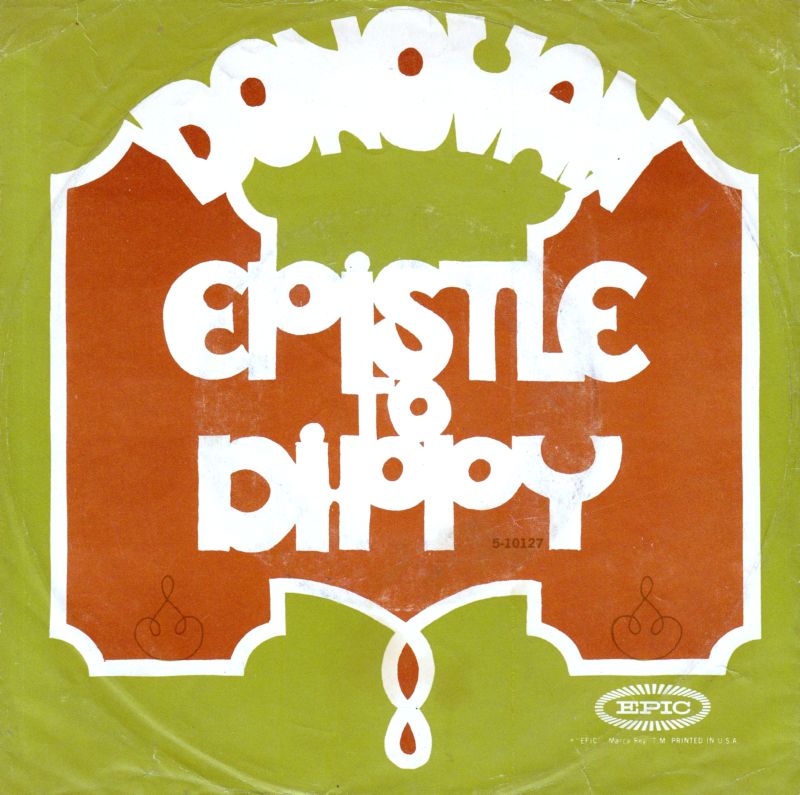
2: Epistle to Dippy (1967)
How to describe “Epistle to Dippy”?  Let’s just say it’s Donovan at his absolute acid rock pinnacle.  With a fabulous tune and delightfully nonsensical lyrics, this is British psychedelia 101.  Did I mention that’s Jimmy Page on guitar, making his second appearance on a Donovan record? This non-album track was issued as a US single in February 1967 and later appeared as a bonus track on the Mellow Yellow album. 


1: Hurdy Gurdy Man (1968)
With so many classics to choose from, picking Donovan’s best track was never going to be an easy task, but after much deliberation I’m opting for this one.  Written alongside the Beatles in India during their 1968 visit to study Transcendental Meditation under the Maharishi, “Hurdy Gurdy Man” is a 3-minute psych masterpiece and one of the most original pop singles of the 60s.

It combines elements of everything that made Donovan’s records so beguiling: psychedelic whimsy, eastern influences, otherworldly vocals and a killer guitar solo. Don originally wanted Hendrix to play on the record, but Jimi was unavailable and so was second choice Jimmy Page.  Eventually the task fell to session player and future Blue Mink guitarist Alan Parker who, under the circumstances (no pressure, then?), played an absolute blinder. Parker later played on records by David Bowie and T.Rex, plus many others.

George Harrison wrote a few lines for the song which didn't end up on the released version, and Donovan now sings the Quiet One’s 'lost verse' when he performs “Hurdy Gurdy Man” live.  It's hard to think of another record this side of the Beatles which taps into the 60s zeitgeist so comprehensively.
The song has been covered at least a dozen times by the likes of Butthole Surfers, Steve Hillage and even Neil from The Young Ones. But the version to look out for must surely be the 1970 recording by Eartha Kitt from her album Sentimental Eartha.


A Murmuration of Tired Starlings: Cream – Wheels of Fire (Super Deluxe Edition)

by Stuart Penney I must declare a vested interest here. There was a period when  Wheels of Fire  was my all-time favourite album. From Marti...