Showing posts with label George Harrison. Show all posts

Saturday, 21 January 2023

In Praise Of Strawberry Fields Forever

Nothing To Get Hung About - The Day My Beatles Single Almost Caused A Riot

"The Beatles are turning awfully 'funny', aren't they?" - HRH Queen Elizabeth II to EMI chairman Sir Joseph Lockwood, October 1967.

“Strawberry Fields Forever” will be 56 years old in February of 2023.  As we approach the Emerald (+ 1) anniversary of the Beatles’ landmark 14th UK single Stuart Penney remembers buying the record on the day of release and the unexpectedly hostile reception it received from some of his peers.

I heard “Strawberry Fields Forever” on the radio today.  It came up on one of those set-and-forget oldies stations and, as always, I stopped what I was doing and listened to all 4 minutes and 7 seconds of it from start to finish.  To encounter this most weirdly magnificent Beatles’ track in such a place came as something of a surprise, I don’t mind admitting.  It’s one of those songs I never grow tired of hearing, and yet it seemed somehow inappropriate to find it rubbing shoulders with prosaic “classic rock” staples by the likes of Billy Joel, Meat Loaf and Buckingham-Nicks era Fleetwood Mac.  


They often play Beatles’ records on the radio station in question, of course they do, but rarely does “Strawberry Fields” get an airing.  Even now, over half a century after it was released, it’s a record that demands the listener’s attention from the very first note.  56 years later it still sounds weird, otherworldly and unsettling, yet infuriatingly catchy at the same time.  It’s quite unlike anything else that made it to the top of the charts at that time.  And before you pedants jump in, I’m fully aware that “SFF” was cruelly kept off the UK number one spot by Engelbert Humperdinck’s sappy “Release Me,” thus interrupting the Fabs’ unparalleled run of 11 straight chart toppers.  But that little nugget of trivia only adds to the mystique.  It may make for a great pub quiz factoid, but after this slight blip the Beatles went on to effortlessly score six more UK number ones as if nothing had happened. 


But if “Strawberry Fields” with Paul’s wonky Mellotron intro (played on the “flute” setting, fact fans), John's heavily processed vocals and George Martin's dreamlike string and brass arrangement still seems eerie and captivating now, imagine what it sounded like in February 1967 when it first arrived.  We tend to think of the song as emblematic of the psychedelic era but together with its equally wonderful joint A-side “Penny Lane,” recording actually began in late 1966, making it one of the earliest records of its kind.  As with almost everything else they turned their hands to, the Beatles got there first.


As any fan worthy of the name will tell you, “Strawberry Fields” and “Penny Lane” were the first two songs recorded during the Sgt. Pepper's Lonely Hearts Club Band album sessions.  It had been six months since their last single "Yellow Submarine"/"Eleanor Rigby" and in an era when four singles and two LPs a year (plus maybe a couple of EPs as well) was the norm, the Fab Four were starting to look like slackers.  Also, it was the first time since 1963 they hadn’t had the number one Christmas single (Tom Jones claimed it in 1966 with “Green, Green Grass Of Home”).  So, because the album was taking longer than usual to complete, the two songs already in the can were rushed out as a single to keep the public happy.  

There’s something typically British about that.  Two of the finest pop songs of the sixties were hurriedly put out together on the same single, meaning that one of them was, in purely commercial terms at least, effectively wasted.  Until the Beatles came along to turn them into an art form, B-sides were not considered terribly important.  They were traditionally makeweight, disposable songs, often written by the artist (or someone close to them, such as their producer) in order to secure a share of the composer royalties via the back door (the writer of the B-side received the same royalty rate as the A-side composer).  


They could quite easily have made two singles out of “Strawberry Fields” and “Penny Lane” with a couple of existing LP tracks as B-sides and both would have been equally huge hits.  But the Beatles didn’t work like that.  They didn’t care to make people pay twice for the same songs so, in Britain at least, their singles generally comprised brand new songs and not recycled album tracks, as routinely happened in America.  This egalitarian approach meant that those two magnificent songs ended up together as possibly the greatest double-sided pop 45 of all time.  As the Ferrero Rocher advert once famously said “Ambassador, you are really spoiling us.” 


News of the single first appeared in Melody Maker on January 14, 1967, barely two weeks after recording was completed.  In a short news item on page one under the headline “Beatles Record” it read (using strangely mangled tense) The Beatles had recorded several tracks of their new LP at EMI’s Abbey Road Studios in London by the end of last week.  Brian Epstein told the MM: “Any track could be the next single, but it won’t necessarily come from the LP.  The third track would make a great single for anyone else, but the next Beatles single must be supreme.  The record might be released in February.  One rumoured title is “Strawberry Fields Forever.”  The story went on to cover news of a proposed Beatles TV spectacular and a one million dollar offer by American promoter Sid Bernstein for the group to play two shows at Shea Stadium. 


It’s not clear what song Epstein was referring to when he said “the third track” but, according to Mark Lewisohn’s book The Complete Beatles Recording Sessions (Hamlyn 1988), “When I’m Sixty-Four” was recorded concurrently with “Strawberry Fields” and “Penny Lane” during December 1966, so it could have been this. 

On January 28 the Melody Maker front page headline announced, in giant 54-point typeface, New Beatles Record – You Can Buy It On Feb. 17.  The story went on: The Beatles new single is “Strawberry Fields Forever” – as exclusively named in the MM two weeks ago.  The other side (there is no A or B side) is “Penny Lane.”  The Single will be released on February 17.  Both are Lennon-McCartney compositions.  

The first 250,000 copies of the single will be sold in a colour presentation sleeve specially prepared by EMI.  This is the first Beatles single since “Eleanor Rigby” and “Yellow Submarine” was released on August 5 last year. 

Just the first quarter million copies came in a picture sleeve, then?  In this age of downloads and streaming, 250,000 physical copies of any record is an undreamed-of amount, but such were the Beatles’ sales figures in 1967 when each new release filled warehouses across Britain.  And after the picture cover copies were sold out, the record probably went on to sell a similar amount in a generic Parlophone company sleeve.

With scant regard for factual accuracy, plus a certain amount of guesswork, the story continued “Strawberry Fields Forever” is about a Liverpool reform school for girls.  “Penny Lane” is the name of a road in the northern part of Liverpool – near the areas where John Lennon, Paul McCartney and George Harrison lived.  

“Strawberry Fields Forever” is very much a John Lennon composition.  It has none of the lyrical McCartneys [sic] qualities.  It’s a medium tempo number and doesn’t tell a connected story in the way that “Eleanor Rigby” does.  The words are rather bleak.

The group are continuing to work on their next LP and may do a TV spectacular based on the tracks on the album when it is released.  No release date has been set.


In reality Strawberry Field (there is no "s" at the end) was a Gothic Revival style mansion set in extensive grounds just a few hundred yards from John Lennon’s childhood home "Mendips" in Menlove Avenue, Woolton.  Built circa 1870 as a private residence, it was acquired in 1934 by the Salvation Army and converted to an orphanage (for both boys and girls).  The house itself was demolished in 1973, after which the children’s home continued until 2005 in new buildings constructed within the grounds.  The original wrought iron gates at the entrance were stolen in 2000 and sold to an antiques dealer who later returned them after he realised where they had come from. Strawberry Field was opened to the public in September 2019.

On his death in 1980 Lennon left a donation in his will to the children’s home and a few years later Yoko Ono gifted £50,000 towards the upkeep of the orphanage.  As for Penny Lane, the street lies well to the southeast of Liverpool city centre, not the north as the Melody Maker story reported.  

I was in my second year at college in Chesterfield when “Strawberry Fields” was released on Friday, February 17, 1967.  As with virtually every Beatles single since “She Loves You” four years earlier, I bought the record on the day of release.  Whether by accident or design (I never discovered which) for several years during the 60s British 7” singles sold for six shillings and eight pence each (that’s 33p in new money).  It sounds like an odd amount today, but thanks to the idiosyncrasies of the pre-decimal monetary system, it meant you could get three 45s for exactly one pound, something that has always struck me as a wonderfully neat and symmetrical thing.  But I digress.  

I handed over my 6s/8d at Hudsons record shop in the Chesterfield Market Hall during my lunch break and hurriedly took the single (Parlophone R5570) back to the college common room where we had a standard issue Dansette mono record player.  

As Melody Maker had predicted, the record came in an attractive picture sleeve, which was most unusual for UK singles at that time.  Countries in mainland Europe had been issuing their 45s in picture covers for years, but this didn’t become standard practice in post-austerity Britain until the late 60s/early 70s.  One side of the sleeve showed the Beatles in their new psychedelic garb set within an elegant picture frame, while the other featured childhood photos of the four.  We’ve seen those pictures reproduced many times since in books and the like, but in early 1967 they were a revelation, especially the modern photo showing their brand-new image. 

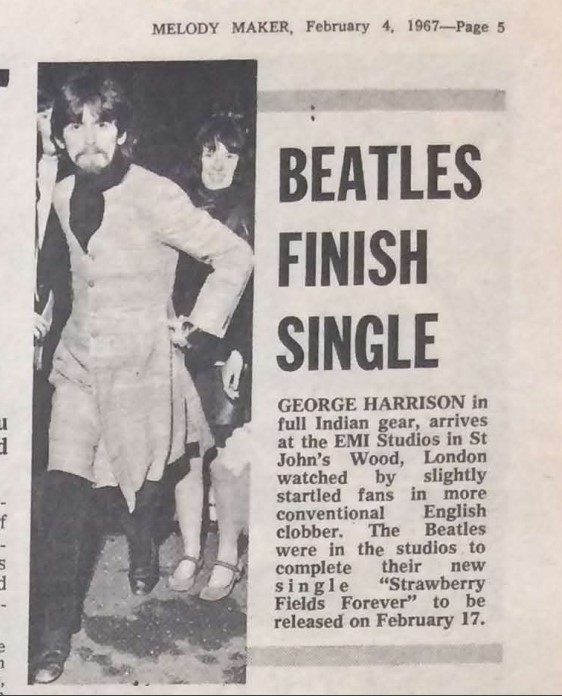
No longer the cuddly mop tops, all four now had moustaches and George was sporting a goatee beard.  John’s National Health wire spectacles were in evidence for the first time while George was wearing a long Nehru jacket of Indian design.  Paul and Ringo, meanwhile, simply looked cool in dark suits, double-breasted jackets and scarves or cravats. Spotlights were positioned alongside each band member and aimed directly at the camera.

The Dansette sat on the floor at the far end of the common room and a group of students gathered round in expectation as I placed the single on the turntable.  As “Strawberry Fields” began to play, we listened in silence, trying to make sense of this curious record.  Then, as it reached the end, we began to hear the first rumblings of dissent. 


Chesterfield College of Technology, as it was then called (it became simply Chesterfield College in 1984), housed a range of students.  Some, like me, were full-time scholars who fancied themselves as wannabe bohemian university types, but there was also an intake of part-time day-release students, many of whom came in from the nearby rural areas of Derbyshire a couple of days a week to study for apprenticeships in engineering, building work, animal husbandry and the like.  There was an uneasy dynamic between the two disparate groups and as Rudyard Kipling wrote in 1892, never the twain shall meet.  But on the rare occasions when they did cross paths, it sometimes ended badly.

It was one such red-faced farm boy who initially complained about the music.  Just as the strange backwards ending of “Strawberry Fields” began to drift back in, he came striding purposefully across the room and, elbowing his way through the gaggle of students around the Dansette he demanded, in his flat North Derbyshire vowels, “Turn that bloody rubbish off!”  Thus emboldened, some of his mates then joined in.  “I’ve never heard owt like it”, spluttered one, shaking his head.  Eventually one of the day-release boys reached down and unceremoniously ripped the tone arm from the record, causing a dreadful screeching sound as the stylus raked across the vinyl.  It’s the one sound every record buff has learned to fear above all others. 

From there the situation escalated into an unseemly slanging match with insults flying and both sides getting heated.  There was even some pushing and shoving amid the verbal abuse, but it thankfully never developed into real fisticuffs.  Just as well, really.  We were the ineffectual, long-haired students and they were, for the most part, brawny farm boys and factory workers.  Had violence eventuated, it would have been a one-sided contest, I fear.  We had by far the better vocabulary, though, and batted away their crude expletives with what we fondly imagined to be witty, Wildean rejoinders.

One of my college classmates at the time was none other than John Tams, soon to become properly famous in the world of folk music and acting.  He recorded with the Albion Band in the late 70s and appeared in the 90s TV series Sharpe where he played rifleman Daniel Hagman alongside Sean Bean as the eponymous star of the show.  It was Tams who introduced me to acoustic folk music and blues with records by Bert Jansch, John Renbourn, Tom Paxton, Lightnin' Hopkins, Sonny Terry & Brownie McGhee and others.  In May 1966, together with some other student friends, Tams and I went to see Bob Dylan at the Gaumont cinema in Sheffield.  I wrote about that momentous day here: LINK

Always the level-headed one, it was John Tams who eventually calmed things down that February lunchtime, and both sides drifted away amid muttered threats and insults.  But the fact that a humble pop record (albeit an extraordinarily good one) could provoke such intense feelings and conflicting emotions among what were, after all, a bunch of teenagers seems quite astonishing today.  It really was a textbook case of two very different worlds colliding.

Every new Beatles’ single was a huge deal, of course, but “Strawberry Fields” was a massive leap forward even for them.  They had been re-writing the pop music rule book with each new release since 1963 and this record took things to levels undreamed-of, setting the scene for the Sgt Pepper album which arrived a few months later in May 1967.  If they weren’t already unassailable, from this point on they had surely staked their claim for music immortality.

As for me, I was left feeling disgruntled with bruised pride and a nasty scratch across my brand-new copy of “Strawberry Fields.”  It was years before I managed to replace it with another and the clicks and pops on the original forever reminded me of that memorable ruckus in the student common room at Chesterfield College of Technology. 

Hudson's record store sadly closed its doors in 2012 after trading in Chesterfield for an incredible 105 years. I'm told it was the oldest family run record store in the world.


Seven Interesting Facts About Strawberry Fields Forever

  1. Recording began on November 24, 1966 and was completed on December 29.  The finished version stitched together two different recordings of the song (takes 7 and 26), one slowed down and the other speeded up, so they exactly matched each other in pitch and tempo.  Take a bow George Martin.  The edit comes at exactly 60 seconds into the released single after the line “Let me take you down ‘cause I’m going to…”  Spot it if you can. 

  2. In February 1967 “Strawberry Fields Forever”/ “Penny Lane” peaked at #2 in the UK singles chart but barely made the top ten in America.  It reached number one in Australia and several countries across Europe, however.

  3. Although “Strawberry Fields Forever” and “Penny Lane” weren’t heard in the Magical Mystery Tour film, their first appearance on album came when both were included on the US version of the MMT LP released at the end of November 1967.   

  4. On January 30 and 31, 1967 the Beatles shot a promo film clip for “Strawberry Fields Forever” at Knole Park in Sevenoaks, Kent.  A week later they filmed part of the promo for “Penny Lane” at the same location.  

  5. In March 1976 “Strawberry Fields Forever”/ “Penny Lane” re-entered the UK singles chart, reaching #32 as part of EMI’s Beatles reissue programme. Then, between 1982-1990 all 22 of the Beatles’ UK singles were reissued once again on the 20th anniversary of their original release.  “Strawberry Fields Forever”/ “Penny Lane” reached #65 in February 1987.  All their UK Parlophone and Apple singles were also made available as 7” picture discs during this time.  

  6. In the backwards coda section of the record, John is heard to say "cranberry sauce." In America this was misheard as "I buried Paul" providing an early so-called "clue" in the risible "Paul is dead" rumour of 1967.

  7. Many unreleased versions and remixes of “SFF”, from John’s home demo to the finished released version and all points in between, have appeared on the Beatles’ albums Anthology 2 (1996), Love (2007) and Sgt Pepper’s Lonely Hearts Club Band 50th Anniversary Box Set (2017).

    Hudsons record shop, Chesterfield, pictured circa 1969

Thursday, 9 April 2020

Donovan - His 50 Greatest Songs – Ranked


by Stuart Penney
We’re living in extraordinary and uncertain times.  2020 will probably be the most momentous year any of us will experience in our lifetimes.  So, whether you’re in voluntary self-isolation or total lockdown, what better way to occupy that enforced leisure time than to explore some of the most captivating and original pop music from the second half of the 1960s.  Here for your delectation is a roundup of what I consider to be the top 50 Donovan songs (plus half a dozen extras I simply couldn’t leave out) in order of importance, not to say greatness. It’s a dirty job, but someone had to do it.  Please feel free to disagree.
Bubbling Under:
56: Lord of the Dance (1971)
Written in 1967 by poet Sydney Carter and set to the tune of Joseph Brackett’s 1848 American Shaker song “Simple Gifts”, “Lord of the Dance” is a singalong highlight on HMS Donovan
55: The Fat Angel (1966)
Conceived at Shawn Phillips’ Marble Arch flat and written for Mama Cass Elliot, the lyrics reference a certain recently formed San Francisco group, with the line “Fly Jefferson Airplane”.  Two years later Grace Slick’s band recorded their own version of “The Fat Angel” on the 1968 live album Bless Its Pointed Little Head.  Body shaming was an alien concept in the 60s and, however well-meaning, I suspect “The Fat Angel” might have a different title if it were written today. Find it on the US version of Sunshine Superman.
54: Please Don’t Bend (1996)
The 1996 Rick Rubin-produced Sutras was Donovan’s first album of new material in over a decade.  It was released on Rubin’s own American Recordings label with the idea of introducing Don to a new generation of fans. Sutras failed to sell, but tracks such as “Please Don’t Bend” (on which Donovan was re-united with Danny Thompson) were well received and helped re-establish him as a current artist releasing new material.


53: The Heights of Alma (1980)
Donovan plays a cittern / octave mandolin on this rousing Crimean War song from the Neutronica album.  Following a run of slow sellers in the late 70s Don’s stocks were low and the LP was initially released only in Germany, France, Italy and Australia.
52: Voyage into the Golden Screen (1967)
A deceptively simple song from For Little Ones, which is the acoustic half of A Gift To A Flower To A Garden box set (the two AGFAFTAG albums were also released separately in the US and other territories).  Double tracked Jansch-style acoustic guitar and some of Donovan’s most florid lyrics make this track irresistible.  
51: Breezes of Patchulie (1966)
Perhaps because of its resemblance to “Celeste” this charming outtake from 1966 remained unreleased until the Troubadour box set in 1992.  It was later added to the Sunshine Superman CD as a bonus track.  In 2014 the song gave its name to the four CD set Breezes of Patchouli – His Studio Recordings 1966–1969.  A very early prototype version titled “Darkness of My Mind” appeared on the album Sixty-Four, released in 2004.  The spelling presumably should be Patchouli rather than Patchulie, but both variations have been seen on CD booklets over the years.


The Top 50:
50: Song Of The Wandering Aengus (1971)
With words by W.B. Yeats (1865-1939) from his 1899 poetry collection Wind Among The Reeds this piece is especially remembered for its evocative final two lines: "The silver apples of the moon / The golden apples of the sun" which have been used many times elsewhere.  Donovan wrote the tune and delivers a captivating solo acoustic performance on the HMS Donovan album. 
49: Summer Day Reflection Song (1965)
The style was still acoustic folk, but the lyrics were veering toward Ginsberg-style beat poetry: “Marionette dangles death / Insensitivity is fed / By the TV wizard's wand / Whilst in the spell you're conned”.  Don plays some adept finger picking while Shawn Phillips adds 12-string guitar fills to this Fairytale track.  In 2000 the 36-track double CD Summer Day Reflection Songs collected every track Donovan recorded for the Pye label during 1965.


48: I Like You (1973)
This highly personal Cosmic Wheels track was the last Donovan single to trouble the charts anywhere in the world, creeping into the top 60 in the US and Australia.  It’s a fine song though, featuring Cozy Powell (drums), Clive Chaman (bass) and Chris Spedding (guitar).


47: Ferris Wheel (1966)
Featuring no chorus or middle eight, this hypnotic Sunshine Superman song uses just two chords throughout.  Driven by Shawn Phillips on sitar, it bears a passing resemblance to the verse of Manfred Mann’s “Pretty Flamingo”, also from 1966.  Apparently based on a true story about a girl who really did catch her hair in a Ferris wheel.
Ever wonder why Ferris wheels are so named? Wonder no longer. Civil engineer George Washington Gale Ferris Jr designed and built a giant rotating wheel of 70.4m (230ft) for Chicago's celebratory World's Columbian Exposition planned for 1893. It was then the biggest wheel of its kind in the world and future structures adopted the Ferris name.


46: Museum (1967)
Was there ever a better chat-up line than “Meet me under the whale in the Natural History Museum”?  This poptastic song from the Mellow Yellow album was covered three times in 1967 by Herman’s Hermits (another Mickie Most act), Beverley (Kutner/Martyn) and Noel Harrison respectively.


45: Peregrine (1968)
Dedicated to George Harrison and taking its cue from the likes of “Blue Jay Way” and “Within You, Without You”, this song has a strong eastern flavour.  It’s driven by a harmonium drone plus bowed double bass and bongos. Find it on the Hurdy Gurdy Man album.
44: Poor Cow (1968)
“Poor Cow” has a long and convoluted history.  Originally written as “Poor Love” for an aborted Lord of the Rings project, it was re-structured with slightly different lyrics for the soundtrack of the 1967 Ken Loach movie Poor Cow. The song was eventually released as the B-side of “Jennifer Juniper” in early 1968.  A live version recorded in November 1967 was included on the Donovan In Concert album, released in August 1968.


43: In an Old-Fashioned Picture Book (1971)
Epic records declined to release HMS Donovan in America and so it was issued only in the UK on the Dawn label, Pye’s progressive rock imprint.  Presumably Epic reasoned that an acoustic double album of children’s songs and nursery rhymes wasn’t exactly destined for the top of the charts.  It was their loss, however, because HMS Donovan is a thoroughly charming record with much to recommend it.  The delightful cover painting was by John “Patrick” Byrne, who also designed sleeves for fellow Scots the Humblebums, Stealers Wheel and Gerry Rafferty.  ”Patrick” even submitted a design for the Beatles’ “White Album” which was held over until 1980 when it was used instead for The Beatles Ballads compilation.  “In An Old Fashioned Picture Book” is a typically whimsical Donovan acoustic song from the period with a great tune and some lovely acoustic guitar work. 
42: Preachin’ Love (1966)
In which our man channels Georgie Fame via a John Cameron big band jazz arrangement.  Originally the non-album UK B-side of “Mellow Yellow” and the US flip of “Epistle to Dippy”, “Preachin’ Love” was later added to the Mellow Yellow album as a bonus track.


41: Happiness Runs (1969)
Sure, it’s a cutesy children’s singalong, but that didn’t do “Yellow Submarine” any harm, did it?  “Happiness Runs” first appeared on the 1968 Donovan In Concert album where it was titled “Pebble and the Man”.  It was re-worked and re-named for Barabajagal a year later.  Performed as a canon, or round, whereby two different tunes are sung simultaneously, it features an all-star line-up of backing singers, including Graham Nash, Mike McCartney and Lesley Duncan.  “Happiness Runs” was covered by Mary Hopkin in 1969 and Bridget St. John (under the original title of “The Pebble and the Man”) in 1970.


40: Bert’s Blues (1966)
Donovan’s admiration for folk legend Bert Jansch runs deep.  In the early part of his career he recorded three Jansch covers and two self-penned tribute songs.  “Bert’s Blues” appeared on both the UK and US versions of Sunshine Superman and while John Cameron’s baroque style arrangement sounds nothing like anything Bert ever recorded, the results are a jazz/psych triumph. 
Marianne Faithfull covered the song (re-titled “Good Guy”) on her 1967 album Love In A Mist and Beverley (Martyn/Kutner) recorded it as Picking Up the Sunshine. Her version eventually appeared as a 2017 Record Store Day release.

39: Skip-a-Long Sam (1967)
Successfully blending jazz with acid folk, this A Gift From A Flower To A Garden track is a joy to behold.  With heavily treated multi layered vocals and some impressive guitar from Eric Leese, who seemingly changes chords with every beat, Wes Montgomery style, the song grooves (if not skips) along seductively.  A favourite of Nick Drake, apparently, it was covered by jazz legend Cleo Laine on her 1974 album A Beautiful Thing.
38: House of Jansch (1967)
Starting with some convincing Jansch-like solo acoustic guitar, this song gradually blossoms into a flute, sax and celeste (keyboard) extravaganza, courtesy of John Cameron.  The second of two Bert Jansch tributes written by Donovan (see also “Bert’s Blues"), “House of Jansch” appeared on the US Mellow Yellow album but remained unreleased in Britain until the CD era. 
The title refers to the house at 30 Somali Road, Cricklewood, London NW2 where Bert shared an upstairs flat with fellow folk guitar legend John Renbourn in the mid-60s (the Young Tradition folk group lived on the ground floor).  It was quite literally the House of Jansch. Donovan has hinted that the song references the love triangle between himself, Beverley (Martyn/Kutner) and Bert Jansch.
The House of Jansch itself – 30 Somali Road, Cricklewood

37: Universal Soldier (1965)
This famous Buffy Sainte-Marie anti-war protest song was the title track of Donovan’s first EP which reached #5 in the UK singles chart.  In the US it was added to the Fairytale album, replacing the Bert Jansch cover “Oh Deed I Do”.  There was a rumour in the 90s that Buffy had sold Donovan the rights to “Universal Soldier” but it was never confirmed.


36: Sand and Foam (1967)
Due to ongoing legal wrangles with his UK management, producer and record label, four of Donovan’s US 60s albums were not released in Britain until the CD era.  Seven tracks from the US Sunshine Superman album and five from Mellow Yellow appeared as a catch-up compilation in mid-1967 with a new sleeve design but also titled Sunshine Superman.  So, “Sand and Foam” appears on the UK version of Sunshine Superman, but on the US Mellow Yellow album.  Confused?  Written following a trip to Mexico with Gypsy Dave, this solo acoustic song also appears on the B-side of “There Is A Mountain.”


35: Celtic Rock (1970)
Open Road was Donovan’s back-to-basics album, his Let It Be, if you will.  Gone was Mickie Most and with him went the elaborate productions of the 60s, replaced with a simple 70s rock sound featuring only guitar, bass, drums and piano.  Pye records in Britain clearly weren’t expecting much in the way of sales from Open Road and Donovan was shunted sideways onto their new progressive offshoot Dawn for his last two records on the label.  As it turned out, Open Road stalled at #30 in the UK, but did rather better in America, making the top 20.  The tune of this Tolkienesque tale of heroes and trolls was recycled a year later for “Jabberwocky” on the HMS Donovan album.


34: Celeste (1966)
“Majestic” is the only way to describe the closing track on the US Sunshine Superman album.  It rolls along on a wave of stately church organ with added harpsichord and sitar.  Like so many Donovan songs from this period it has an unforgettable melody, too. Covered by the “San Francisco (Be Sure To Wear Some Flowers In Your Hair)” hitmaker Scott McKenzie on his 1967 debut album and erstwhile Manfred Mann singer Paul Jones on Come Into My Music Box in 1969.


33: Coulter’s Candy (1971)

This lively Scottish children’s song opens side two of HMS Donovan.  Written by Robert Coltart (1832 - 1880), “Coulter’s Candy” started life as an advertising jingle for the aniseed-flavoured confectionery he manufactured in Melrose and sold around the markets of the Scottish Border towns.  In 2019 a statue of Coltart was erected in his hometown of Galashiels.


32: Yellow Star (1973)
For Essence to Essence Mickie Most was replaced by Andrew Loog Oldham as co-producer with Donovan.  It seemed an odd pairing, but the material was strong and the results were encouraging.  “Yellow Star” has a novelty reggae feel, great lyrics and a stellar line-up of musicians. Henry McCullough and Denny Seiwell (both had recently quit Paul McCartney’s Wings), Jim Gordon (late of Derek & the Dominos) and Alan Spenner (Grease Band and Kokomo) all play on the song.


31: Turquoise (1965)
The third UK single didn’t fare nearly as well as the previous two, peaking at #30.  John Lennon clearly liked it, however, as it was one of the records on his personal jukebox which was auctioned in 1989.  The song was written for Joan Baez, who Donovan had met at the 1965 Newport Folk Festival and she recorded her own version of “Turquoise” on the 1967 album Joan.
30: The Entertaining of a Shy Little Girl (1968)
An enchanting track from the Hurdy Gurdy Man album.  With charming melodic simplicity, this song is almost worthy of “White Album” era Paul McCartney.


Melody Maker, November 1966
29: New Year’s Resovolution (1970)
Thought to be inspired by Paul McCartney (who apparently loaned a guitar for the sessions) the closing track on Open Road is one of those anthemic, rolling tunes Donovan did so well.  The title is a clever combination of “Resolution” and “Revolution”.  Too clever for some, it seems, as in later years most sources (CD covers, Spotify etc) renamed it, simply, “New Year’s Resolution”.  Covered by Helen Reddy on her 1971 self-titled album. 
28: Young Girl Blues (1967)
Another song which was split between the UK Sunshine Superman and the US Mellow Yellow albums.  Performed solo with gently strummed acoustic guitar overloaded to the point of distortion, the mundane bedsit narrative is cleverly presented from a woman’s viewpoint and was instantly covered by both Marianne Faithfull and Julie Felix, almost before Donovan’s own version had appeared.


27: Maria Magenta (1973)
With Donovan on 12-string guitar plus Cozy Powell on drums, Chris Spedding on bouzouki and Clive Chaman on bass “Maria Magenta” was the second single from Cosmic Wheels.  It failed to chart but works just fine as an album track.


26: Hampstead Incident (1967)
Based around an A minor chord with a shifting bass line of A-G-F#-F-E, as found in a million other songs (some of them by Led Zeppelin) “Hampstead Incident” features a gorgeous harpsichord and string arrangement from the always reliable John Cameron.  In what was becoming a pattern, Marianne Faithfull covered the song (re-titled “In The Night Time”) on her 1967 album Love In A Mist.  Fun fact: “The Everyman” referenced in the first line of the song is a north London cinema, still operating, in Heath Street, Hampstead.  
25: Cosmic Wheels (1973)
The title track from Donovan’s last LP to chart in the UK (#15) and his final collaboration with producer Mickie Most (until 1977, at least).  An impressive line-up of musicians was assembled for the album, including Chris Spedding, Cozy Powell, John “Rabbit” Bundrick and Clive Chaman.


24: Candy Man (1965)
The first two Donovan albums were recorded at Peer Music, a small studio located in the basement of Southern Music publishers at 8 Denmark Street in London’s West End.  In 1992 Southern Music became the last major publisher to move out of Tin Pan Alley amid the influx of guitar stores. “Candy Man” opens side two of Fairytale with a powerful acoustic performance and one of Don's best early vocal performances.


23: Sunny Goodge Street (1965)
With jazz guitar chords, brass arrangement, cello and the legendary Harold McNair on flute (his first appearance on a Donovan record?) this gentle Fairytale track was a giant leap forward from the early acoustic folk material.  The line “Violent hash smoker shook a chocolate machine” drew the attention of the notorious Sgt Norman Pilcher of the Drug Squad and in June 1966 Don was the first British rock star of note to be busted.  Covered by Judy Collins and Marianne Faithfull among others, it was the earliest of several Donovan songs to namecheck a London location.


22: Colours (1965)

Donovan’s simple but catchy second single reached #4 in Britain, but only #61 in the US.  He played the song in an open D tuning (D-A-D-F#-A-D) with a capo on the second fret, transposing it to the key of E major.  The single version featured harmonica, which is missing on the Fairytale recording.


21: Legend Of A Girl Child Linda (1966)
A stand-out track from Sunshine Superman, this almost seven-minute song is basically a succession of 18 identical verses with no choruses, middle eight or bridge.  The magic arrives via John Cameron’s quite amazing string and woodwind arrangement which grows verse by verse, turning the simple tune into an orchestral tour de force.   Written for Linda Lawrence, now Donovan’s wife of over 50 years, but in 1966 the girlfriend of Brian Jones.


20: Mellow Yellow (1967)
Sure, it’s a childlike novelty song and hippies everywhere took to smoking dried banana skins on the strength of it.  But it’s infuriatingly catchy and falls just the right side of twee.
The brass arrangement by John Paul Jones (who also plays bass) is legendary and you won’t find many kids’ songs featuring John McLaughlin on guitar, or with Paul McCartney contributing background party noises.  Inspired by a visit Don made to New Orleans and the music he heard there, this was another huge hit, reaching #2 in America and #8 in the UK. 
19: Writer in the Sun (1967)
In which the 20-year-old Donovan considers the possibility of early retirement during an enforced lay-off due to his 1966 contractual hassles.  Another masterful John Cameron arrangement, “Writer in the Sun” features flute (Harold McNair, natch), woodwind, harpsichord and the esteemed Danny Thompson on concert bass. From the US Mellow Yellow the UK Sunshine Superman albums.


18: Catch The Wind (1965)
Fresh from a three-week residency on Ready Steady Go! Donovan released his debut single in March 1965 (#4 UK, #24 US).  It was re-recorded within weeks for his first album What’s Bin Did and What’s Bin Hid and that’s the version to go for, minus the string section, but with added harmonica.  Brian “Licorice” Locking, who played with the Shadows in 1961/62, contributes upright bass.  Can you imagine a single like this making the top five today? No, me neither.


17: Sailing Homeward (1973) 

The closing track on Essence to Essence first appeared (as “Riding Homeward”) on the soundtrack of the 1972 David Putnam film The Pied Piper in which Donovan played the title role.  A beautifully constructed song with a melody to die for, “Sailing Homeward” also features Carole King on piano.


UK 7" single with the title misspelled

16: Riki Tiki Tavi (1970)
After inventing psychedelia and heavy rock, Donovan then moved on to create hip hop with this Open Road track.  Not really, but “Riki Tiki Tavi” does feature a thoroughly convincing proto-rap section, it must be said.  The song is loosely based around Rudyard Kipling’s Jungle Book character although in the original story the name of the mongoose was spelled Rikki-Tikki-Tavi.  A much longer 1969 recording, featuring only Donovan plus Harold McNair on flute, appeared on the 1992 career retrospective Troubadour. UK 7" singles misspelled the title as "Ricki Ticki Tavi" on the labels.


15: Hey Gyp (Dig The Slowness) (1965)
Although authorship is credited to Donovan, this rhythmic two chord acoustic rocker is probably based on Memphis Minnie and Kansas Joe McCoy’s 1930 recording of “Can I Do It For You” with the title changed in tribute to Don’s buddy Gypsy Dave.  Eric Burdon and the Animals quickly picked it up for their 1966 album Animalism. 
In 2001 a generic recording was used in a General Motors TV commercial using the opening line of the song “I’ll buy you a Chevrolet”.  As recently as 2019 Jack White recorded a version with the Raconteurs which captured much of the energy of Donovan’s original. 
14: The Trip (1966)
One of the pivotal songs in the shift from acoustic folk into the world of psychedelic rock.  Named after a Sunset Strip club, it starts by describing an LA acid trip and goes on to reference Don’s 1965 meeting with Bob Dylan and Joan Baez at London’s Savoy Hotel. This was the original B-side of the "Sunshine Superman" single.  
13: Sunny South Kensington (1967)
“Come take a walk in sunny South Kensington, any day of the week”.  No one wrote so vividly about London in the Summer of Love than Donovan.  The song also name-checks Cromwell Road, Portobello Road and Mary Quant, along with beat poet Allen Ginsberg and French actor Jean-Paul Belmondo.  This Mellow Yellow album track is another timeless pop/psych gem with harpsichord, sitar and a full rock band.

Kate Bush’s cover of Lord of the Reedy River with a tribute to Donovan in the runout grooves
12: Lord of the Reedy River (1971)
There can’t be many people keen enough to sit through a lightweight 100-minute feature film simply to watch a two-minute performance of an obscure song.  But that’s exactly what I did in early 1970. The location was the London Pavilion cinema in Piccadilly Circus (now part of the Trocadero Centre), the movie was If It’s Tuesday, This Must Be Belgium and the song was “Lord of the Reedy River”.  In superb close-up Donovan is seen playing the gentle ballad in a (supposed) Swiss youth hostel as a group of hip teenagers sit around smoking what we can only assume are jazz cigarettes.  The rest of this 1969 rom com is dated and forgettable, but that short clip is worth the price of admission alone. Find it on YouTube.
  
Originally demoed for the Barabajagal album in 1969, “Lord of the Reedy River” turned up two years later on HMS Donovan.  This achingly beautiful tune was first released on record by Mary Hopkin on her 1969 Postcard album and later covered by Kate Bush as the B-side of her 1981 single “Sat In Your Lap”.  It was the first non-original song Kate recorded, and she added a "Thank You Donovan" message etched into the run-out groove of the record.


11: Laléna (1968)
Inspired by the actress Lotte Lenya and her character in the film version of The Threepenny Opera.  One of Donovan’s prettiest, most melodic songs, “Laléna” first appeared as a US non-album single in October 1968.  It was included on the album Donovan’s Greatest Hits in January 1969 and was added to the 2005 Hurdy Gurdy Man CD as a bonus track.  
The song has been covered several times, most notably by Deep Purple on their 1969 eponymous third album.


10: Celia of the Seals (1971)
Dedicated to animal rights activist and 60s model Celia Hammond (then Jeff Beck’s girlfriend), “Celia of the Seals” is undoubtedly the most commercial track on HMS Donovan.  Featuring just guitar/vocal with Danny Thompson creating some ethereal sounds on bowed concert bass (earning him a co-credit on the record label) this charming song failed to trouble the UK charts but made #84 in America. In 1986 the Celia Hammond Animal Trust was created with the aim of opening a low-cost neutering clinic to control the feral animal population in Britain.

9: There Is A Mountain (1967)
Few artists could conjure up a catchy tune from just one chord and a strong rhythm as well as Donovan and this is a textbook example.  Harold McNair’s flute accompaniment is the icing on the cake. Another strong chart showing, reaching #8 in the UK and #11 in America. 
“There Is A Mountain” has been covered several times, most famously by the Allman Brothers who turned it into the 30 minute “Mountain Jam” on their 1972 album Eat A Peach.


8: Jennifer Juniper (1968)
With harp, oboe, acoustic bass and the intrepid Harold McNair on flute, this irresistibly charming song from the Hurdy Gurdy Man album was a UK top five hit single in early 1968.  Written for Jenny Boyd, Pattie’s younger sister, who also travelled to India with Donovan and the Beatles.  Fun fact: Jenny later married and divorced Mick Fleetwood – twice.
7: Atlantis (1968)
Who doesn’t love a song with a spoken intro?  Over a gentle acoustic guitar and piano backing Donovan intones a two-minute history of the submerged kingdom before the song explodes into a repeated heavy rock coda in the style of “Hey Jude”.  Simple, but incredibly effective. “Atlantis” reached #7 in the US but stalled at #23 in Britain.


6: Sunshine Superman (Extended Version) (1966)
The first product of the highly successful collaboration with producer Mickie Most, this was Donovan’s biggest hit and is probably his best-known song.  It reached #1 in the US in mid-1966 and #2 in Britain toward the end of the same year. Recorded in December 1965, it could be argued that psychedelia started right here (can we name an earlier psych track?)  Jimmy Page and John Paul Jones, then working as session men, play on the record, with Eric Ford doing the volume swells guitar parts. An extended version with a longer guitar solo appeared on Donovan’s Greatest Hits album in 1969 and that’s the one to seek out.


5: Wear Your Love Like Heaven (1967)
A Gift From A Flower To A Garden was arguably pop’s first box set and the opening track is a psych pop masterpiece.  Delightfully surreal lyrics, wonderful arrangement and a great tune earns “Wear Your Love Like Heaven” a top five place.
  
4: Season of the Witch (1966)
A highlight of the none-more-psychedelic Sunshine Superman album, the languid A7 to D9 chord sequence (inspired by Bert Jansch) proved the perfect launchpad for improvisation.  This is possibly Donovan’s most covered song with recordings by Dr. John, Al Kooper & Stephen Stills, Julie Driscoll with Brian Auger & the Trinity, Vanilla Fudge and a dozen more.
Joe Boyd named his production company Witchseason after this song and the logo appeared on timeless records by Nick Drake, Fairport Convention, John Martyn and the Incredible String Band.

3: Barabajagal (1969)
In which our hero invents heavy metal.  It was all Mickie Most’s idea. As producer of both Donovan and Jeff Beck, Mickie came up with the unlikely notion of putting them together to see what would happen.  As it turned out, not much of value came from the sessions, other than this solitary track (and the B-side “Trudi”), but what a mighty song it was. Recorded in May 1969 at Olympic Studios in Barnes, South West London with the entire Beck-Ola era Jeff Beck Group, comprising Ron Wood, Nicky Hopkins and Tony Newman (Rod may even have contributed backing vocals), “Barabajagal” is a three-minute slab of funk rock genius.


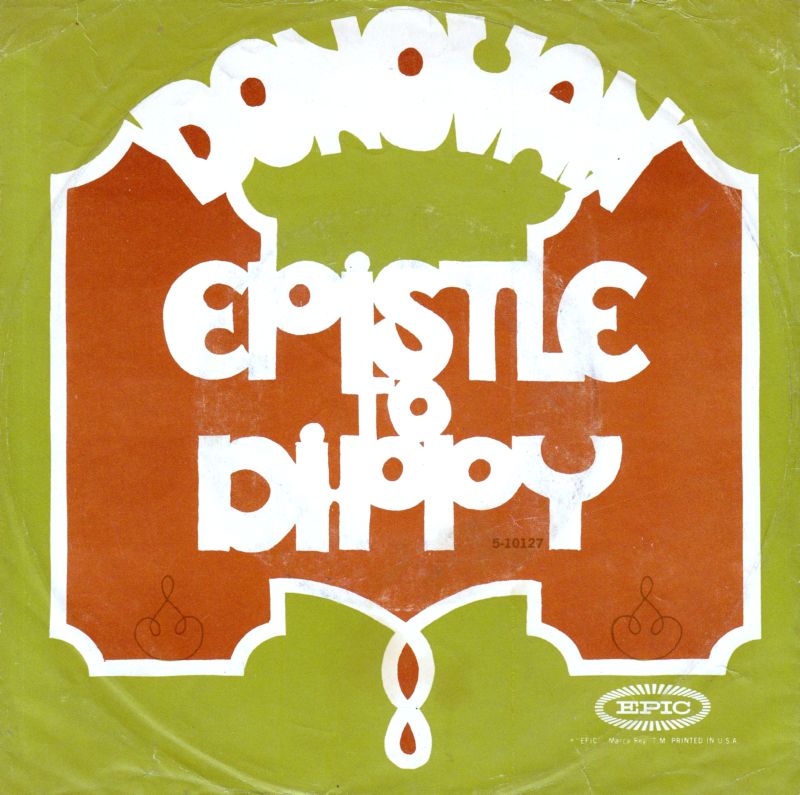
2: Epistle to Dippy (1967)
How to describe “Epistle to Dippy”?  Let’s just say it’s Donovan at his absolute acid rock pinnacle.  With a fabulous tune and delightfully nonsensical lyrics, this is British psychedelia 101.  Did I mention that’s Jimmy Page on guitar, making his second appearance on a Donovan record? This non-album track was issued as a US single in February 1967 and later appeared as a bonus track on the Mellow Yellow album. 


1: Hurdy Gurdy Man (1968)
With so many classics to choose from, picking Donovan’s best track was never going to be an easy task, but after much deliberation I’m opting for this one.  Written alongside the Beatles in India during their 1968 visit to study Transcendental Meditation under the Maharishi, “Hurdy Gurdy Man” is a 3-minute psych masterpiece and one of the most original pop singles of the 60s.

It combines elements of everything that made Donovan’s records so beguiling: psychedelic whimsy, eastern influences, otherworldly vocals and a killer guitar solo. Don originally wanted Hendrix to play on the record, but Jimi was unavailable and so was second choice Jimmy Page.  Eventually the task fell to session player and future Blue Mink guitarist Alan Parker who, under the circumstances (no pressure, then?), played an absolute blinder. Parker later played on records by David Bowie and T.Rex, plus many others.

George Harrison wrote a few lines for the song which didn't end up on the released version, and Donovan now sings the Quiet One’s 'lost verse' when he performs “Hurdy Gurdy Man” live.  It's hard to think of another record this side of the Beatles which taps into the 60s zeitgeist so comprehensively.
The song has been covered at least a dozen times by the likes of Butthole Surfers, Steve Hillage and even Neil from The Young Ones. But the version to look out for must surely be the 1970 recording by Eartha Kitt from her album Sentimental Eartha.


A Murmuration of Tired Starlings: Cream – Wheels of Fire (Super Deluxe Edition)

by Stuart Penney I must declare a vested interest here. There was a period when  Wheels of Fire  was my all-time favourite album. From Marti...