Showing posts with label Paul McCartney. Show all posts

Sunday, 16 July 2023

Paul McCartney Meets the Press Downunder


by Stuart Penney

30 years ago on March 4, 1993, I attended a Paul McCartney press conference in Perth, Western Australia.  It didn’t go entirely to plan.

There is, we are told, much to be said for being a big fish in a small pond.  Similarly, and stretching the metaphor to breaking point for the purposes of this story, even an ambitious minnow can sometimes get lucky in an isolated city such as Perth.  

Located way out on the west coast of Australia, Perth is said to be the most remote capital city on the planet.  It’s a spectacularly beautiful and relaxed place to live.  The skies are enormous, and the sun nearly always shines.  But it is also a mighty long way from anywhere else, something the locals can get a little touchy about if it’s mentioned too often.  

The facts are inescapable, however.  With a population of around two million, Perth sits a scarcely believable 2,693 km (1673 miles) from Adelaide, the closest city of comparable (or, indeed, of any) size.  To give some indication, that’s further than London to Moscow.  

There are pros and cons to this extreme isolation, naturally.  The tyranny of distance and the time difference between the east and west coasts mean that Perth had to create, by necessity, its own self-contained entertainment microcosm.  This was especially true before the internet brought instant communication and made the world a somewhat smaller place.  

At one time all the major record labels had offices in Perth and most of the national radio and TV stations still do.  Just about every international rock tour from Europe and the US invariably started or ended here.  It was (and still is) geographically expedient for them to do so.  The one notable exception being the Beatles, who skipped Perth completely during their sole Australian visit of 1964.

In the early 90s I freelanced for the street paper X-Press magazine.  Focussing on music, movies, the arts and entertainment, it was a kind of Perth “what’s on” freesheet - think of it as an inky version of London’s famous Time Out, if you will.  Given away at record stores, pubs, nightclubs, shopping malls and the like, its revenue came purely from advertising.  Every Australian state capital city had at least one such publication back then and the big population centres such as Sydney and Melbourne had two or three competing titles.

I was recruited as the X-Press heavy rock reviewer.  1991 was the year when grunge and thrash started to take off in a big way and the magazine urgently needed someone who could write about it.  This was not nearly as glamorous as it sounds.  I wasn’t exactly a heavy metal expert but since absolutely no one else at the mag wanted the job (in fact, most looked down their noses at the genre) I decided to give it a go.  How hard could it be, I reasoned.  

Before long I was interviewing big-name bands such as Metallica, Megadeth, Faith No More, Iron Maiden, Kiss and Def Leppard on a regular basis.  Along with the weekly album and live reviews I even had my own column titled, somewhat unimaginatively, “Full Metal Racket.”  There’s the Perth small pond syndrome at work in a nutshell.

The freelancers were paid a pittance, but by way of compensation we did get shedloads of free records and CDs plus tickets for almost every concert which came to town.  For a Perth music writer in the 90s life was good. 

Pre-release album previews and concert meet and greet events were also a big thing back then.  And just occasionally there were the press conferences.  So it was that in March 1993 I got a call from the local EMI office asking if I was interested in attending a Paul McCartney press conference scheduled to take place ahead of his first Australian tour in 18 years.  Was I interested?  I’d not enjoyed some of his recent albums around that time, it’s true (Press To Play and Off The Ground were particularly limp affairs) but this was Paul bloody McCartney, after all.  

After confirming that I was, indeed, interested I was instructed to report to a specific entrance at the concert venue, Subiaco Oval, an Australian Rules Football stadium the following afternoon.  

There I was ushered into a holding room along with a bunch of newspaper reporters, TV and radio presenters and a smattering of local media types.  I recognised a few of them from television, but we freelancers were a long way down the journalistic pecking order, so pleasantries were not exchanged.  

Since Perth was to be the first concert of the 10 date Australasian leg of McCartney’s 1993 The New World Tour, reporters from Sydney and Melbourne had also flown in to preview the show before it reached the all-important east coast cities.  These were Macca’s first Australian dates since the 1975 Wings Over the World Tour and media interest was running high. 

We were each handed a press pack consisting of a folder containing several 8 x 10 glossies of Paul, plus assorted biographical info and details about the tour itself. 

McCartney’s energetic publicist Geoff Baker then bounded into the room to deliver a pre-conference pep talk.  Fashionably unshaven with wire-rimmed glasses and wild hair, he resembled a hip geography teacher combined with perhaps a hint of Frank Zappa.  He was not at all what you might expect from the high-powered PR man of arguably the biggest rock star in the world.  

Baker briefed us on what was about to happen and exactly how the press conference would play out.  We were advised which topics to avoid during the Q&A section (these were mostly of the “will the surviving Beatles ever reform” type, although this directive was largely ignored by the mainstream newsmen) and told that Paul would sign autographs for us when it was all over.


Formerly the showbiz editor of the unashamedly downmarket UK red top tabloid Daily Star, Geoff Baker worked for McCartney for around 15 years, but it all ended badly in 2004 when he was sacked amid accusations that, in Paul’s words, “his work had failed to meet professional standards.”  

Baker had, in fact, previously been briefly dismissed and re-hired in 2003 after he tipped off journalists about Macca’s late-night visit to see illusionist David Blaine during his 44-day endurance stunt in a glass cage by the river Thames.  This resulted in an unseemly press scrum with some photographers claiming they were roughed-up by McCartney’s security team.  But it was when Paul’s second wife the abrasive Heather Mills entered the picture in 2002 that Baker’s position became untenable, and he was finally let go two years later.

After the briefing we trouped out to the football field where several rows of plastic chairs were arranged on the grass in front of a raised platform with a desk, upon which sat maybe 20 microphones.  This was to be an open-air press conference and there was a small PA system off to the side.  At this point Baker left us to wait under the unforgiving Western Australian sun for what seemed like an eternity.


Geoff Baker

Eventually, a top-of-the-line Ford LTD limousine (a stretched version of a Ford Falcon/Fairlane and probably the most prestigious Aussie-built car at that time) entered the field and parked on the grass a couple of hundred yards away from where we were sitting.  Paul and Linda got out and, shadowed by an enormous bodyguard built like a sumo wrestler, they walked to a roped-off area some distance from us where a gaggle of photographers was waiting. 

It was at this point I left my seat to take a closer look.  There was no way I was going to sit idly by while an actual Beatle was posing for photographs only yards away.  Significantly, I was the only one from the press enclosure to do so.  This would prove to be a miscalculation.

I made my way circuitously to the roped-off section and stood behind the photographers as they furiously snapped away.  It was bedlam with the newsmen jostling for position and calling out inanities like “This way Paul!” “One more!” and “Over here Linda!”  But the couple remained utterly unfazed throughout.  The thought occurred that McCartney had been living this fishbowl existence for 30 years, his entire adult life, in fact, so this was just another day at the office for him.  

Standing just a couple of feet away, I was struck by how tanned and attractive Linda looked in a blue floral dress and without a hint of make-up.  Her bare legs were heavily freckled, and she was the picture of health.  Sadly, within five years she would no longer be with us. 

The photo call completed, Paul’s entourage began to make its way to where the actual press conference was due to take place.  This was awkward.  I didn’t want to cut in front of them to re-take my seat, so I hung back, deciding to take the long way around and enter the area from the back.

At this point a heavily built man in a suit and carrying a walkie talkie who I assumed to be part of the stadium security stepped in front of me and stuck his arm out, blocking my path.  “Where do you think you’re going?” he barked aggressively.  “Er, back to my seat over there,” I said sheepishly, pointing in the general direction of the press conference area.  He became angry and not a little flustered at this, “You shouldn’t have been at the photo call in that case!” he spluttered.  

I don’t think he believed me at first, thinking I was just a chancer who had wandered in off the street.  Although that would have been extremely unlikely because as I noticed when arriving at the stadium earlier there was rigid security at every conceivable entrance.  I’d been asked to produce ID to gain access and my name was checked against a list. 

He was becoming more obnoxious by the second and at one point it seemed as if I was about to be ejected.  Eventually I produced my X-Press laminate and he finally seemed satisfied, albeit grudgingly, snapping “Hurry up and sit down, then, for God’s sake!”  I did as I was told and scrambled back to my seat just as Paul reached the platform and the press conference began.

I suppose it lasted around 30 minutes with questions ranging from the mundane (“What can fans expect from this tour?”) to the parochial (“How does it feel to be back in Australia?”) via the inevitable (“Do you have any plans to work with George and Ringo again?”).  

Serious questions were asked about drugs (Paul said while he was against the hard stuff, he was in favour of decriminalising marijuana); the hole in the ozone layer (a huge topic at the time) and animal rights, including laboratory experiments on monkeys.  The Royal Family and the Charles and Diana phone scandal were also discussed.  The so-called “Camillagate” and “Squidgygate” tapes had just been released by the media to huge public interest.  “Do you believe those tapes?” he said in bemused amazement. 

Paul was his usual upbeat, matey self throughout, offering friendly, non-controversial answers to even the most boring and unimaginative queries.  I was just happy to be there as an interested observer and didn’t raise my hand to pose a question.  If I had done so it probably would have been something painfully dull about guitars or similar. 


Finally, the press conference was over and Geoff Baker stepped up to announce that Paul would now sign autographs.  At this juncture all hell broke loose.  I was surprised to see hard-nosed TV newsmen and serious journalists in smart suits make a mad scramble towards the raised platform like crazed teenage Beatle fans.  They were literally elbowing each other out of the way and knocking over chairs in their haste to get a signature.  Items were roughly thrust at Paul from all directions, and he calmly and diligently began to sign them all.  He’d clearly experienced this a thousand times before. 

Not wishing to get caught up in the unseemly scrum, I decided to hang back and wait for the crush to thin out before offering up one of the 8 x 10 glossies to be signed (pictured here).  The signature was rushed (not surprising under the circumstances) and we didn’t make eye contact.  Polly, a friend and journalist colleague from X-Press had the foresight to take the colour photo insert of Paul from the Beatles’ “White Album” to get autographed and I cursed myself for not bringing something more imaginative.

After every last photo and scrap of paper had been signed, we were asked to wait in the enclosure while Paul and Linda, accompanied by the bodyguard, walked back to the limo and left the stadium.  And then it was all over.  

I should add at this point that I didn’t attend the McCartney concert on March 5.  It was one of those rare events where free tickets were in very short supply and X-Press was only allocated a couple which were immediately snapped up by others.  It seems crazy to say this now, but that run of poor McCartney albums from the late 80s/early 90s had dampened my enthusiasm somewhat.  I can offer no further excuses than that, m’lud.

Running for 78 shows in 19 countries and spanning five continents, The New World Tour kicked off in late February 1993 with concerts in Italy and Germany before ending in Chile, South America just before Christmas.  Along the way it took in Australasia, North America, Japan and most of Europe.  

The touring band consisted of Paul and Linda, Robbie McIntosh (guitar), Hamish Stuart (guitar, bass), Paul ‘Wix’ Wickens (keyboards) and Blair Cunningham (drums).  This was the line-up which had recently completed the album Off The Ground.  The tour was commemorated with the concert album Paul Is Live, released in November 1993.  Although mostly recorded in the US, it also featured three tracks from the March shows in Sydney. 

By coincidence, Bob Geldof was also in Perth in March 1993 doing a week-long stint as a DJ on the local radio station 96fm.  Geldof and McCartney had been mates since Live Aid in 1985 and Paul was invited on the show where they chatted on air between records.  

A journalist for the West Australian daily newspaper found himself in the centre of a media storm after filing a scathing review of the concert.  Veteran writer Ron Banks claimed the Perth show was a “limp squib” (perhaps he intended to write “damp squib”?) and that some fans had left the venue after an hour.  The review also got some of the song titles wrong.

It transpired that, to meet the deadline, Banks had dictated his copy mid-way through the concert using a primitive early mobile phone and, to add insult to injury, the sub-editors at his newspaper had mangled his words making the show seem even worse.  

Geoff Baker responded with a press release: “It is always the people, not the critics, who matter, and we were touched to hear of your concerns that we might be leaving Perth with a bad feeling (because of the blue meanie Ron Banks).

“Worry not - you have been nothing but kind to us since we arrived here, and we leave with your cheers in our hearts.”

The backlash from fans around the world proved so strong that Ron Banks was obliged to retract his original review and issue a clarification. 

Paul did not return to Perth until late 2017 with his One On One tour.  Subiaco Oval had closed since his last visit and this time he played the nib Stadium, a football (soccer) ground close to the city centre.  We live in the era of ground sponsorship and this stadium has had no few than six different names in recent years.  At the time of writing, it goes under the name HBF Park.

It wasn’t the end of McCartney’s link with the suburb of Subiaco, however.  On November 30, 2017, he performed an intimate rehearsal concert and Q&A session in front of 20 selected fans at the historic Regal Theatre.  Opened in 1938 the art deco venue has a seating capacity of just over 1,000.

Set List, Subiaco Oval, March 5, 1993

1. Drive My Car

2. Coming Up

3. Get Out Of My Way

4. Another Day

5. All My Loving

6. Let Me Roll It

7. Peace In The Neighbourhood

8. Off The Ground

9. I Wanna Be Your Man

10. Robbie's Bit

11. Good Rockin' Tonight

12. We Can Work It Out

13. And I Love Her

14. Every Night

15. Hope Of Deliverance

16. Michelle

17. Biker Like An Icon

18. Here, There And Everywhere

19. Yesterday

20. My Love

21. Lady Madonna

22. Live And Let Die

23. Let It Be

24. Magical Mystery Tour

25. The Long And Winding Road

26. C'Mon People

27. Paperback Writer

28. Fixing A Hole

29. Penny Lane

30. Sgt. Pepper's Lonely Hearts Club Band

Encore

31. Band On The Run

32. I Saw Her Standing There

33. O Sole Mio (snippet)

34. Hey Jude


Stop Press:
In August 2023 it was announced that McCartney's Got Back tour would play six dates in Australia during October/November.  Sadly, no Perth dates were scheduled this time.

Saturday, 21 January 2023

In Praise Of Strawberry Fields Forever

Nothing To Get Hung About - The Day My Beatles Single Almost Caused A Riot

"The Beatles are turning awfully 'funny', aren't they?" - HRH Queen Elizabeth II to EMI chairman Sir Joseph Lockwood, October 1967.

“Strawberry Fields Forever” will be 56 years old in February of 2023.  As we approach the Emerald (+ 1) anniversary of the Beatles’ landmark 14th UK single Stuart Penney remembers buying the record on the day of release and the unexpectedly hostile reception it received from some of his peers.


I heard “Strawberry Fields Forever” on the radio today.  It came up on one of those set-and-forget oldies stations and, as always, I stopped what I was doing and listened to all 4 minutes and 7 seconds of it from start to finish.  To encounter this most weirdly magnificent Beatles’ track in such a place came as something of a surprise, I don’t mind admitting.  It’s one of those songs I never grow tired of hearing, and yet it seemed somehow inappropriate to find it rubbing shoulders with prosaic “classic rock” staples by the likes of Billy Joel, Meat Loaf and Buckingham-Nicks era Fleetwood Mac.  


They often play Beatles’ records on the radio station in question, of course they do, but rarely does “Strawberry Fields” get an airing.  Even now, over half a century after it was released, it’s a record that demands the listener’s attention from the very first note.  56 years later it still sounds weird, otherworldly and unsettling, yet infuriatingly catchy at the same time.  It’s quite unlike anything else that made it to the top of the charts at that time.  And before you pedants jump in, I’m fully aware that “SFF” was cruelly kept off the UK number one spot by Engelbert Humperdinck’s sappy “Release Me,” thus interrupting the Fabs’ unparalleled run of 11 straight chart toppers.  But that little nugget of trivia only adds to the mystique.  It may make for a great pub quiz factoid, but after this slight blip the Beatles went on to effortlessly score six more UK number ones as if nothing had happened. 


But if “Strawberry Fields” with Paul’s wonky Mellotron intro (played on the “flute” setting, fact fans), John's heavily processed vocals and George Martin's dreamlike string and brass arrangement still seems eerie and captivating now, imagine what it sounded like in February 1967 when it first arrived.  We tend to think of the song as emblematic of the psychedelic era but together with its equally wonderful joint A-side “Penny Lane,” recording actually began in late 1966, making it one of the earliest records of its kind.  As with almost everything else they turned their hands to, the Beatles got there first.


As any fan worthy of the name will tell you, “Strawberry Fields” and “Penny Lane” were the first two songs recorded during the Sgt. Pepper's Lonely Hearts Club Band album sessions.  It had been six months since their last single "Yellow Submarine"/"Eleanor Rigby" and in an era when four singles and two LPs a year (plus maybe a couple of EPs as well) was the norm, the Fab Four were starting to look like slackers.  Also, it was the first time since 1963 they hadn’t had the number one Christmas single (Tom Jones claimed it in 1966 with “Green, Green Grass Of Home”).  So, because the album was taking longer than usual to complete, the two songs already in the can were rushed out as a single to keep the public happy.  

There’s something typically British about that.  Two of the finest pop songs of the sixties were hurriedly put out together on the same single, meaning that one of them was, in purely commercial terms at least, effectively wasted.  Until the Beatles came along to turn them into an art form, B-sides were not considered terribly important.  They were traditionally makeweight, disposable songs, often written by the artist (or someone close to them, such as their producer) in order to secure a share of the composer royalties via the back door (the writer of the B-side received the same royalty rate as the A-side composer).  


They could quite easily have made two singles out of “Strawberry Fields” and “Penny Lane” with a couple of existing LP tracks as B-sides and both would have been equally huge hits.  But the Beatles didn’t work like that.  They didn’t care to make people pay twice for the same songs so, in Britain at least, their singles generally comprised brand new songs and not recycled album tracks, as routinely happened in America.  This egalitarian approach meant that those two magnificent songs ended up together as possibly the greatest double-sided pop 45 of all time.  As the Ferrero Rocher advert once famously said “Ambassador, you are really spoiling us.” 


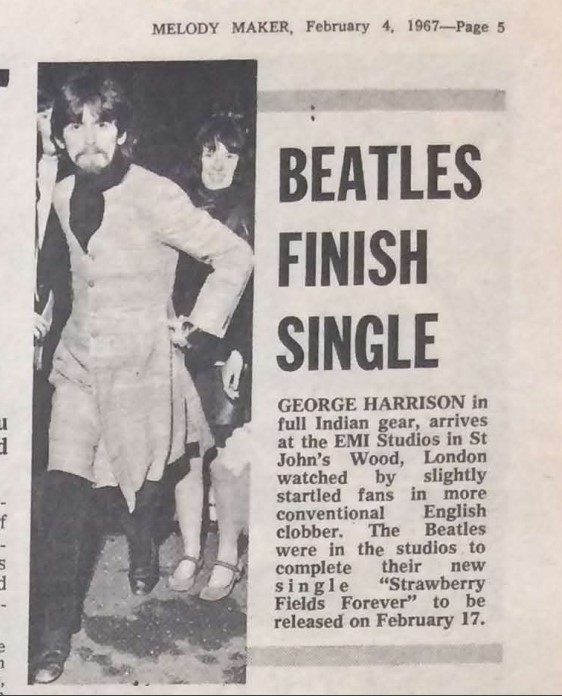
News of the single first appeared in Melody Maker on January 14, 1967, barely two weeks after recording was completed.  In a short news item on page one under the headline “Beatles Record” it read (using strangely mangled tense) The Beatles had recorded several tracks of their new LP at EMI’s Abbey Road Studios in London by the end of last week.  Brian Epstein told the MM: “Any track could be the next single, but it won’t necessarily come from the LP.  The third track would make a great single for anyone else, but the next Beatles single must be supreme.  The record might be released in February.  One rumoured title is “Strawberry Fields Forever.”  The story went on to cover news of a proposed Beatles TV spectacular and a one million dollar offer by American promoter Sid Bernstein for the group to play two shows at Shea Stadium. 


It’s not clear what song Epstein was referring to when he said “the third track” but, according to Mark Lewisohn’s book The Complete Beatles Recording Sessions (Hamlyn 1988), “When I’m Sixty-Four” was recorded concurrently with “Strawberry Fields” and “Penny Lane” during December 1966, so it could have been this. 

On January 28 the Melody Maker front page headline announced, in giant 54-point typeface, New Beatles Record – You Can Buy It On Feb. 17.  The story went on: The Beatles new single is “Strawberry Fields Forever” – as exclusively named in the MM two weeks ago.  The other side (there is no A or B side) is “Penny Lane.”  The Single will be released on February 17.  Both are Lennon-McCartney compositions.  

The first 250,000 copies of the single will be sold in a colour presentation sleeve specially prepared by EMI.  This is the first Beatles single since “Eleanor Rigby” and “Yellow Submarine” was released on August 5 last year. 

Just the first quarter million copies came in a picture sleeve, then?  In this age of downloads and streaming, 250,000 physical copies of any record is an undreamed-of amount, but such were the Beatles’ sales figures in 1967 when each new release filled warehouses across Britain.  And after the picture cover copies were sold out, the record probably went on to sell a similar amount in a generic Parlophone company sleeve.

With scant regard for factual accuracy, plus a certain amount of guesswork, the story continued “Strawberry Fields Forever” is about a Liverpool reform school for girls.  “Penny Lane” is the name of a road in the northern part of Liverpool – near the areas where John Lennon, Paul McCartney and George Harrison lived.  

“Strawberry Fields Forever” is very much a John Lennon composition.  It has none of the lyrical McCartneys [sic] qualities.  It’s a medium tempo number and doesn’t tell a connected story in the way that “Eleanor Rigby” does.  The words are rather bleak.

The group are continuing to work on their next LP and may do a TV spectacular based on the tracks on the album when it is released.  No release date has been set.


In reality Strawberry Field (there is no "s" at the end) was a Gothic Revival style mansion set in extensive grounds just a few hundred yards from John Lennon’s childhood home "Mendips" in Menlove Avenue, Woolton.  Built circa 1870 as a private residence, it was acquired in 1934 by the Salvation Army and converted to an orphanage (for both boys and girls).  The house itself was demolished in 1973, after which the children’s home continued until 2005 in new buildings constructed within the grounds.  The original wrought iron gates at the entrance were stolen in 2000 and sold to an antiques dealer who later returned them after he realised where they had come from. Strawberry Field was opened to the public in September 2019.

On his death in 1980 Lennon left a donation in his will to the children’s home and a few years later Yoko Ono gifted £50,000 towards the upkeep of the orphanage.  As for Penny Lane, the street lies well to the southeast of Liverpool city centre, not the north as the Melody Maker story reported.  

I was in my second year at college in Chesterfield when “Strawberry Fields” was released on Friday, February 17, 1967.  As with virtually every Beatles single since “She Loves You” four years earlier, I bought the record on the day of release.  Whether by accident or design (I never discovered which) for several years during the 60s British 7” singles sold for six shillings and eight pence each (that’s 33p in new money).  It sounds like an odd amount today, but thanks to the idiosyncrasies of the pre-decimal monetary system, it meant you could get three 45s for exactly one pound, something that has always struck me as a wonderfully neat and symmetrical thing.  But I digress.  

I handed over my 6s/8d at Hudsons record shop in the Chesterfield Market Hall during my lunch break and hurriedly took the single (Parlophone R5570) back to the college common room where we had a standard issue Dansette mono record player.  

As Melody Maker had predicted, the record came in an attractive picture sleeve, which was most unusual for UK singles at that time.  Countries in mainland Europe had been issuing their 45s in picture covers for years, but this didn’t become standard practice in post-austerity Britain until the late 60s/early 70s.  One side of the sleeve showed the Beatles in their new psychedelic garb set within an elegant picture frame, while the other featured childhood photos of the four.  We’ve seen those pictures reproduced many times since in books and the like, but in early 1967 they were a revelation, especially the modern photo showing their brand-new image. 

No longer the cuddly mop tops, all four now had moustaches and George was sporting a goatee beard.  John’s National Health wire spectacles were in evidence for the first time while George was wearing a long Nehru jacket of Indian design.  Paul and Ringo, meanwhile, simply looked cool in dark suits, double-breasted jackets and scarves or cravats. Spotlights were positioned alongside each band member and aimed directly at the camera.

The Dansette sat on the floor at the far end of the common room and a group of students gathered round in expectation as I placed the single on the turntable.  As “Strawberry Fields” began to play, we listened in silence, trying to make sense of this curious record.  Then, as it reached the end, we began to hear the first rumblings of dissent. 


Chesterfield College of Technology, as it was then called (it became simply Chesterfield College in 1984), housed a range of students.  Some, like me, were full-time scholars who fancied themselves as wannabe bohemian university types, but there was also an intake of part-time day-release students, many of whom came in from the nearby rural areas of Derbyshire a couple of days a week to study for apprenticeships in engineering, building work, animal husbandry and the like.  There was an uneasy dynamic between the two disparate groups and as Rudyard Kipling wrote in 1892, never the twain shall meet.  But on the rare occasions when they did cross paths, it sometimes ended badly.

It was one such red-faced farm boy who initially complained about the music.  Just as the strange backwards ending of “Strawberry Fields” began to drift back in, he came striding purposefully across the room and, elbowing his way through the gaggle of students around the Dansette he demanded, in his flat North Derbyshire vowels, “Turn that bloody rubbish off!”  Thus emboldened, some of his mates then joined in.  “I’ve never heard owt like it”, spluttered one, shaking his head.  Eventually one of the day-release boys reached down and unceremoniously ripped the tone arm from the record, causing a dreadful screeching sound as the stylus raked across the vinyl.  It’s the one sound every record buff has learned to fear above all others. 

From there the situation escalated into an unseemly slanging match with insults flying and both sides getting heated.  There was even some pushing and shoving amid the verbal abuse, but it thankfully never developed into real fisticuffs.  Just as well, really.  We were the ineffectual, long-haired students and they were, for the most part, brawny farm boys and factory workers.  Had violence eventuated, it would have been a one-sided contest, I fear.  We had by far the better vocabulary, though, and batted away their crude expletives with what we fondly imagined to be witty, Wildean rejoinders.

One of my college classmates at the time was none other than John Tams, soon to become properly famous in the world of folk music and acting.  He recorded with the Albion Band in the late 70s and appeared in the 90s TV series Sharpe where he played rifleman Daniel Hagman alongside Sean Bean as the eponymous star of the show.  It was Tams who introduced me to acoustic folk music and blues with records by Bert Jansch, John Renbourn, Tom Paxton, Lightnin' Hopkins, Sonny Terry & Brownie McGhee and others.  In May 1966, together with some other student friends, Tams and I went to see Bob Dylan at the Gaumont cinema in Sheffield.  I wrote about that momentous day here: LINK

Always the level-headed one, it was John Tams who eventually calmed things down that February lunchtime, and both sides drifted away amid muttered threats and insults.  But the fact that a humble pop record (albeit an extraordinarily good one) could provoke such intense feelings and conflicting emotions among what were, after all, a bunch of teenagers seems quite astonishing today.  It really was a textbook case of two very different worlds colliding.

Every new Beatles’ single was a huge deal, of course, but “Strawberry Fields” was a massive leap forward even for them.  They had been re-writing the pop music rule book with each new release since 1963 and this record took things to levels undreamed-of, setting the scene for the Sgt Pepper album which arrived a few months later in May 1967.  If they weren’t already unassailable, from this point on they had surely staked their claim for music immortality.

As for me, I was left feeling disgruntled with bruised pride and a nasty scratch across my brand-new copy of “Strawberry Fields.”  It was years before I managed to replace it with another and the clicks and pops on the original forever reminded me of that memorable ruckus in the student common room at Chesterfield College of Technology. 

Hudson's record store sadly closed its doors in 2012 after trading in Chesterfield for an incredible 105 years. I'm told it was the oldest family run record store in the world.


Seven Interesting Facts About Strawberry Fields Forever

  1. Recording began on November 24, 1966 and was completed on December 29.  The finished version stitched together two different recordings of the song (takes 7 and 26), one slowed down and the other speeded up, so they exactly matched each other in pitch and tempo.  Take a bow George Martin.  The edit comes at exactly 60 seconds into the released single after the line “Let me take you down ‘cause I’m going to…”  Spot it if you can. 

  2. In February 1967 “Strawberry Fields Forever”/ “Penny Lane” peaked at #2 in the UK singles chart but barely made the top ten in America.  It reached number one in Australia and several countries across Europe, however.

  3. Although “Strawberry Fields Forever” and “Penny Lane” weren’t heard in the Magical Mystery Tour film, their first appearance on album came when both were included on the US version of the MMT LP released at the end of November 1967.   

  4. On January 30 and 31, 1967 the Beatles shot a promo film clip for “Strawberry Fields Forever” at Knole Park in Sevenoaks, Kent.  A week later they filmed part of the promo for “Penny Lane” at the same location.  

  5. In March 1976 “Strawberry Fields Forever”/ “Penny Lane” re-entered the UK singles chart, reaching #32 as part of EMI’s Beatles reissue programme. Then, between 1982-1990 all 22 of the Beatles’ UK singles were reissued once again on the 20th anniversary of their original release.  “Strawberry Fields Forever”/ “Penny Lane” reached #65 in February 1987.  All their UK Parlophone and Apple singles were also made available as 7” picture discs during this time.  

  6. In the backwards coda section of the record, John is heard to say "cranberry sauce." In America this was misheard as "I buried Paul" providing an early so-called "clue" in the risible "Paul is dead" rumour of 1967.

  7. Many unreleased versions and remixes of “SFF”, from John’s home demo to the finished released version and all points in between, have appeared on the Beatles’ albums Anthology 2 (1996), Love (2007) and Sgt Pepper’s Lonely Hearts Club Band 50th Anniversary Box Set (2017).

    Hudsons record shop, Chesterfield, pictured circa 1969

A Murmuration of Tired Starlings: Cream – Wheels of Fire (Super Deluxe Edition)

by Stuart Penney I must declare a vested interest here. There was a period when  Wheels of Fire  was my all-time favourite album. From Marti...