Wednesday, 12 April 2023

Keith Reid – The Last Fandango


by Stuart Penney

So, farewell to wordsmith extraordinaire Keith Reid, who died on March 23 at the age of 76.  I encountered him only once, extremely fleetingly.  Shortly after I moved to London in the summer of 1967 my job as a messenger boy for a West End music publisher took me to Golden Square in Soho, not far from Regent Street.  On this particular day I was tasked with delivering a package (on foot, as usual) to the offices of one of the film companies located there.


As I crossed the square, I became aware of a stylish figure walking a few yards in front.  He had an impressive Hendrix-style halo of curls, a Carnaby Street military style jacket and, best of all, he was wearing an extremely desirable pair of red Cuban heel boots.  In 1967 those boots would have cost him close to £25, or the equivalent of three-week’s wages for the likes of me.  As Cuban heels were, ahem, inclined to do, the boots affected his gait somewhat, causing him to teeter slightly forward as he walked.  56 years later I can picture that image now as vividly as if it were yesterday.

He entered the office block slightly ahead and turned to hold open the door.  During this random act of courtesy, I saw his face for the first time and recognised the man in the wire granny glasses right away.  It was Keith Reid who had written the words to what was indisputably the biggest hit single of 1967, “A Whiter Shade of Pale.”


He asked for directions to whatever office he was visiting.  I can’t recall where I was headed, but it was on different floor to his destination.  So, I directed him to a board showing a list of businesses in the building and went on my way. 

As founder and non-performing member of Procol Harum, Reid wrote the lyrics for every one of their albums and singles from 1967 to 2003.  “A Whiter Shade of Pale,” their first and biggest hit, topped the UK charts for six weeks and reached number one in dozens of other countries around the world, eventually selling 10 million copies along the way, one of the few singles ever to achieve this figure.  Although not performing with Procol onstage, he was often pictured with them in the music press, making him instantly familiar to those of us who pored over such details.


But Reid didn’t confine his writing skills to Procol Harum.  He also penned lyrics for others.  In 1986 he co-wrote “You’re the Voice” for John Farnham, one of Australia’s most enduring pop stars.  The song appeared on Farnham’s album Whispering Jack which was a massive hit down under, achieving sales of 24 x platinum* and becoming the biggest selling Australian album of all time.  It also sold well in other parts of the world, particularly Scandinavia.  

*(In Australia an album qualifies for platinum certification if it exceeds 70,000 copies shipped to retailers.  So, 24 x platinum equates to 1,680,000 albums, or one record in approximately every five homes.  Not bad for a country of just 26 million people).


“You’re the Voice” was named 1987 Australian single of the year.  It topped the singles chart in Germany and reached the top ten in the UK and elsewhere.  

In an attempt to rally voters, the song has been used in TV adverts during Australian state and federal elections and during the COVID 19 pandemic “You’re the Voice” was played by anti-lockdown protesters in Melbourne and elsewhere.


Consequently, it was no surprise when, in an act of unabashed patriotism and/or blatant parochialism, virtually all the Australian newspaper obituaries I saw of Reid featured headlines such as “You’re the Voice Songwriter Dies” and covered the John Farnham connection in great depth before mentioning “A Whiter Shade Of Pale” almost as an afterthought. 


Friday, 7 April 2023

Syd Barrett - A Madcap Mystery Solved


by Stuart Penney

In late 1969 photographer Mick Rock visited Syd Barrett at his flat in Wetherby Mansions, Earls Court to take pictures for the cover of Syd’s first solo album The Madcap Laughs.  Those images are among the most powerful rock photos of the era and many ended up in the hugely collectible (and now very expensive) book Psychedelic Renegades (Plexus Publishing 2007).  

(Ed. Note: Mick Rock has said the photo session took place in Autumn 1969, while other sources claim it happened much earlier in the year. We assume Mick's date is correct).


Due to his “erratic behaviour” Barrett had been ousted from Pink Floyd in early 1968 and embarked on a hesitant and short-lived solo career.  While Syd was not officially fired from the band, the Floyd members have said they simply stopped calling ‘round to pick him up for gigs.


The Madcap Laughs was eventually released in January 1970, followed later in the year by Barrett, his second and final album. After this Syd went into rapid decline, disappearing from public view in the mid-70s and eventually moving back to his hometown of Cambridge. Barrett’s mental health may have been fragile in autumn 1969, but Mick Rock captured him at his lithe, handsome best.  With wild, tousled hair and eyes heavily lined with kohl Syd cut a magnificent figure and it’s probably true to say that he never looked better than in the series of photos taken that day.


A few outdoor shots show Syd stretched along the bonnet of his 1959 dark blue Pontiac Parisienne in red velvet trousers and regulation rock star Cuban heel shoes from Gohil’s.*  The enormous left-hand drive American car languished, neglected and undriven, for months in the street outside the Earls Court mansion block until it was eventually removed (some say Syd gave it away). The car was later pictured on the back cover of the Barrett LP.


*(Ed. Note: Velji Gohil opened his Camden store in 1966 making handmade leather boots and shoes which became popular with the rock aristocracy.  Roger Waters later name-checked the shop in the song “Nobody Home” on side three of The Wall: “I’ve got a pair of Gohills [sic] boots, and I’ve got fading roots.”)


The Pontiac resurfaced in the 1970 black comedy film Entertaining Mr. Sloane, wearing the same London registered number plate VYP 74 but resprayed bright pink.  As to the car’s history, the story goes that Mickey Finn of T.Rex bought it in an auction at the Royal Albert Hall but didn’t like the attention it brought him.  So, a swap was arranged.  Syd became the new owner of the Pontiac, while Mickey got Barrett’s Mini in exchange.  True or not, it’s a great tale.


Another photograph shows a shirtless Syd crouching next to an open window, with the sunlight streaming in.  The bare wooden floorboards have been painted alternately orange and dark blue, the kind of project which probably seemed like a great idea at the time before it became clear, in the cold light of day, that the high gloss paint would probably take an eternity to dry.  The same photo also shows some unpainted floorboards, indicating the job was unfinished (a paint pot and brush are visible nearby).  Those famous Wetherby Mansions floorboards can be seen in all their striped glory on the front cover of The Madcap Laughs.

UPDATE: In July 2024 those actual painted floorboards from Syd's flat were offered for sale by Omega auctions. The approx. 70 planks, each about three metres in length, sold for a total of £28,500.


To the right of the photo is a stereo separates system.  Sitting next to an amplifier of indeterminate make we see a Garrard SP-25 Mk 1 idler drive turntable, then standard issue hi fi equipment for budget conscious music lovers across the land.  Introduced in 1967 the SP-25 is a four speed semi-automatic turntable capable of playing records at 16, 33, 45 and 78 rpm.  It wasn’t exactly high-end audiophile gear, but it was robust enough and did the job just fine.  A pair of giant loudspeakers (possibly Wharfedales) are placed haphazardly in the centre of the room, atop which sits a domestic reel-to-reel tape recorder.


On the turntable is an LP with a yellow label.  Keen-eyed record spotters will quickly identify the Direction label, a CBS offshoot launched in November 1967 to issue mainly American soul and R&B in the UK.  Direction didn’t flourish, however, and CBS closed the label in 1970 after releasing only around 26 albums and approx 100 singles. But since we can't read the label and the sleeve is nowhere to be seen, how can we identify the LP on Syd’s turntable?

Fortunately, with only around two dozen Direction LPs to deal with, it was a relatively easy task to work out that the record is The Natch’l Blues (Direction S58-63397) the second album by bluesman Taj Mahal and the 10th LP issued on the label.  It was a fairly new release in the UK at the time, appearing in March 1969 (although the US version had been released several months earlier on Columbia with a totally different sleeve design).  

How do we know this?  Zooming in, Syd’s record shows five banded tracks.  Four of them are roughly the same width, but the last one “Done Changed My Way Of Living” is much wider, running around seven minutes.  Not one of the other 25 Direction LPs have tracks which exactly match this pattern (yes, I methodically worked through all 50+ sides). So, by a process of elimination, it can only be side one of The Natch’l Blues.


Further evidence emerged in a January 1970 Record Mirror interview (later reprinted in issue #17 of the mid-70s Barratt fanzine Terrapin.) When asked what music he'd been listening to, Syd said: “During the past six months there have been some very good things released.  The best things I've bought are the new Taj Mahal album, Captain Beefheart and The Band.  I don't think any of them have influenced my writing though.  I've been writing in all sorts of funny places.”

Of course, in the interview Syd could have been referring to the third Taj Mahal album, the double Giant Step / De Ole Folks At Home (Direction S8-63820/1) which was released in the UK in November 1969, but I like to think he meant The Natch’l Blues. 

All photos of Syd by Mick Rock (1948 - 2021) and Aubrey "Po" Powell


Saturday, 18 March 2023

Bob Dylan - The Australian Connection - Part 2: Masterpieces


by Stuart Penney

1978 was an unusually busy year for Bob Dylan.  In January he re-signed a long-term contract with CBS and embarked on a 114-date world tour which ran (with breaks) from February through to December.  

Along with the albums Street Legal (June) and Bob Dylan at Budokan (August), we also got a trio of singles, two of which (“Is Your Love In Vain” and “Baby Stop Crying”) appeared on the new-fangled 12” format, a first for Bob.  

On the movie front the four-hour arse-numbing marathon that was Renaldo & Clara arrived in cinemas to mixed reviews in January, followed in April by his show-stealing appearance in The Band’s concert film The Last Waltz.  

And as if that weren’t enough Bob action, 1978 also saw the release of another significant Dylan record, one which many fans in Europe and America were blissfully unaware of at the time.


Continuing our trawl through Dylan’s Australian catalogue, we arrive at the triple compilation album Masterpieces (CBS S3BP 220502).  Released March 1978 exclusively in Australia, New Zealand and Japan, presumably to tie-in with the Oceania leg of his World Tour, it represents arguably the finest overview of his 60s and 70s work this side of Biograph.  Alongside the big hits and familiar classics, it also contained quite a few surprises, which we will examine below.  

I acquired my first vinyl copy of Masterpieces in the early 80s when a girlfriend brought one back from a visit to Australia.  It was an extremely desirable item in those pre-internet days with import record shops in London charging huge prices for it.  Although containing only one genuinely rare cut (“Mixed Up Confusion”) there are several other obscure and unusual tracks, plus singles and B-sides which were either difficult to find, or unavailable on album at the time, making it an important piece of the Dylan discography.  In Australia the triple vinyl set was immediately well received, selling well enough to reach #2 in the album chart and it was certified gold within four weeks of release, despite retailing at more than twice the price of a regular LP. 


With 39 selections spread over six sides and practically no sleeve information other than the track listing, buyers were left to figure out for themselves where the songs originated.  Most were obvious enough but tracks such as “Like A Rolling Stone” and “The Mighty Quinn,” for example, unexpectedly turned out to be the live Self Portrait versions from the 1969 Isle of Wight festival.  It wasn’t until we played the records that this, and a whole lot more, was revealed.  

The Cover:

Although not credited anywhere on the sleeve the front cover image is a tightly cropped head shot photo of Bob by Ken Regan (1939-2012) who was the official photographer on the Rolling Thunder Revue tour of 1975 / 76.  A wider shot is shown below.  Another photo from the same session later turned up in the booklet of the 2003 SACD release of Desire.


The hat Dylan is wearing shows up in countless photos from that period and is the same one seen throughout the movie Renaldo & Clara and on the sleeves of Desire and The Bootleg Series Vol.5 – Bob Dylan Live 1975 which were also photographed by Regan.


Ken Regan’s photos appeared on many Dylan albums, including Empire Burlesque, Biograph and several volumes of The Bootleg Series.  His work can also be seen on records by David Bowie, the Rolling Stones and countless others. 

Despite the paucity of liner notes, the tri-fold sleeve of Masterpieces was nonetheless impressive, featuring several full-page photos of Dylan from the Rolling Thunder Revue period.  Three showed him wearing the distinctive loose-fitting durag or middle eastern headgear adopted by virtually all band members onstage during the tour.  

In Sid Griffin’s book Shelter From The Storm: Bob Dylan's Rolling Thunder Years (2010), T.Bone Burnett insists the durag or bandana style head coverings were inspired by bricklayers who were building a wall at Dylan’s house around that time.  The workers wore rags around their heads “to stop them getting concrete and various bits of plaster or whatever in their hair.”  Dylan picked up on this look and, naturally, where Bob went so did those around him.


On the back cover, together with the track listing, we see a picture of Bob onstage at the Starlight Ballroom in the Belleview Biltmore Hotel, Clearwater, Florida.  The Rolling Thunder Revue played two shows there on April 22, 1976, both of which were filmed for a possible one-hour TV special.  The film was never broadcast but with a little judicious searching the footage can be found online.  

In the photo Dylan is wearing a durag with a distinctive Om (or Aum) Hindu symbol and playing a small body Martin 00-21 acoustic with slotted headstock.  This is the guitar he used throughout the 1974 Before the Flood tour with The Band, and it was later seen onstage in September 1975 at the Tribute to John Hammond show in Chicago.  Perhaps more importantly, we are assured this is the very same instrument Dylan used to record “Tangled Up in Blue” in late 1974.


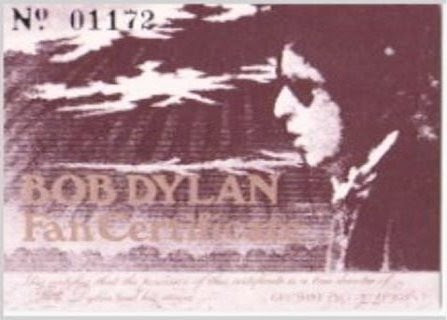
Although the Australian pressing was nicely presented in a triple fold-out sleeve, the Japanese, predictably, went one better with their deluxe version (CBS/Sony 57AP-875/6/7) which boasted all manner of extras including an impressive 40-page lyric/photo/discography book, an individually numbered "Fan Certificate" card, a poster and an obi (paper title strip), none of which were included with the Aussie or New Zealand versions.


Some of the eight Tokyo concerts from February and March were recorded and released in August 1978 as the double album Bob Dylan at Budokan (CBS/Sony 40AP 1100-1).  This was initially available only in Japan, until huge demand forced a worldwide release in April 1979.


Meanwhile, back in Australia there is a story that in 1978 a beer company ran a special promotion whereby purchasers of a 24-can carton of grog could get a free copy of Masterpieces!  The story may well be apocryphal, but I feel it really ought to be true.  It is Australia, after all. 

Dylan opened the 1978 world tour with 23 concerts in Japan (his first ever shows there), New Zealand and Australia.  These dates ran from late February, through March and into early April, making the March 1978 release of Masterpieces perfect timing, for Australian and New Zealand fans, at least. 


The Compact Discs:

The CD version of Masterpieces was released only in Australia, and it appeared in three distinctly different variations.  First in 1987 came a cruelly truncated two CD version with only 35 tracks (instead of 39 on the vinyl version).  The four missing tracks on this first CD pressing (CBS 462448 2) are “Idiot Wind,” “I Want You,” “Song To Woody” and “Love Minus Zero: No Limit”.  Meanwhile, “Rita May” and "George Jackson,” although included, suffered the indignity of early fade-outs. 

In 1991 Masterpieces was restored to its full 3 CD/39 track glory (Columbia 462448 9) and unbelievably, it appears just a single complaint to the record company brought about the change.


John Lattanzio, a Dylan fan based in Melbourne has claimed sole credit for the corporate U-turn.  He told me: “I wrote to Sony and complained about the fact that they'd edited songs by making them fade more quickly so they could fit on 2 CDs.  I said this was artistically reprehensible and it was like cutting pieces off the Mona Lisa to make it fit in the new frame.  I got a reply from someone who said they agreed with me, and they would immediately remaster it for a 3 CD set.  I was surprised!  I asked how many people complained and he said, ‘Only you, but we thought about it, and we agreed with you.’”

It seemed like a major win for the fans except, unfortunately, at this point Sony also changed the front cover to the rather unflattering close-up sepia photo of Dylan, taken from the inside centre panel of the LP gatefold sleeve.  Later CD pressings from 1992 mercifully reverted to Ken Regan’s original “blue sky” cover photo.

Masterpieces was also released as a double cassette in Australia with both CD cover variations.


The Track Listing:

Record 1, Side 1/CD 1: 

1: Knockin' On Heaven's Door (from Pat Garrett & Billy the Kid 1973)

2: Mr. Tambourine Man (from Bringing It All Back Home 1965)

3: Just Like A Woman (from Blonde on Blonde 1966)

4: I Shall Be Released (acoustic duet with Happy Traum from Greatest Hits Vol. II [aka More Bob Dylan Greatest Hits] 1971)

5: Tears Of Rage (from The Basement Tapes 1975)

6: All Along The Watchtower (from John Wesley Harding 1967) 

7: One More Cup Of Coffee (from Desire 1975)

Record 1, Side 2: 

8: Like A Rolling Stone (live 1969 Isle of Wight version from Self Portrait 1970)

9: The Mighty Quinn (Quinn the Eskimo) (live 1969 Isle of Wight version from Self Portrait 1970)

10: Tomorrow Is A Long Time (April 1963 live recording at Town Hall, New York City - from Greatest Hits Vol. II [aka More Bob Dylan Greatest Hits] 1971)

11: Lay, Lady Lay (live version from Hard Rain 1976)

12: Idiot Wind (live version from Hard Rain 1976)

Record 2, Side 1/CD 2: 

1: Mixed Up Confusion (mono alternate take of the 1962 single with later overdubs.  A stereo remix of this version was later included on the Biograph box set)

2: Positively 4th Street (single version 1965)

3: Can You Please Crawl Out Your Window? (fast version from the 1965 single)

4: Just Like Tom Thumb's Blues (recorded live in Liverpool, May 1966 and originally released as the B side of the June 1966 single “I Want You”)

5: Spanish Is the Loving Tongue (mono B side of the 1971 single “Watching the River Flow.”  A different version, recorded in 1969, appears on the Dylan album 1973)

6: George Jackson (Big Band Version) (B-side of the 1971 single)

7: Rita May (B-side of “Stuck Inside of Mobile with the Memphis Blues Again” live single.  From the Desire sessions 1975.  In some territories “Rita May” was the A-side) 

Record 2, Side 2

8: Blowin' In The Wind (from The Freewheelin’ Bob Dylan 1963)

9: Hard Rain's A-Gonna Fall (from The Freewheelin’ Bob Dylan 1963)

10: The Times They Are A Changin' (from The Times They Are A-Changin’ 1964)

11: Masters Of War (from The Freewheelin’ Bob Dylan 1963)

12: Hurricane (from Desire 1975)

Record 3, Side 1/CD 3: 

1: Maggie's Farm (live version from Hard Rain 1976)

2: Subterranean Homesick Blues (from Bringing It All Back Home 1965)

3: Ballad of A Thin Man (from Highway 61 Revisited 1965)

4: Mozambique (from Desire 1975)

5: This Wheel's On Fire (from The Basement Tapes 1975)

6: I Want You (from Blonde on Blonde 1966)

7: Rainy Day Women #12 & 35 (from Blonde on Blonde 1966)

Record 3, Side 2

8: Don't Think Twice, It's All Right (from The Freewheelin’ Bob Dylan 1963)

9: Song To Woody (from Bob Dylan 1962)

10: It Ain't Me Babe (from Another Side Of Bob Dylan 1964)

11: Love Minus Zero: No Limit (from Bringing It All Back Home 1965)

12: I'll Be Your Baby Tonight (from John Wesley Harding 1967)

13: If Not For You (from New Morning 1970)

14: If You See Her, Say Hello (from Blood On The Tracks 1975)

15: Sara (from Desire 1975)

1978 Australian Tour Dates:

March 9, 12, 13, 14, 15 - Brisbane Festival Hall

March 18 - Adelaide Westlake Stadium

March 20, 21, 22 - Melbourne Myer Music Bowl

March 25, 27, 28 - Perth Entertainment Centre

April 1 - Sydney Sportsground


CBS or Columbia?

As every Dylan fan knows, until 1991 Bob’s records appeared on the Columbia label in North America and on CBS in the UK and elsewhere.  Although the two labels were part of the same parent company it often seemed like they operated independently of each other.  But why was this?

The story of how the music world ended up with two very different and competing record labels named Columbia is a long and complex one involving endless mergers, takeovers and bankruptcies dating back more than a century.  Here’s a quick and (hopefully) relatively simple explanation:

It all started in 1889 in the District of Columbia (which is the “DC” in Washington DC) where the Columbia Phonograph Company had a monopoly on sales and service of phonograph players in DC and the surrounding states.  The company also manufactured commercial recordings of its own and by 1908 it had jettisoned the cylinder format in favour of the new flat disc records. 

In 1925 the Columbia Phonograph Company was bought out by its UK subsidiary the Columbia Graphophone Company (“Graphophone” was the name and trademark of an “improved” version of the phonograph).

In 1931 the UK Columbia Graphophone Company merged with the Gramophone Company, which sold records under the name His Master’s Voice (HMV), to form Electrical and Musical Industries (EMI).  

At this point EMI sold off the US arm of the Columbia Graphophone Company which was absorbed by Columbia Broadcasting System (CBS) in 1938.  From then on CBS/Columbia (US) and EMI/Columbia (UK) parted ways and operated as entirely separate companies.  The UK branch kept the Columbia “magic notes” logo which had originated with the US company in the early 1900s.  This logo continued to be used on British pressings until relatively recently.


The CBS label was launched in Europe in 1962 (until then their releases had appeared in the UK via the Philips group of labels).  Consequently, from 1962 to 1991 all US Columbia Records were released outside of North America on the CBS label to avoid conflict/confusion with EMI’s Columbia Gramophone Company.  

EMI guarded their own Columbia copyright fiercely and whenever the US-made records were exported into the UK/Europe any mention of “Columbia” had to be painstakingly blacked out (some might say "redacted") by hand on the labels and sleeves.  Anyone who frequented the London import record stores in the 70s will surely have noticed this puzzling phenomenon, sometimes known as the "doughnut labels" because of the black rings covering the Columbia name and details. Sometimes CBS stickers were added to these Columbia export copies but more often than not they were left with no label identity at all.

UK Columbia had once been arguably the most powerful and successful British label in the EMI group (certainly in the pre-Beatles era), but it was eventually overtaken by its erstwhile poor relation Parlophone.  During the late 70s it was gradually wound down, releasing its last single in 1989, after which the UK Columbia name and trademark were sold to the Japanese company Sony Music.  

Conveniently, Sony had already acquired Columbia Records in the US and Canada in 1988 and since it now owned the rights to both the US and UK labels, this left the door open for the American Columbia name to finally be used worldwide.  

The CBS label identity was then quickly phased out and since 1991 all Dylan’s releases have appeared on the Columbia label regardless of country (including the second CD version of Masterpieces).  Sometimes we saw a nod to the old EMI imprint, such as when Time Out Of Mind used the Columbia “magic notes” logo on the disc, presumably to add a retro feel.  

We live in an age where record labels have disappeared to the point where just two or three multi-national entertainment companies now own virtually everything there is to own in the music business.  So, it’s worth remembering that Columbia, the flagship label of Sony Music, remains as the oldest surviving brand name in recorded music. 


Just The Facts:

Of the 39 tracks on Masterpieces, 32 are drawn from 16 different Dylan albums.  The other seven tracks, all of them located on side two of record two (or at the start of disc two of the three CD set), are singles and B-sides, including the alternate take of “Mixed Up Confusion.”  

Every CBS/Columbia album released up to 1976 is represented, with the exception of Nashville Skyline and (perhaps unsurprisingly) Dylan.  Obviously, there is also nothing from the two 1974 breakaway albums Planet Waves and Before the Flood which were first released on Asylum (US) and Island (UK). 

Desire and Freewheelin’ fare best with four tracks each, followed by Hard Rain, Bringing It All Back Home and Blonde on Blonde with three apiece.  Greatest Hits Vol.II, The Basement Tapes, John Wesley Harding and Self Portrait get two tracks each, leaving seven albums represented by just a solitary track. 

With the benefit of hindsight, it was clearly a mistake to use live versions of “Like A Rolling Stone” and “Lay Lady Lay” in preference to the far superior and more popular studio recordings.  In 2023 the Spotify streaming figures tells us that the original versions of these songs are the second and ninth most popular Dylan tracks with 294 million and 82 million streams respectively.  On the other hand, side one, track one of Masterpieces leads off with “Knockin’ On Heaven’s Door” the most popular Dylan song of all with almost 300 million Spotify streams, so they got that one right. 

Masterpieces includes six of the top ten most popular Dylan songs on Spotify today, with a further two represented by live versions.  Not a bad strike rate for an album compiled 45 years ago.  It also helps that there is nothing more recent than “Hurricane” (1976) in the Spotify Dylan top ten, I suppose. 

Values:

At least seven different Australian vinyl pressings of Masterpieces have been identified dating from 1978 to the mid-80s.  All of them used the yellow/orange CBS label and the only differences appear to involve publishing credits, label typesetting, matrix number variations and the like.  Today, copies in top condition can be picked up for around AUD$50 - $70 (US$30 - $50 approx.) regardless of pressing.


The Japanese vinyl version, complete with all inserts, is much harder to find and prices exceeding AUD$300 (US$200 approx.) are not uncommon.  The CDs were only released in Australia, and all versions regularly turn up for around AUD$50 (US$30 approx.) or less. 


This is a heavily revised and expanded version of a feature which first appeared in “It - The Australian Record Collectors Magazine” issue #29, dated December 1998 – January 1999.  At that point Bob Dylan’s current album was
Time Out Of Mind.  Since this article was first published, several of the obscure tracks on Masterpieces have been officially released as downloads or as physical records/CDs.  

Many thanks to John Lattanzio.


The Week "Love Me Do" Was Released…

by Stuart Penney “Which famous 7-inch single had the catalogue number R4949?" asked Bamber Gascoigne, peering over his wire-rimmed sp...